A New Push to Accelerate Scientific Discovery
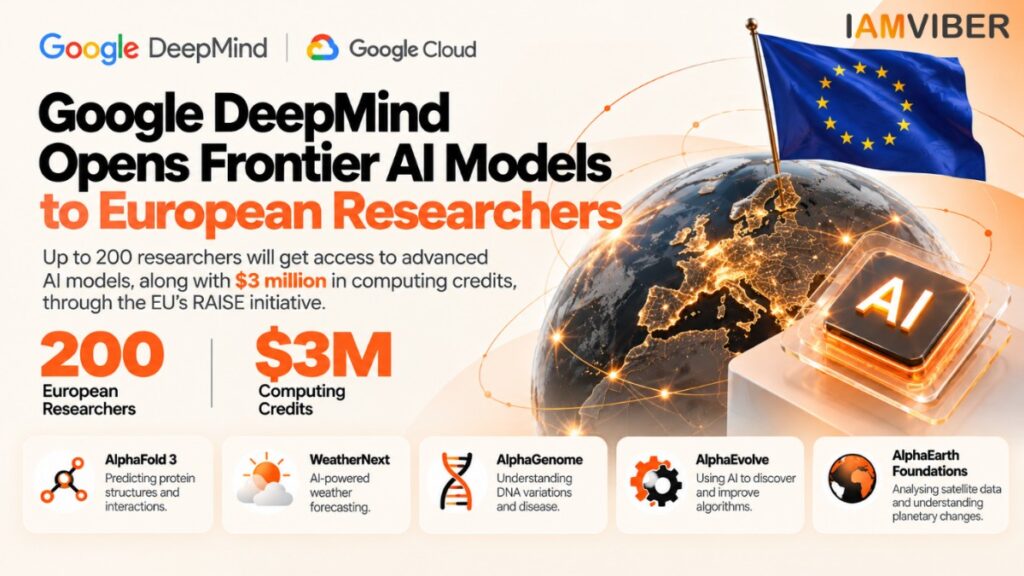
Scientific breakthroughs require more than a strong hypothesis. Researchers need reliable data, specialised tools, time and computing power to test ideas. On 14 October 2026, Google DeepMind and Google Cloud announced that up to 200 European scientific researchers will receive direct access to selected frontier AI tools, alongside $3 million in computing credits. This gives selected teams a chance to work directly with Google DeepMind AI models while investigating complex scientific questions.
The announcement makes Google DeepMind AI models part of a broader effort to strengthen Europe’s research capacity. It supports the EU’s Resource for AI Science in Europe, or RAISE initiative, which aims to pool computing resources, data, talent and funding for research involving AI.
Advanced computing is not equally available to every laboratory. Pairing model access with compute credits may help teams turn promising questions into practical experiments.
What Has Google Announced?
Up to 200 eligible European researchers will be able to use selected tools developed by Google DeepMind and Google Cloud, supported by $3 million in compute credits. The named tools are AlphaFold 3, WeatherNext, AlphaGenome, AlphaEvolve and AlphaEarth Foundations. Together, these Google DeepMind AI models address different areas, from molecular structures and biological processes to weather forecasting and Earth-observation data.
The commitment does not mean every European scientist will automatically receive access or that all models are unrestricted. The practical value will depend on project needs and how tools fit existing workflows. Google DeepMind AI models can help researchers explore possibilities, but experiments, peer review and careful interpretation remain essential.
The programme’s mix of Google DeepMind AI models is designed to support several disciplines rather than a single research field. Its importance lies in connecting advanced technology with scientific questions that can benefit from computational analysis.
Five Tools With Different Scientific Roles
1. AlphaFold 3: Exploring Molecular Structures
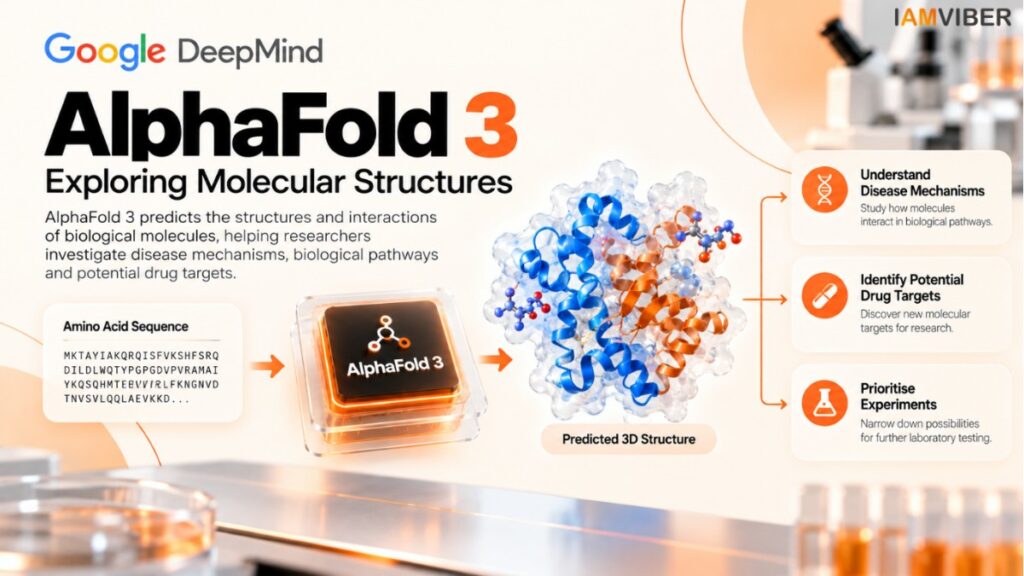
AlphaFold 3 predicts structures and interactions of biological molecules. These insights can help researchers investigate disease mechanisms, biological pathways and potential drug targets, then prioritise experiments.
A team studying a disease pathway could use a prediction to explore how a molecule may interact with a protein. It is a starting point, not proof; laboratory work and independent validation remain essential. AlphaFold 3 illustrates how Google DeepMind AI models may help narrow a scientific search space.
Drug discovery involves identifying promising targets, studying molecular interactions and testing potential treatments through a lengthy validation process. Google DeepMind AI models, including tools designed for biological research, can help scientists investigate molecular structures and generate hypotheses for further study. However, AI predictions do not establish whether a treatment is safe or effective; laboratory experiments and clinical evaluation remain essential.
2. WeatherNext: Researching Weather Patterns
WeatherNext focuses on AI-powered weather forecasting. Researchers can compare predictions, explore atmospheric patterns and study forecast performance. For extreme-weather research, usefulness depends on location, forecast horizon and data quality, so Google DeepMind AI models should be evaluated against observations and established methods.
Better forecasting tools could help scientists examine changing weather conditions and improve how they study potential risks. Still, predictions need to be tested rather than accepted automatically, particularly when research informs decisions involving public safety, agriculture or infrastructure.
Environmental research involves large datasets collected from satellites, weather systems and scientific observation networks. Google DeepMind AI models can support investigations into weather patterns, geographical changes and environmental processes. Researchers must still assess data quality, uncertainty and model performance before using outputs to support scientific conclusions or policy decisions.
3. AlphaGenome: Studying DNA and Genetic Activity
AlphaGenome helps researchers explore how DNA sequences and genetic variations relate to biological functions. Because these relationships are complex, AI predictions may help identify patterns and prioritise questions. They are not a diagnosis or definitive explanation of disease; predictions from Google DeepMind AI models still need validation.
By supporting the investigation of gene regulation and genetic variation, these capabilities can help researchers formulate new hypotheses. Scientific conclusions must nevertheless rely on appropriate evidence and careful evaluation.
4. AlphaEvolve: Improving Algorithms
AlphaEvolve applies AI to discovering and improving algorithms used in mathematics and computing. It can propose candidate solutions for testing against defined performance criteria. Researchers must verify correctness and reproducibility, meaning Google DeepMind AI models may help improve the computational methods scientists use.
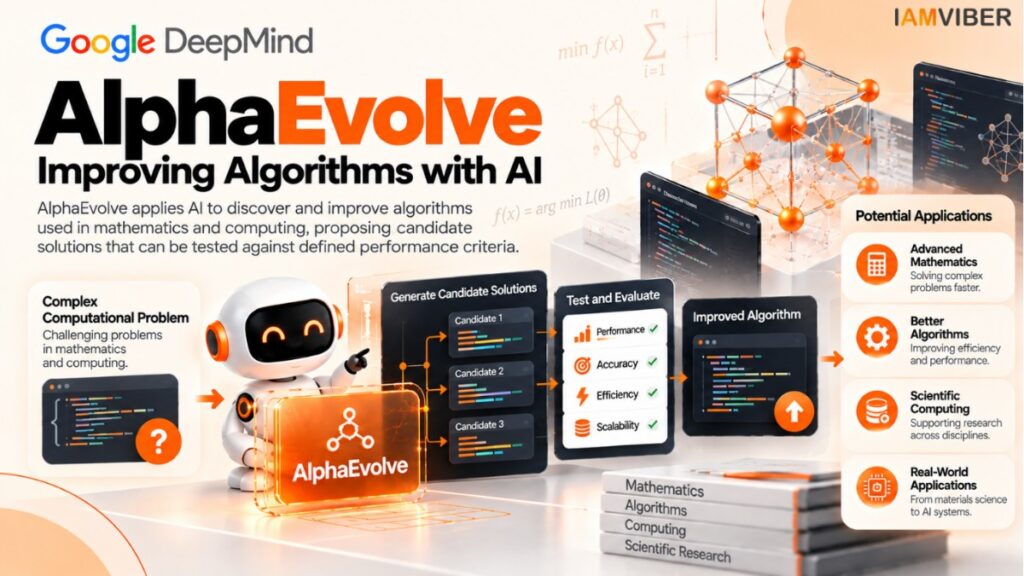
This is an important distinction: AI is not only being applied to scientific data but can also contribute to the methods researchers use to solve difficult computational problems. Correctness and repeatability remain essential.
5. AlphaEarth Foundations: Learning From Planetary Data
AlphaEarth Foundations helps researchers analyse satellite and Earth-observation data to study land use and environmental change. Because sources differ in coverage, resolution and timing, data quality matters. AI can identify patterns worth investigating, but conclusions and Google DeepMind AI models’ outputs must be checked against trusted observations.
These tools could help scientists explore large volumes of geographic information and investigate how environments change over time. The usefulness of their findings still depends on reliable data, suitable methods and independent verification.
Why Computing Credits Matter
Advanced AI does not run on software alone. Many research tasks require specialised hardware, processing time and technical expertise. These demands can make it difficult for laboratories to run Google DeepMind AI models at the scale their work requires.
The $3 million in computing credits is therefore an important part of the commitment. Model access without adequate compute can leave researchers unable to run experiments at the needed scale. The combination of tools and credits is intended to make participation more practical for selected teams.
The RAISE initiative has a related purpose at a wider level: connecting computing capacity, data, research talent and funding so AI can be used across scientific disciplines. In that context, access to Google DeepMind AI models is one component of a broader research ecosystem. The European Commission presents RAISE as part of its wider strategy for AI-enabled science and research collaboration.
Access to Google DeepMind AI models could help teams test ideas, but computing credits alone cannot guarantee discovery. Researchers still need good datasets, domain expertise and validation.
What This Could Mean for AI Research in Europe
Scientific research increasingly crosses disciplines: biology combines lab work with modelling, climate science relies on satellite imagery and forecasting, and materials research may simulate interactions before physical tests.
The RAISE initiative aims to support this collaboration by connecting researchers and resources. It seeks to strengthen both AI development and the use of AI across scientific disciplines. Google DeepMind AI models could become one part of this wider effort.
The commitment could allow participating scientists to explore problems previously constrained by compute costs or limited access to specialised tools. Its longer-term impact will depend on the quality of research, available support and whether findings can be independently validated.
For Google DeepMind, the programme also offers an opportunity to understand how specialised tools perform against real research questions. Meaningful outcomes will include reproducible findings, useful methods and stronger collaboration—not just the number of models made available.
Opportunities and Risks of AI for Science
AI can help scientists organise information, identify patterns, generate hypotheses and examine more possible solutions. It may also help direct expensive experiments more efficiently.
However, models can produce plausible but incorrect outputs or perform unevenly across datasets. Researchers should document methods, evaluate uncertainty and validate key claims. AI should be treated as a tool, not an authority; data protection, independent review and reproducibility remain essential when researchers use Google DeepMind AI models for consequential work.
Scientific research also requires transparency. Researchers need to understand the limitations of a model, explain how it contributed to their findings and distinguish predicted results from experimentally confirmed outcomes.
In fields such as genomics, medicine and climate science, careful interpretation matters because misleading conclusions can have real-world consequences. Advanced AI is most useful when combined with scientific expertise and established methods of verification.
What Researchers Should Watch Next
Important questions remain: how researchers will be selected, what access projects will receive, what technical support is available and how success will be measured. These details will shape how teams use Google DeepMind AI models.
Researchers should combine model outputs with domain knowledge, existing data and experimental validation. Strong projects will begin with a clear question and an evaluation plan. Universities will also need skills in computing, data governance and model assessment; training matters as much as tools.
Transparent evaluation could help the scientific community understand where AI adds value and where traditional methods remain more reliable. This will be important if programmes like RAISE are to produce outcomes that can be replicated by researchers elsewhere.
Conclusion
The long-term impact of Google DeepMind AI models will depend on whether researchers can turn model capabilities into reliable, repeatable scientific results. Transparent methods, independent validation and collaboration between AI specialists and domain experts will be important. The European research initiative could provide useful insights into how advanced AI tools can support different scientific disciplines at scale.
The announcement brings together two important resources for science: advanced AI tools and the computing capacity needed to use them. It reflects a wider shift in which AI is increasingly applied to biology, weather forecasting, algorithms and planetary data.
For selected European researchers, the commitment may make it easier to explore complex questions and test new approaches. For Google DeepMind, the initiative is an opportunity to support scientific work across multiple disciplines.
The true measure of success will be the quality, reliability and reproducibility of the science—not AI access alone. Strong results will require capable tools, computing resources, domain expertise, collaboration and careful validation.
Frequently Asked Questions
1. What did Google DeepMind announce for European researchers?
Google DeepMind AI Models and Google Cloud announced direct access to selected frontier AI tools for up to 200 European scientific researchers, alongside $3 million in computing credits through the EU’s RAISE initiative. The programme aims to support scientific research with advanced AI capabilities.
2. What is the RAISE initiative?
RAISE stands for Resource for AI Science in Europe. It aims to pool computing resources, data, talent and research funding to support AI research and scientific work that uses AI.
3. Which AI tools are included in the announcement?
The announcement names AlphaFold 3, WeatherNext, AlphaGenome, AlphaEvolve and AlphaEarth Foundations. They support different scientific areas, including molecular modelling, weather forecasting, genomic research, algorithm development and Earth observation.
4. How much computing support is available?
The commitment includes $3 million in compute credits, alongside access to selected tools for up to 200 European researchers. The credits are intended to help participating teams run computationally demanding research.
5. Can AI replace scientists?
No. AI can assist with data analysis, hypothesis generation and computational modelling, but researchers must validate results, interpret uncertainty and apply scientific judgement.
6. Why is AI for science important?
AI for science can help researchers analyse complex data, explore possible explanations and prioritise experiments. Its value depends on reliable data, suitable methods and independent validation.
7. What could this initiative mean for Europe?
The programme supports Europe’s effort to strengthen AI-enabled research by connecting researchers with advanced tools and computing resources. Its outcome will depend on adoption, collaboration and validated scientific results.
8. Where can readers find the original announcement?
Readers can visit Google’s official announcement for details of the commitment and the scientific tools included.
Topics to follow on IAMVIEBR : AI & Tech, Startup, AI Creative, Agentic AI, Current Affairs & Insights, Collaboration