
A Fresh Funding Round for AI-Powered Financial Services
Banking apps have made financial services available beyond physical branches, but access alone does not guarantee that customers can use them confidently. People may still struggle with onboarding, identity verification, product choices or understanding the next step in a financial journey. Bengaluru-based RevRag AI wants to address these friction points with AI agents embedded directly inside financial applications.
On October 14, 2026, the company announced a $2.5 million seed funding round led by Accion Ventures, with Cedar Hill Capital, Wyser and Venture Catalysts participating. According to Accion Ventures’ announcement, the capital will support product development, additional enterprise deployments and planned expansion into the United States. 333
The round follows an earlier pre-seed investment from Powerhouse Ventures and angel investors, including Kunal Shah of CRED and Madhusudhan, founder of KreditBee. The raise places RevRag AI in a growing category of fintech infrastructure companies using AI to improve how customers interact with financial products—not simply how institutions process data behind the scenes.
The round also reflects a wider trend in fintech startup funding: investors are backing specialised AI products designed to solve real operational and customer-experience problems.
What Does RevRag AI Do?
RevRag AI describes its product as an AI-agent platform for banking, financial services and insurance (BFSI) companies. Its goal is to make financial apps more guided and responsive. Rather than making customers search help pages or abandon a task when confused, an embedded agent can explain the next step and help them progress through a journey.
The company’s official platform website describes in-app copilots, visual avatar agents, and voice or WhatsApp agents. These tools are designed to provide contextual help within existing customer journeys. In practical terms, RevRag AI aims to put assistance inside the customer journey rather than outside it. The idea is not to replace every human relationship manager, but to make basic guidance and support available to more people when they need it.
Unlike a conventional FAQ chatbot, an integrated AI agent may understand the workflow a customer is using, explain the next step and help complete a task. Its available actions depend on the institution’s integrations, permissions and security controls.
Why AI Relationship Managers Matter
Traditional relationship management is valuable because customers can ask questions, receive explanations and get help choosing or using products. But one-to-one human support is expensive to scale, especially for mass-market products and customers who do not qualify for dedicated service.
AI relationship managers aim to make this guidance available digitally and at scale: explaining loan documents, guiding insurance renewals or clarifying the first steps in an investment journey.
The platform aims to offer help when a customer appears stuck, rather than waiting for a support ticket. Its impact will depend on whether guidance is accurate, relevant and welcome—not merely automated.
For example, a customer applying for a loan may not understand why identity verification is required. An AI agent could explain the step, outline the documents needed and guide the customer through the process. A similar approach could help an insurance customer understand renewal steps or assist a first-time investor navigating a financial application.
This is where AI relationship management could become valuable: making relevant assistance available at the moment a customer needs it.
Four Potential Use Cases for AI Agents in Banking
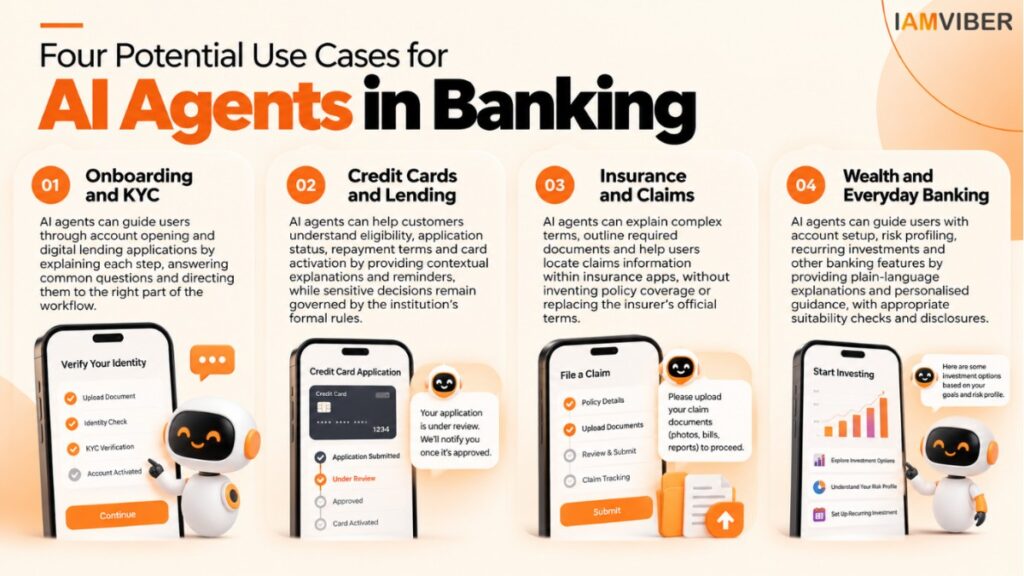
1. Onboarding and KYC
Account opening and digital lending applications often require document uploads, identity checks and several sequential steps. Clear instructions can reduce confusion. An agent could explain a step in plain language, answer common questions and direct a user to the right part of the workflow.
2. Credit Cards and Lending
Customers may need help understanding eligibility, application status, repayment terms or card activation. AI agents can provide contextual explanations and reminders, while sensitive decisions such as approval, pricing and eligibility must remain governed by the institution’s formal rules.
3. Insurance and Claims
Insurance journeys can involve complex terms and documentation. An embedded assistant could explain a form, outline required documents or help a user locate claims information. It should not invent policy coverage, promise claim approval or replace the insurer’s official terms.
4. Wealth and Everyday Banking
New investors may need plain-language explanations of account setup, risk profiling or recurring investment options. In everyday banking, an agent could guide users to features or explain how to complete a task. Personalised financial recommendations need appropriate suitability checks, disclosures and compliance safeguards.
These use cases help explain the interest in AI agents in banking: the technology sits close to customer intent and may reduce the gap between opening an app and completing a meaningful action.
The Digital Banking Opportunity in India
India has made significant progress in digital financial access, from mobile banking and digital payments to online lending and investment platforms. But inclusion is not only about opening an account or downloading an app. Customers must also understand interfaces, trust the process and complete tasks successfully.
Accion Ventures’ funding announcement points to a gap between financial account ownership and active digital use. This creates an opportunity for clearer help inside existing apps, without requiring customers to find a branch or a separate support channel.
Language matters too: voice-enabled, multilingual guidance could help users who find financial terminology or English-heavy interfaces difficult, provided the experience is tested with diverse customers.
For digital banking in India, technology is only part of the answer. Institutions must also design accessible journeys, communicate fees and risks clearly, and make human assistance available when automated help is insufficient.
If designed responsibly, AI-powered guidance could help financial institutions serve a wider range of customers while making digital financial services easier to understand.
How the Funding Could Help RevRag AI Grow
The company says the $2.5 million round will fund product development, more enterprise deployments and expansion into the US. For RevRag AI, this makes execution as important as product capability. Those priorities suggest a focus on turning product capabilities into repeatable implementations across financial services businesses.
Enterprise deployments can be demanding. Banks, insurers and lenders typically require system integrations, security reviews, monitoring, audit trails and evidence that a new tool improves measurable outcomes. A startup selling into this market must show not only that its agents can converse naturally, but that they work reliably in regulated workflows.
Success measures could include onboarding completion, fewer abandoned applications, stronger activation and improved satisfaction. Results should be measured against a baseline; more automation does not automatically mean a better experience.
The funding also signals investor interest in industry-specific AI infrastructure. Rather than building a general assistant for every task, vertical AI companies focus on the workflows, data and constraints of a particular sector. BFSI is demanding because customer journeys involve sensitive information, financial consequences and regulatory obligations.
For RevRag AI, the opportunity lies in proving that AI agents can deliver tangible benefits across real financial products and customer journeys.
Trust, Privacy and Responsible Automation
Financial services require a higher standard of reliability than many consumer applications. An incorrect answer about a loan, insurance policy or investment could cause real harm. Accuracy, transparency and clear escalation paths are therefore essential.
AI agents used by financial institutions should operate within defined permissions, protect personal and financial data, and make it easy for customers to tell guidance apart from a binding decision. Users should be able to reach a human, dispute an answer or resolve a situation that the agent cannot safely handle.
Institutions should test for misleading responses, bias, language gaps and edge cases, tracking whether customers complete tasks more successfully and whether data policies are followed.
These safeguards are not barriers to useful AI. They are conditions for earning trust in a regulated environment.
What This Funding Means for Fintech
The broader shift is from digital self-service to guided digital service. Earlier fintech products focused on moving services online. The next phase may compete on whether customers can understand and use those services with confidence.
Specialised platforms could improve customer experience without requiring banks to rebuild entire apps, while raising expectations for timely, relevant help.
RevRag AI’s progress will depend on turning that promise into repeatable, secure and measurable deployments. The seed round gives the company resources to develop its product and pursue new customers, but execution in real financial workflows will determine how far the model can scale.
Conclusion
The future of financial services will be shaped not just by how many people can access an app, but by how many can use it successfully. By embedding guidance into financial journeys, RevRag AI is pursuing a practical use of AI: helping institutions make digital experiences easier to navigate.
Its funding round is an early milestone, not proof that the model has solved every challenge. For RevRag AI, the next milestone is showing measurable results across real deployments. The real test will be whether it can deliver reliable assistance, protect customer trust and improve outcomes across different financial products and user groups. If it can do that consistently, this approach could become an important layer in the next phase of digital finance.
Frequently Asked Questions
1. What Is RevRag AI and What Does It Do?
RevRag AI is a Bengaluru-based fintech technology startup that builds AI agents for banking, financial services and insurance companies. Its platform aims to guide customers through digital journeys, answer questions and improve engagement within financial applications.
2. How Much Funding Has RevRag AI Raised?
RevRag AI raised $2.5 million in a seed funding round led by Accion Ventures. The round included participation from Cedar Hill Capital, Wyser and Venture Catalysts, supporting the company’s product development and expansion plans.
3. Who Invested in RevRag AI?
Accion Ventures led the $2.5 million seed funding round for RevRag AI. Other participating investors included Cedar Hill Capital, Wyser and Venture Catalysts, according to the funding announcement.
4. What Are AI Relationship Managers in Banking?
AI relationship managers are digital agents that help customers navigate financial products and services. RevRag AI aims to use these agents to guide users through onboarding, explain banking processes and improve customer interactions inside financial apps.
5. How Can RevRag AI Help Banks and Financial Institutions?
RevRag AI aims to help banks improve digital adoption by providing contextual assistance within their apps. Its AI agents may guide customers through onboarding, product discovery and service workflows, potentially reducing confusion and improving task completion.
6. How Will RevRag AI Use Its $2.5 Million Funding?
RevRag AI plans to use its seed funding to support product development, expand enterprise deployments and pursue growth in the United States. These investments are intended to help the company scale its AI relationship management platform.
7. How Is RevRag AI Different From a Traditional Banking Chatbot?
A traditional banking chatbot typically answers questions or directs users to information. RevRag AI focuses on contextual, AI-powered guidance within customer journeys, with capabilities depending on integrations, permissions and the financial institution’s implementation.
8. What Is the Future of RevRag AI and AI Agents in Banking?
The future of RevRag AI will depend on how effectively its AI agents improve customer engagement, digital adoption and service delivery. If the company can demonstrate reliable performance, strong data protection and measurable results, its approach could become increasingly relevant to digital banking and fintech.
Topics to follow on IAMVIEBR : AI & Tech, Startup, AI Creative, Agentic AI, Current Affairs & Insights, Collaboration