Google has officially entered its next frontier-model chapter with Gemini 4 Argon, a new AI system designed for complex, long-running workloads across software engineering, enterprise knowledge work and cybersecurity.
Announced on September 30, 2026, Gemini 4 Argon is positioned by Google as its most capable model yet. Rather than focusing primarily on everyday chatbot interactions, Google is targeting tasks that require deeper reasoning, multiple steps and sustained execution.
The launch also comes with an unusual rollout strategy. Instead of immediately opening the model to everyone, Google is initially providing access to selected cybersecurity experts through its Fairwind Program. Broader access is planned later, beginning with paid API customers and Google AI Ultra subscribers.
What Is Gemini 4 Argon?
Gemini 4 Argon is the flagship model announced as part of Google’s new Gemini 4 generation.
Google describes it as a frontier model built to maintain deep reasoning across complex, long-horizon workflows. That distinction matters because many AI systems are optimized for relatively short interactions: ask a question, receive an answer, and move on.
Argon is designed for something different.
It is intended to work through larger engineering problems, conduct deeper research, handle specialized business tasks and assist with cybersecurity defense. Google says its engineers are already using the model internally for debugging, large-scale code migrations, algorithm design and other specialized work.
In other words, Google is positioning Gemini 4 Argon less as a conversational assistant and more as an AI system capable of participating in extended professional workflows.
Why Google Is Focusing on Long-Horizon AI
One of the biggest developments surrounding Gemini 4 Argon is its emphasis on long-horizon reasoning.
Real-world professional tasks rarely end after one prompt.
A software engineer may need to understand an unfamiliar codebase, identify a problem, develop a solution, test it and then modify several related components. A financial analyst may need to examine multiple documents, compare information and produce a structured conclusion. A cybersecurity team may need to identify a vulnerability, validate it and develop a remediation strategy.
These workflows involve multiple connected steps.
Google has therefore increased Argon’s output capacity dramatically. The model supports an output limit of up to 1 million tokens, compared with 64,000 tokens in previous Gemini models, according to Google.
That does not simply mean “more text.”
The larger output window gives the model substantially more room to work through complex tasks in a single trajectory. For developers and enterprises, this could become particularly important when AI systems are expected to operate on large codebases, extensive documents or complicated research workflows.
Gemini 4 Argon and Software Engineering
Coding is one of the central areas where Gemini 4 Argon is expected to compete.
Google says its engineers have been using Argon for everything from everyday debugging to large-scale codebase migrations and algorithm design.
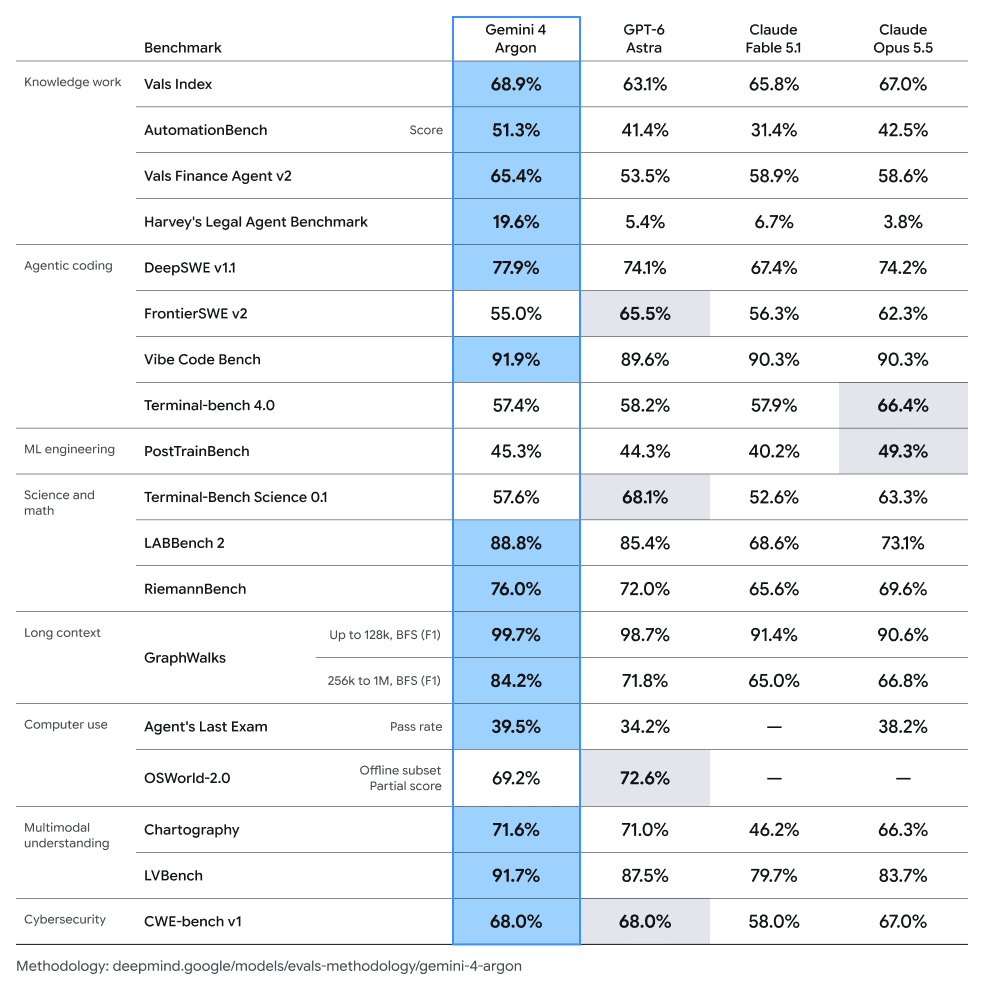
The company reports a 77.9% score on DeepSWE v1.1, a benchmark designed to evaluate performance on real-world, long-horizon software engineering tasks.
The significance of this type of benchmark is that modern AI coding is moving beyond autocomplete.
The emerging goal is AI that can understand a broader engineering objective, inspect relevant code, reason about dependencies and execute multiple stages of a development task.
That could eventually change how development teams use AI.
Instead of simply asking an AI to write a function, developers could increasingly delegate larger pieces of engineering work while retaining human oversight for architecture, review and deployment.
For startups and smaller development teams, this could be particularly significant because sophisticated AI coding systems can potentially reduce the amount of manual work required for repetitive engineering tasks.
A Bigger Role for AI in Enterprise Work
Another major focus of Gemini 4 Argon is enterprise knowledge work.
Google specifically highlights areas such as finance and legal work, where tasks often involve large quantities of information, structured reasoning and domain-specific analysis.
The company says Argon leads on its Vals Index evaluation and reports strong performance on specialized evaluations including financial research and legal research and drafting. Google also reports a 51.3% score on AutomationBench, Zapier’s benchmark for end-to-end execution across core business functions.
For businesses, this points toward a broader shift in how generative AI could be deployed.
The next generation of enterprise AI may not simply answer employee questions. Instead, AI agents could increasingly participate in workflows involving documents, spreadsheets, research, coding, analysis and business operations.
That is where the commercial importance of Gemini 4 Argon could extend beyond the chatbot market.
Cybersecurity Is a Major Part of the Launch
Perhaps the most unusual aspect of the launch is cybersecurity.
Google says Gemini 4 Argon has been trained to support cybersecurity defense and can autonomously identify, validate and patch critical software vulnerabilities.
Because these capabilities can also potentially be misused, Google is taking a phased approach to deployment.
The first external users are trusted cyber defenders participating in Google’s Fairwind Program. Google says it is also participating in the U.S. government’s voluntary process for pre-release model access as it works on safeguards before wider availability.
This restricted launch reflects a larger challenge facing frontier AI developers.
The more capable AI systems become at coding, vulnerability research and autonomous task execution, the more important controlled deployment becomes.
Google is therefore treating cybersecurity capability as both a product feature and a safety consideration.
Multimodal Understanding Gets a Boost
Gemini 4 Argon is also designed for multimodal knowledge work.
Google highlights its ability to understand charts, long videos and collections of documents. The company reports a 91.7% score on LVBench, an evaluation focused on long-video understanding.
This matters because enterprise information is rarely stored exclusively as plain text.
Companies work with presentations, PDFs, spreadsheets, videos, diagrams, dashboards and other visual material.
An AI system capable of reasoning across these formats could potentially become much more useful for research and operational workflows.
For example, an enterprise AI agent could eventually analyze a collection of reports, inspect visual dashboards, extract relevant information and prepare a structured business analysis.
Gemini 4 Argon Pricing
Google has also revealed initial API pricing for Gemini 4 Argon. During the introductory period, Google says the model will cost:
- $2 per million input tokens
- $10 per million output tokens
- Cached input tokens receive a 95% discount from the input-token price.
After the introductory period, Google says pricing will increase to $4 per million input tokens and $20 per million output tokens.
Pricing will matter because the economics of AI agents are becoming increasingly important.
A highly capable model can be valuable, but businesses also need to determine whether the cost of running extended workflows makes commercial sense.
The combination of long output capacity and token-based pricing will therefore be closely watched by developers and enterprise buyers.
Can You Use Gemini 4 Argon Right Now?
Not yet in the normal consumer sense.
At launch, Gemini 4 Argon is being provided to a limited group of trusted cybersecurity defenders.
Google says the model will eventually become available to developers, enterprises and consumers, with broader availability beginning with paid API customers and Google AI Ultra subscribers after the initial cybersecurity testing phase. Google has not provided a specific public release date for everyone.
That means the announcement is currently more about what is coming than a model that everyone can immediately open and test.
How Gemini 4 Argon Fits Into the AI Race
The arrival of Gemini 4 Argon comes at a time when frontier AI competition is increasingly focused on reasoning, coding, agents and specialized professional work.
Google is competing with other major AI developers that are also moving beyond traditional chatbots toward models capable of completing longer and more complex tasks.
Google described Argon as its most performant model yet and said the company sees it as comparable with frontier systems from competitors on selected coding and cybersecurity benchmarks. Reuters also noted that the model is larger than Google’s previous top-tier Pro models.
However, benchmark comparisons should be read carefully.
Different models can perform differently depending on the benchmark, task design and evaluation methodology. A model leading on one test does not automatically mean it is superior for every real-world use case.
The more interesting question may therefore be how consistently Argon performs across actual workflows once broader access becomes available.
What Gemini 4 Argon Means for Businesses
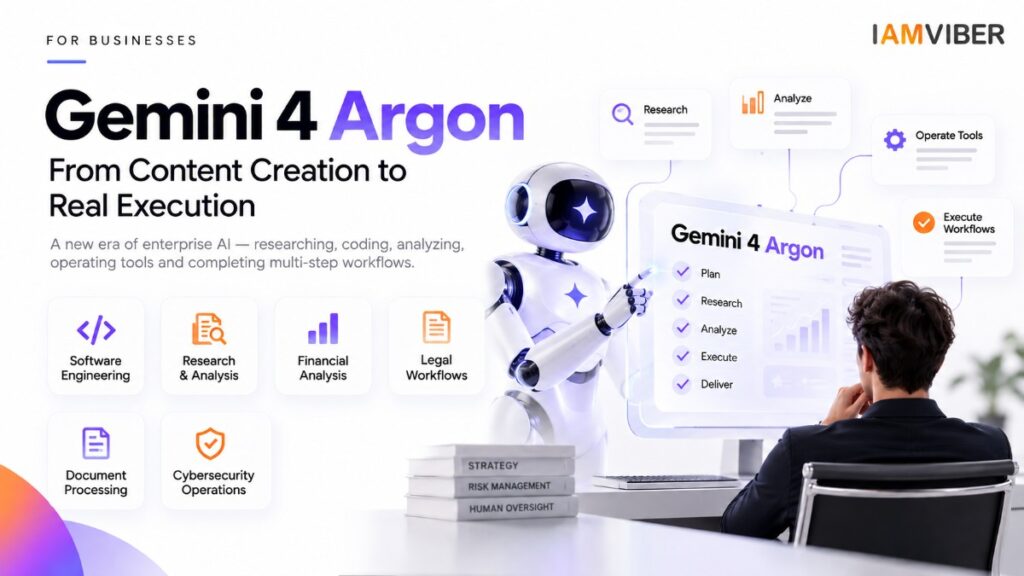
For businesses, Gemini 4 Argon signals a broader transition in enterprise AI.
The first generation of generative AI largely focused on content creation: writing emails, summarizing documents, generating images and answering questions.
The next phase is increasingly about execution.
AI systems are being developed to research, code, analyze, operate tools and complete multi-step workflows.
If Argon performs as Google claims when broadly deployed, companies could potentially use it for software engineering, research, financial analysis, legal workflows, document processing and cybersecurity operations.
That does not eliminate the need for humans.
Instead, it could change where human effort is concentrated—from performing every individual task to defining objectives, reviewing results, managing risk and making higher-level decisions.
The Bigger Picture
The arrival of Gemini 4 Argon is important not simply because Google has launched another large AI model.
It represents where the AI industry is heading next.
The competitive advantage is increasingly moving from “Who has the smartest chatbot?” toward “Which AI system can reliably complete complex work?”
Google’s answer is Argon.
With a 1-million-token output limit, strong coding and enterprise benchmarks, multimodal capabilities and a dedicated cybersecurity focus, the model is clearly designed for demanding professional workflows.
But the real test will come later.
Once developers, enterprises and consumers can use the model at scale, the industry will have much more evidence about reliability, cost, speed, safety and real-world performance.
For now, Google is deliberately keeping the first phase controlled. And that may be one of the most important details of the entire announcement.
Gemini 4 Argon is not just another model release. It is Google’s bet that the next era of AI will be defined by systems capable of working through complicated problems for much longer—and doing substantially more than simply generating an answer.
Frequently Asked Questions
1. What is Gemini 4 Argon?
Gemini 4 Argon is Google’s new flagship frontier AI model, designed for complex software engineering, enterprise knowledge work and cybersecurity workflows.
2. Why is Gemini 4 Argon significant?
Google has designed the model for long-horizon reasoning and reports strong performance across coding, enterprise automation, multimodal understanding and cybersecurity.
3. How many tokens can Gemini 4 Argon generate?
Google says the model has an output limit of up to 1 million tokens, substantially above the 64,000-token limit of previous Gemini models.
4. Can I use Gemini 4 Argon now?
General public access is not available at launch. Google is initially working with trusted cybersecurity defenders before expanding access.
5. How much does Gemini 4 Argon cost?
The introductory API price is $2 per million input tokens and $10 per million output tokens. Google says regular pricing will later become $4 per million input tokens and $20 per million output tokens.
6. When will Gemini 4 Argon be available to everyone?
Google has not announced a specific date for broad consumer availability. The company says wider access will follow the initial testing phase.
7. What can Gemini 4 Argon be used for?
Gemini 4 Argon is designed for advanced use cases including software engineering, code migration, research, enterprise knowledge work, multimodal analysis and cybersecurity defense.
8. Is Gemini 4 Argon available for developers?
At launch, access is limited while Google conducts its initial testing and cybersecurity deployment. Broader access for developers, enterprises and consumers is planned after this initial phase.