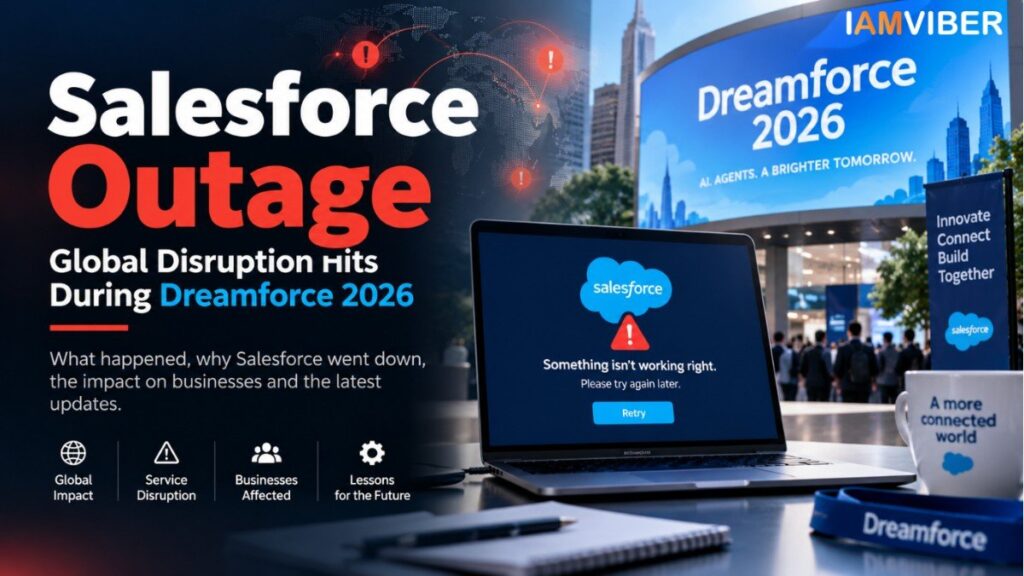
A major Salesforce outage disrupted customers across multiple regions on September 16, 2026, creating an unusual moment for one of the world’s largest enterprise software companies. The disruption came as Salesforce was hosting its annual Dreamforce conference in San Francisco, where the company was showcasing its latest developments in artificial intelligence, Agentforce and enterprise automation.
According to reports, the Salesforce outage began at around 3:50 a.m. Eastern Time on Wednesday. Customers reported severe delays, intermittent errors and problems accessing Salesforce services. The incident affected customers across Salesforce’s operating regions, with reports particularly highlighting customers in the United States and other international markets.
The timing made the incident especially notable. Thousands of technology professionals, developers, business leaders and Salesforce customers were attending Dreamforce 2026 in San Francisco while the company’s cloud platform was experiencing a widespread service disruption.
What Happened During the Salesforce Outage?
The Salesforce outage affected access to parts of Salesforce’s cloud software environment. Customers reported difficulties accessing services, significant delays and intermittent errors.
Salesforce’s incident response indicated that engineers were investigating the problem and working toward a resolution. Later updates said the company had identified the issue, tested a fix and started deploying it across affected environments.
The company began rolling out the fix after validating it on a test instance. By the morning, Salesforce said services were beginning to return toward normal operation, although the incident remained a major service disruption while restoration work continued.
The Salesforce global outage therefore moved through several stages: initial customer reports, investigation, identification of the technical issue, testing of a fix and deployment across affected environments.
For businesses that rely on Salesforce for sales operations, customer management, support workflows and other critical processes, even a temporary disruption can create operational difficulties.
Why Did Salesforce Go Down?
One of the biggest questions surrounding the Salesforce outage is what caused the disruption.
Initial incident information pointed toward a problem affecting an internal login-related service and an external dependency. Reports indicated that requests were becoming stalled, affecting customers’ ability to access parts of the Salesforce environment.
However, it is important to distinguish between preliminary incident information and a final post-incident technical analysis. At the time of publication, Salesforce was still working through its resolution process, meaning the complete root-cause analysis may evolve as the company publishes additional technical details.
This distinction matters because cloud incidents can involve multiple layers, including authentication, infrastructure dependencies, APIs, databases, networking and application services.
The Salesforce service disruption demonstrates how a failure in one important component can potentially affect multiple customer-facing workflows.
Salesforce Outage Happened During Dreamforce 2026
The timing of the incident is one of the most striking aspects of the story.
The Salesforce outage happened during Dreamforce 2026, Salesforce’s flagship annual technology conference in San Francisco. The event began earlier in the week and features announcements, product demonstrations, customer sessions and discussions around the future of enterprise technology.
Salesforce’s official Dreamforce information confirms that the conference is taking place in San Francisco from September 15 through September 17, with sessions and activities continuing throughout the week.
The conference is particularly important this year because Salesforce is placing significant emphasis on AI-powered enterprise software.
At Dreamforce 2026, Salesforce announced developments including its Koa AI reasoning model, AIforce and expanded integrations involving Anthropic’s Claude. The company is also continuing to push Agentforce as part of its strategy for helping organizations build more autonomous, AI-driven enterprise workflows.
That made the Salesforce outage more than a routine cloud-service incident from a news perspective. It occurred at precisely the moment when Salesforce was presenting its vision of increasingly automated and AI-powered enterprises.
Is Salesforce Down Right Now?
For customers searching “Salesforce down”, the answer can depend on the specific Salesforce instance, product and region involved.
During the incident, customers reported service-access problems across multiple environments. Salesforce’s response indicated that engineers had identified the issue and begun deploying a fix. Reports later indicated that services were progressively returning to normal.
This is why users should rely on Salesforce’s official status information when checking whether a particular service is operational rather than assuming that every Salesforce product is affected in exactly the same way.
A global cloud platform is made up of many services and infrastructure components. An incident affecting one component does not necessarily mean every Salesforce product will experience identical downtime.
What Businesses Could Not Do During the Outage
The impact of the Salesforce outage varied depending on which services and instances customers depended upon.
Salesforce is widely used for customer relationship management, sales operations, customer service, marketing, analytics and business workflows. Organizations can also connect Salesforce to other applications through APIs and integrations.
When access to a core enterprise platform becomes unreliable, businesses may experience delays in routine activities such as accessing customer information, updating records, processing workflows or interacting with connected systems.
For companies that have built highly automated processes around Salesforce, the disruption can also highlight the importance of redundancy, monitoring and contingency planning.
The Salesforce global outage is therefore a useful reminder that cloud adoption does not eliminate operational risk. Instead, it changes the type of risk businesses need to manage.
Why This Matters in the Age of AI
The Salesforce outage also raises a broader question about the future of enterprise AI.
Salesforce is increasingly positioning its platform around AI agents that can work with enterprise data and execute business tasks. Agentforce, AIforce and other AI-related products are designed to make software more capable of taking action rather than simply displaying information.
But AI agents still depend on the infrastructure underneath them.
If authentication, APIs, databases or core cloud services become unavailable, an AI agent may also be unable to access the information or tools required to complete its task.
This creates an important lesson for companies adopting agentic AI: AI reliability is ultimately connected to infrastructure reliability.
Businesses deploying AI agents should therefore think beyond model performance. Availability, authentication, data access, monitoring, security, fallback mechanisms and disaster recovery can all become part of the AI reliability equation.
What Salesforce's Response Shows
During the Salesforce outage, the company’s engineering teams investigated the disruption, identified the issue and tested a fix before beginning broader deployment.
That response reflects the standard pattern for large-scale cloud incidents: detect, isolate, diagnose, test and progressively restore services.
Salesforce also indicated that it was working toward a longer-term code-level resolution rather than relying only on an immediate workaround.
For enterprise customers, transparency during such incidents can be almost as important as restoration itself. Businesses need timely information to determine whether they should wait for recovery, activate contingency procedures or communicate with their own customers.
What Companies Can Learn From the Salesforce Outage
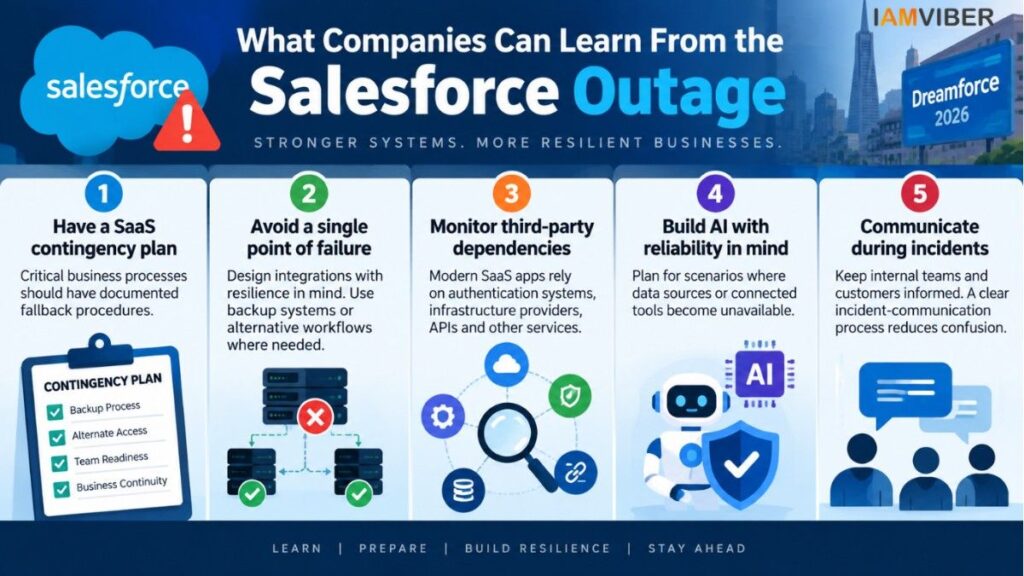
The Salesforce outage offers several practical lessons for organizations that depend heavily on cloud platforms.
1. Have a SaaS contingency plan
Critical business processes should have documented fallback procedures. Teams should know what to do if their primary CRM or business platform becomes unavailable.
2. Avoid a single point of failure
Integrations should be designed with resilience in mind. Where appropriate, companies can consider backup systems, queues or alternative workflows for critical processes.
3. Monitor third-party dependencies
Modern SaaS applications rarely operate in isolation. They depend on authentication systems, infrastructure providers, APIs and other services.
4. Build AI with reliability in mind
Organizations deploying AI agents should plan for scenarios where data sources or connected tools become unavailable.
5. Communicate during incidents
Internal teams and customers need clear information when a platform outage affects business operations. A prepared incident-communication process can reduce confusion.
Salesforce Outage Highlights the Cloud Dependency Problem
The Salesforce outage is another example of how deeply cloud platforms have become embedded in modern businesses.
For years, SaaS adoption has allowed companies to avoid maintaining large amounts of software infrastructure themselves. But the trade-off is increased dependency on external platforms.
That dependency becomes more significant as businesses connect more systems together.
A CRM may connect with email platforms, payment systems, analytics tools, marketing automation, customer-support software and AI agents. When one critical service becomes unavailable, the effects can potentially move across the wider technology stack.
This does not mean companies should avoid SaaS. Instead, it highlights why resilience, observability and business continuity need to become part of enterprise technology planning.
What Happens Next?
Following the Salesforce outage, customers will likely be watching for additional technical information about the incident and Salesforce’s permanent remediation.
The immediate priority is restoring stable service across affected environments. The longer-term focus will likely be understanding the root cause and reducing the possibility of similar disruptions.
For Salesforce customers, the best source for real-time service information remains the company’s official Trust and status communications.
The incident also arrives at a particularly important time for Salesforce. The company is using Dreamforce 2026 to promote its vision of AI-powered and increasingly agentic enterprises. Its announcements this week have focused heavily on AI, enterprise data and autonomous workflows.
That makes reliability an increasingly important part of the conversation.
Final Takeaway
The Salesforce outage on September 16, 2026, disrupted access to Salesforce services across multiple regions while the company was simultaneously hosting Dreamforce 2026 in San Francisco.
Salesforce identified the issue, tested a fix and began deploying it across affected environments, with services subsequently beginning to recover.
For customers, the incident is a reminder that even major enterprise cloud platforms can experience significant disruptions.
For the broader technology industry, the story carries another message: as companies move toward AI agents and increasingly automated business operations, reliability becomes just as important as intelligence.
The future of enterprise software may be increasingly autonomous, but that autonomy still depends on infrastructure that businesses can access when they need it.
Frequently Asked Questions
1. What caused the Salesforce outage?
The outage was linked to an issue affecting Salesforce services, including login-related functionality and an external dependency. Salesforce engineers investigated the incident, identified the issue, tested a fix and began deploying it across affected environments.
2. Is Salesforce down right now?
Salesforce experienced a major service disruption on September 16, 2026, but services began recovering after Salesforce deployed a fix. Users should check Salesforce’s official status page for the latest information about specific products or instances.
3. When did the Salesforce outage start?
The incident reportedly began at approximately 3:50 a.m. Eastern Time on September 16, 2026, with customers subsequently reporting access problems, errors and significant delays.
4. Did the Salesforce outage affect customers worldwide?
Yes. Reports indicated that customers across multiple Salesforce regions experienced disruptions. The exact impact varied depending on the customer’s Salesforce instance, service and geographic region.
5. Did the Salesforce outage happen during Dreamforce 2026?
Yes. The incident occurred on September 16, 2026, while Salesforce was hosting its annual Dreamforce conference in San Francisco. The timing attracted significant attention because the conference was heavily focused on AI and enterprise technology.
6. What services were affected by the Salesforce outage?
The impact varied across Salesforce environments and services. Customers reported difficulties accessing Salesforce, errors and delays. Salesforce’s status updates provided information about affected instances and the restoration process.
7. How did Salesforce respond to the outage?
Salesforce engineers investigated the incident, identified the underlying issue, tested a solution and began progressively deploying the fix across affected environments. Services subsequently started returning toward normal operation.
8. What does the Salesforce outage mean for businesses using AI agents?
The incident highlights the importance of infrastructure reliability for AI-powered enterprise workflows. AI agents depend on cloud platforms, APIs, authentication systems and business data. Companies using agentic AI should therefore consider monitoring, redundancy, fallback workflows and business-continuity planning alongside AI capabilities.
Topics to follow on IAMVIEBR : AI & Tech, Startup, AI Creative, Agentic AI, Current Affairs & Insights, Collaboration