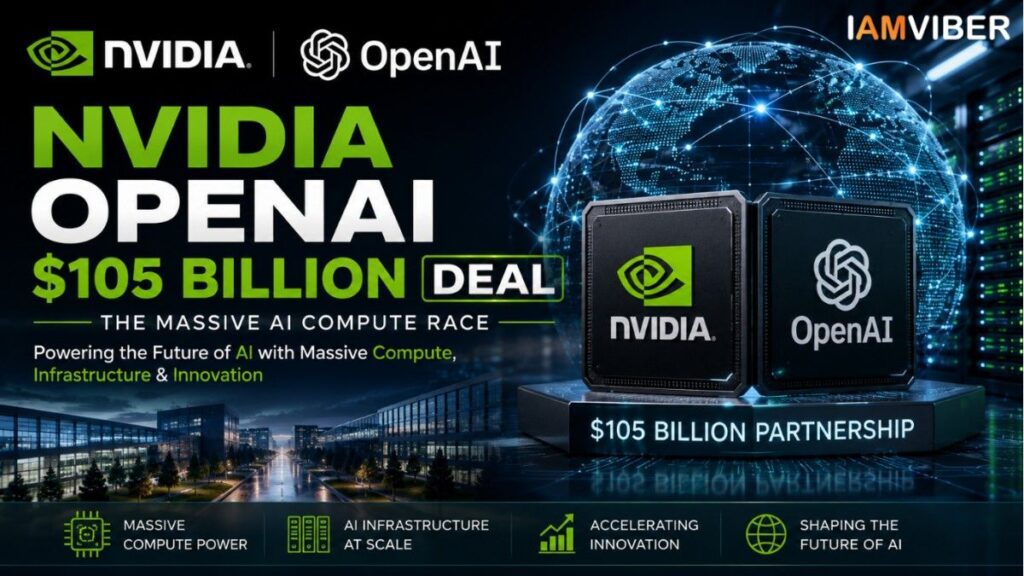
The AI industry has entered a new phase where the biggest competitive advantage may no longer be the smartest model, but the infrastructure required to train and run it. The NVIDIA OpenAI $105 Billion Deal is the latest signal of that shift.
Announced through agreements disclosed on August 17, 2026, the arrangement centers on a massive data-center campus in Pike County, Ohio. NVIDIA has agreed to provide up to $105 billion in guarantees connected to OpenAI’s 20-year lease, while also investing $1.5 billion in SB Energy, the SoftBank-backed developer building the campus.
The project is planned to reach as much as 8 gigawatts of IT capacity, making it one of the most ambitious AI infrastructure projects announced so far. Reuters reports that the first 800 megawatts are targeted to come online in 2028. The NVIDIA OpenAI $105 Billion Deal therefore represents much more than a financing headline: it shows how compute, power, chips and capital are becoming inseparable from AI strategy.
What Is the NVIDIA OpenAI $105 Billion Deal?
At its core, the NVIDIA OpenAI $105 Billion Deal is a large infrastructure-financing and supply arrangement supporting OpenAI’s access to computing capacity in Ohio.
OpenAI has agreed to lease the facility for 20 years. SB Energy will build, own and operate the campus, while NVIDIA will be the exclusive AI compute supplier for the site. The initial phase is expected to provide around 4.25 gigawatts of IT capacity, with a further expansion that could bring the campus to roughly 8 gigawatts.
NVIDIA’s guarantees are not simply a $105 billion cash payment to OpenAI. They are designed to support obligations tied to the project, including lease and infrastructure-related commitments. That distinction matters because describing the announcement as NVIDIA “giving OpenAI $105 billion” would oversimplify the transaction.
The NVIDIA OpenAI $105 Billion Deal also includes NVIDIA’s $1.5 billion investment in SB Energy. According to Reuters, the broader Ohio development involves major power and grid investments, highlighting how difficult it has become to separate AI computing from energy infrastructure.
Why Does 8 Gigawatts Matter?
AI data centers consume enormous amounts of electricity because modern AI systems depend on large clusters of accelerators operating continuously.
An 8-gigawatt campus is therefore not simply a bigger server room. It represents industrial-scale computing infrastructure designed for workloads that require massive amounts of GPUs, networking, cooling and power.
The NVIDIA OpenAI $105 Billion Deal demonstrates the scale required to support the next generation of foundation models, reasoning systems and AI agents.
The project’s first 800 MW is expected in 2028, while the full build-out is planned in stages. This staged approach reflects a broader reality: AI companies can have enormous demand for compute, but building physical infrastructure requires years of permitting, power development, construction and equipment deployment.
NVIDIA Is Moving Beyond the Chip Business
NVIDIA has traditionally been known as the company supplying the GPUs that power modern AI. But the NVIDIA OpenAI $105 Billion Deal illustrates a broader strategy.
The company is increasingly involved in the complete AI infrastructure stack: chips, networking, software, data-center architecture and now financial support for the infrastructure that creates demand for those products.
This is strategically powerful. If AI companies need more computing capacity, NVIDIA can benefit from selling the hardware. If NVIDIA helps infrastructure developers secure financing and capacity, it can potentially accelerate the deployment of its own systems.
That creates a flywheel: more AI demand drives more infrastructure, more infrastructure requires more NVIDIA systems, and more deployed systems enable more AI applications.
OpenAI’s Compute Strategy Is Getting More Ambitious
For OpenAI, the project addresses one of the biggest constraints facing frontier AI companies: access to reliable compute at enormous scale.
The company is no longer building AI systems for a small number of researchers. Its ambitions span consumer products, enterprise applications, AI agents and increasingly sophisticated reasoning systems.
The NVIDIA OpenAI $105 Billion Deal gives OpenAI a long-term path to secure computing capacity rather than relying entirely on short-term cloud availability.
This is especially important because AI workloads can grow faster than traditional data-center infrastructure. The NVIDIA OpenAI $105 Billion Deal gives OpenAI a clearer path to plan around that growth.
The NVIDIA OpenAI $105 Billion Deal is therefore also a bet on future demand. OpenAI is effectively securing infrastructure today for workloads that may not fully exist yet.
The Energy Problem Behind the AI Boom
There is another story hidden inside the NVIDIA OpenAI $105 Billion Deal: electricity.
The AI industry increasingly faces a physical bottleneck. The NVIDIA OpenAI $105 Billion Deal makes that bottleneck impossible to ignore. Chips can be manufactured, but they still need data centers and power to operate.
Reuters reported that SoftBank and SB Energy are planning significant energy and grid infrastructure investments around the Ohio project. The campus is expected to benefit from large-scale power generation and transmission upgrades.
This matters globally. If AI infrastructure expands at the rate companies are planning, electricity availability could become as strategically important as semiconductor supply.
Is This a New Model for AI Financing?

The NVIDIA OpenAI $105 Billion Deal also raises questions about how AI infrastructure will be financed.
The traditional model is straightforward: a company raises capital, leases a data center, buys or rents GPUs and pays cloud providers.
The emerging model is more interconnected. The NVIDIA OpenAI $105 Billion Deal is an example of how those relationships are changing. Chip companies, AI labs, infrastructure developers, energy companies, banks and investors can all participate in financing the same ecosystem.
This creates opportunities but also risks.
The more interconnected these companies become, the harder it can be to understand where economic demand genuinely originates. Critics have already raised questions about circular financing across the AI infrastructure ecosystem.
NVIDIA, however, has argued that the underlying demand for computing is real and that scale is necessary for the next stage of AI development.
What It Means for the Global AI Race
The NVIDIA OpenAI $105 Billion Deal is not only about two American technology companies.
It reflects a broader global competition over compute infrastructure.
The United States, China, the Middle East and other regions are investing heavily in AI data centers, semiconductor supply chains and energy infrastructure. Whoever can combine chips, electricity, capital and software at scale could gain an advantage in the next stage of AI.
This is why AI competition increasingly looks less like a software race and more like an industrial race.
The companies developing the best models still matter. The NVIDIA OpenAI $105 Billion Deal shows why model leadership now depends on infrastructure leadership too.
What Businesses Should Watch Next
For businesses, the NVIDIA OpenAI $105 Billion Deal has a practical lesson: AI adoption is becoming infrastructure-dependent.
Companies do not necessarily need their own gigawatt-scale data centers. But they should pay attention to how compute costs, cloud capacity, AI model availability and energy constraints affect the products they plan to build.
The next generation of enterprise AI may involve more autonomous agents, multimodal systems and continuous inference. Those workloads could increase demand for computing even after model training is complete. That means businesses should evaluate AI investments not only by asking which model is best, but also by asking how reliable, scalable and affordable the underlying infrastructure will be.
The Bigger Picture
The most important takeaway from the NVIDIA OpenAI $105 Billion Deal is simple: the AI race is becoming a race for physical infrastructure.
The next decade of AI will depend on GPUs, data centers, electricity, cooling systems, networking, land and capital as much as it depends on algorithms.
NVIDIA’s role in the Ohio project shows how chipmakers can become deeply involved in financing and building the ecosystem required to consume their products. OpenAI’s long-term lease shows that frontier AI companies are planning their compute needs years ahead.
The NVIDIA OpenAI $105 Billion Deal could ultimately be remembered as a marker of the moment AI infrastructure became a strategic asset on the scale of energy and telecommunications.
The real story is not simply that $105 billion is attached to one data center. The real story is that the economics of AI are moving from software into the physical world. The NVIDIA OpenAI $105 Billion Deal makes that transition visible.
And as the race for smarter models accelerates, the companies that control compute, power and infrastructure may have as much influence as the companies building the models themselves.
Key Takeaway
The NVIDIA OpenAI $105 Billion Deal shows that the next AI race will not be won by models alone. It will depend on who can secure enough chips, electricity, data-center capacity and capital to turn AI ambition into real-world computing power.
For the technology industry, that makes Ohio more than another data-center story. It is a preview of how the global AI economy could be built over the next decade.
Frequently Asked Questions
1. What is the NVIDIA OpenAI $105 Billion Deal?
The NVIDIA OpenAI $105 Billion Deal involves up to $105 billion in guarantees connected to OpenAI’s long-term lease for a massive AI data-center campus in Ohio. NVIDIA is also investing $1.5 billion in SB Energy.
2. Where will the OpenAI data center be located?
The planned AI infrastructure project is located in Pike County, Ohio, and is expected to eventually reach up to 8 gigawatts of IT capacity.
3. How much will NVIDIA invest in SB Energy?
Under the arrangement, NVIDIA plans to invest approximately $1.5 billion in SB Energy, the company developing the Ohio data-center campus.
4. How much computing capacity will the project have?
The Ohio campus is planned to reach up to 8 GW of IT capacity, with the first approximately 800 MW targeted for deployment in 2028.
5. Why is the NVIDIA OpenAI $105 Billion Deal important?
The deal highlights how the AI industry is shifting from a competition focused mainly on models to one involving AI infrastructure, computing power, chips, energy and data centers.
6. What role will NVIDIA play in the OpenAI data center?
NVIDIA is expected to be the exclusive AI compute supplier for the project, providing the chips and computing systems needed for OpenAI’s workloads.
7. Why does AI require such large data centers?
Training and running advanced AI models requires enormous amounts of computing power. As AI agents, reasoning models and generative applications expand, companies need increasingly large GPU clusters, networking systems, cooling infrastructure and reliable electricity.
8. What does the NVIDIA OpenAI $105 Billion Deal mean for the future of AI?
The deal suggests that compute and energy infrastructure will become critical competitive advantages in AI. Future AI leadership may depend not only on developing better models but also on securing the chips, power and data-center capacity needed to operate them at scale.
Topics to follow on IAMVIEBR : Current Affairs & Insights Tech Innovation GenZ entrepreneurship Collaborative Fashion GEO SME