Cursor Origin: Why Cursor Is Taking on GitHub With AI-Native Code Hosting
Cursor Origin is the latest move in the AI coding race, but it is bigger than a simple GitHub alternative. Cursor has started rolling out Origin, a code-hosting platform that brings repositories, pull requests, code browsing and GitHub synchronization into its own developer environment.
The timing has made the launch especially interesting. Origin began rolling out in early beta on August 17, 2026, and reports about the launch landed alongside fresh frustration around GitHub availability. That does not mean Cursor built Origin specifically because GitHub had an outage. The stronger takeaway is that an established developer workflow is becoming a strategic battleground for AI companies.
What is Cursor Origin?
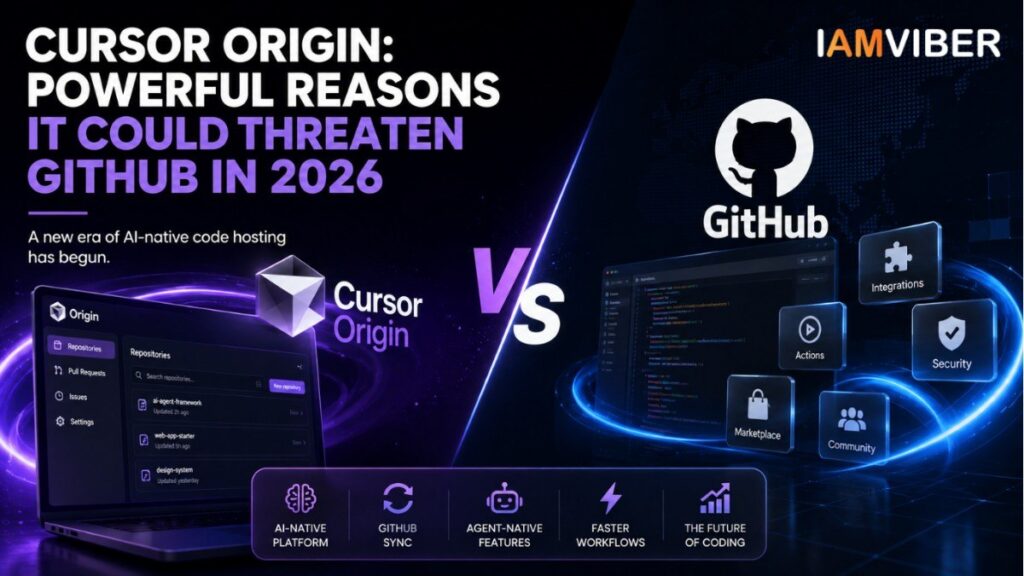
At its core, Cursor Origin gives developers a place to host code and manage common collaboration workflows without leaving Cursor. The company says the early beta is available on paid plans and includes repositories, pull requests, code browsing and GitHub sync. Cursor also says agent-native features are coming soon.
That positioning matters because Cursor is not approaching code hosting as an isolated infrastructure product. Its existing product is an AI coding environment, so the company already sits close to the moment when developers write, review and change software. Adding hosting through Cursor Origin moves Cursor one step closer to owning the full development loop.
Why is Cursor challenging GitHub?
GitHub has spent years becoming more than a repository host. Developers use it for collaboration, pull requests, issue tracking, automation, security workflows and a huge ecosystem of integrations. That network effect is difficult to reproduce.
Cursor Origin therefore does not need to replace GitHub overnight to be strategically important. Its immediate opportunity is among developers already using Cursor heavily and teams increasingly relying on AI agents to create and modify code.
The company is effectively asking a different question: if AI agents are becoming active participants in software development, should the systems that host and review code be designed around those agents too?
That is where Cursor Origin becomes more interesting than a conventional GitHub competitor.
The AI-native angle
Cursor has described Origin as being designed for agent scale. Its changelog says agent-native capabilities will arrive soon, while the company is also building a broader app ecosystem around the platform.
This suggests the long-term product is not simply “GitHub inside Cursor.” Instead, Cursor Origin could become a control layer where an AI agent can work on a repository, create changes, open a pull request, participate in review and eventually move software toward deployment.
That would fit a broader shift happening across developer tools. AI coding assistants are moving from autocomplete and chat toward agents that can perform multi-step software tasks. Once agents can independently modify code, the boundaries between editor, repository, code review and automation become less rigid.
Cursor Origin is therefore positioned around a future in which software development is increasingly a conversation between humans and agents.
The GitHub frustration factor
The launch also arrived at a moment when GitHub reliability was part of the developer conversation. Community discussions around the launch referenced GitHub incidents and asked whether Cursor was trying to take advantage of dissatisfaction with the incumbent.
That narrative is useful for understanding the market, but it should be handled carefully. An outage does not prove that developers are ready to migrate their repositories. GitHub’s advantage is its ecosystem, familiarity and deep integration with existing engineering workflows.
Cursor Origin still has to prove that it can offer enough reliability, integrations and collaboration features to become a serious alternative.
For now, GitHub remains the incumbent. Cursor Origin is the challenger.
Why GitHub still has the advantage
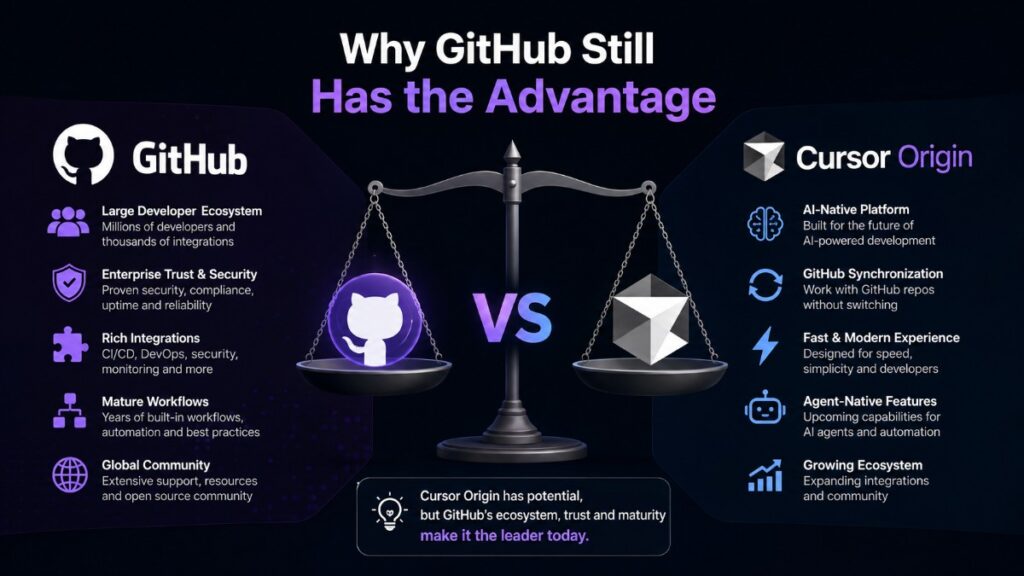
The hardest part of building a GitHub competitor is not storing Git repositories. It is everything around them.
Developers have years of history, workflows, permissions, integrations and automation built around GitHub. Companies also need confidence around security, access controls, compliance, uptime and long-term data management.
The developer ecosystem is another major barrier. Tools across monitoring, project management, CI/CD, security and deployment frequently connect directly to GitHub. Moving the repository is therefore only one part of moving the workflow.
Cursor Origin will need to build or attract that ecosystem if it wants to compete at enterprise scale.
There is also the question of interoperability. The early Cursor Origin release includes GitHub synchronization, which is important because it allows developers to experiment without immediately abandoning their existing GitHub setup.
That could be one of Origin’s smartest early decisions. Rather than forcing a binary migration, Cursor can make its platform easier to test alongside the incumbent.
What this means for AI coding
The bigger story is not whether Cursor can replace GitHub next month. It is whether AI coding companies are starting to compete for ownership of the developer stack.
Cursor already owns a significant part of the coding experience for its users. By adding hosting, it can potentially capture more of the context surrounding each software project.
More context can matter for AI agents. A coding agent that understands the repository, history, pull requests and review process has a richer environment than one that only sees files inside an editor.
That creates a potentially powerful feedback loop: better context can enable better agents, while better agents can make the hosting platform more valuable.
Cursor Origin could eventually benefit from exactly that relationship.
What developers should watch next
The next phase for Cursor Origin will tell us much more than the launch itself.
First, developers will want to see how reliable Origin is under real workloads. Second, teams will look closely at GitHub compatibility and migration options. Third, the promised agent-native features will be critical.
If Cursor can make agents first-class participants in repository workflows, Origin could become more than another GitHub alternative. It could represent a different model for software collaboration.
Pricing and enterprise capabilities will matter too. Large engineering organizations will expect strong security, permissions, auditability and integration support before moving critical repositories.
For individual developers and smaller teams, however, the barrier could be lower. If Origin makes AI-assisted coding, code hosting and review feel like one continuous workflow, it may attract users who are already building software primarily through AI.
The bigger battle is just beginning
Cursor Origin should not be described as a GitHub killer. That would be premature.
What Cursor has actually done is more interesting: it has started building infrastructure around the AI-native development workflow it believes is coming next.
GitHub was built around human developers collaborating through repositories. The next generation of developer platforms may need to account for humans and autonomous or semi-autonomous AI agents working together.
That distinction around Cursor Origin could become important.
Cursor Origin is an early beta, and much of its long-term promise depends on features that have not yet arrived. But the strategic direction is clear. Cursor is moving beyond being an AI editor and toward becoming a broader platform for building software.
For GitHub, that is a signal worth watching. For developers, it is another sign that the AI coding market is moving from tools that help programmers write code toward platforms that can participate in the entire software-development lifecycle.
And that may be the real story behind Cursor Origin: the fight is no longer only about who writes the code. It is increasingly about who owns the environment in which software gets built, reviewed and shipped.
The market will be watching Cursor Origin closely.
Frequently Asked Questions
1. What is Cursor Origin?
Cursor Origin is Cursor’s code-hosting platform, designed to provide repositories, pull requests, code browsing, and GitHub synchronization within the Cursor ecosystem.
2. Is Cursor Origin a GitHub competitor?
Yes. Cursor Origin is positioned as a potential GitHub alternative, particularly for developers who already use Cursor for AI-assisted coding.
3. Why did Cursor launch Origin?
Cursor is expanding beyond its AI coding editor into a broader developer platform. Origin gives Cursor more control over the code-hosting and collaboration workflow.
4. Can developers migrate from GitHub to Cursor Origin?
Cursor Origin includes GitHub synchronization, allowing developers to work with existing GitHub repositories while exploring the new platform. A complete migration may depend on future features.
5. Is Cursor Origin available to everyone?
Origin began rolling out in early beta, with availability initially tied to eligible paid Cursor plans. Availability and features may change as development continues.
6. Will Cursor Origin replace GitHub?
It is too early to say. GitHub has a huge developer ecosystem and extensive integrations. Cursor Origin is currently better viewed as an emerging competitor rather than a replacement.
7. What makes Cursor Origin different from GitHub?
Its biggest potential difference is its focus on AI-native development. Cursor plans to introduce agent-native capabilities, connecting AI coding agents more closely with repositories and development workflows.
8. Could Cursor Origin change AI-powered software development?
Potentially. If Cursor successfully connects AI agents with hosting, code changes, pull requests, and collaboration, it could help create a more agent-native software development workflow.
Topics to follow on IAMVIEBR : Current Affairs & Insights Tech Innovation GenZ entrepreneurship Collaborative Fashion GEO SME