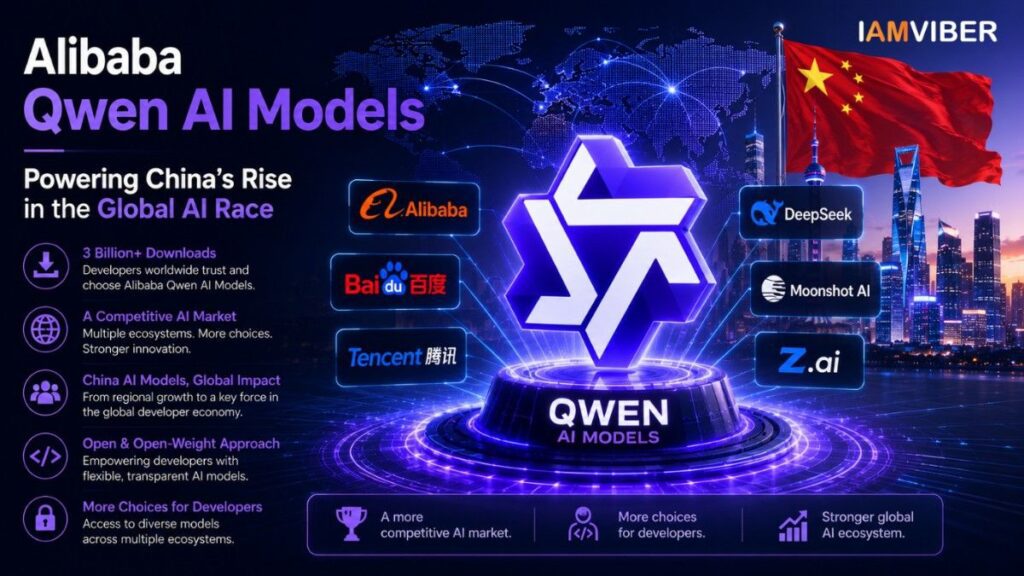
Alibaba Qwen AI Models have reached a remarkable adoption milestone, with the Qwen family reportedly accumulating more than 3 billion global downloads over the past six months. The figure puts Alibaba’s open-weight ecosystem at the center of the global AI race and highlights the growing influence of developer-driven AI adoption.
The milestone is particularly notable because this is not simply about one chatbot or one flagship model. Qwen has evolved into a broad family covering different model sizes, capabilities, and applications. Alibaba says the ecosystem now includes more than 460 models and has generated more than 300,000 derivative models.
That makes the latest numbers more than a download story. They point toward a larger shift in how developers are choosing, adapting, and deploying AI.
What Happened With Qwen?
Alibaba Qwen AI Models crossed the reported 3 billion-download mark during a period of intense competition among open-weight AI developers.
Recent reporting citing Hugging Face data said Qwen’s models accumulated more than 3 billion downloads globally over a six-month period. The same comparison put Google’s models at around 418 million downloads and Meta’s at approximately 227 million during the period discussed.
However, these figures need context.
A model download does not necessarily represent one unique person. Developers can download multiple models, repeat downloads, update files, deploy models through automated systems, or download different versions for testing.
Therefore, the 3 billion figure should be viewed as a measurement of developer and ecosystem activity, rather than a claim that 3 billion individuals use Qwen.
Why the 3 Billion Figure Matters
Alibaba Qwen AI Models are gaining attention because downloads provide a different measure of AI adoption than benchmark scores.
A model can perform extremely well on a leaderboard while having limited real-world adoption. Developers also care about price, licensing, model size, hardware requirements, customization, inference costs, and deployment flexibility.
Qwen’s strategy addresses many of those requirements.
The family includes different sizes and architectures, giving developers more choices depending on their computing resources and use case. Alibaba’s Qwen3 models support both thinking and non-thinking modes and were designed for reasoning, coding, tool use, multilingual tasks, and general conversation.
This flexibility helps explain why Alibaba Qwen AI Models have become increasingly important in the open-weight ecosystem.
Alibaba’s Open-Weight Strategy
Alibaba Qwen AI Models reflect a broader strategy of using broad model availability to accelerate ecosystem growth.
Alibaba has made Qwen models available across platforms including Hugging Face, GitHub, ModelScope, and its own AI services. Developers can download models, experiment with them, fine-tune them, and build specialized applications.
Alibaba’s Qwen3 announcement showed how quickly this strategy was already gaining momentum. The company previously said the Qwen family had surpassed 300 million worldwide downloads and had generated more than 100,000 Qwen-based derivative models on Hugging Face.
The latest reported numbers indicate that the ecosystem has expanded dramatically since then.
The Derivative Model Effect
One of the most important signals behind Alibaba Qwen AI Models is the reported growth in derivative models.
Alibaba says its Qwen ecosystem has generated more than 300,000 derivative models. That means developers are not simply downloading the base models and testing them.
They are adapting them.
Developers can fine-tune models for specific industries, languages, business workflows, coding tasks, research applications, and other specialized requirements.
This creates a powerful network effect.
A strong base model attracts developers. Developers create specialized versions. Those versions generate new applications and use cases. More applications attract more developers.
Hugging Face has previously described Qwen as an ecosystem strategy rather than simply a single flagship model. Its analysis noted Qwen’s large number of derivatives and repositories, demonstrating how widely the model family has been reused.
Qwen Is Becoming More Than a Language Model
Alibaba Qwen AI Models are increasingly becoming a broader AI platform.
The Qwen organization on Hugging Face describes its work as covering large language models, large multimodal models, and other AGI-related projects. The ecosystem now extends into areas such as vision, audio, coding, and other specialized AI applications.
Alibaba has also continued increasing the scale of its flagship models.
In August 2026, Alibaba introduced Qwen3.8-Max, a 2.4 trillion-parameter model with a context window of up to 1 million tokens. Alibaba Cloud described it as its most capable Qwen model at launch, targeting coding, research, real-world work, and long-horizon tasks.
The development shows that Alibaba is pursuing both ecosystem scale and frontier-model capability.
China’s Position in the Global AI Race
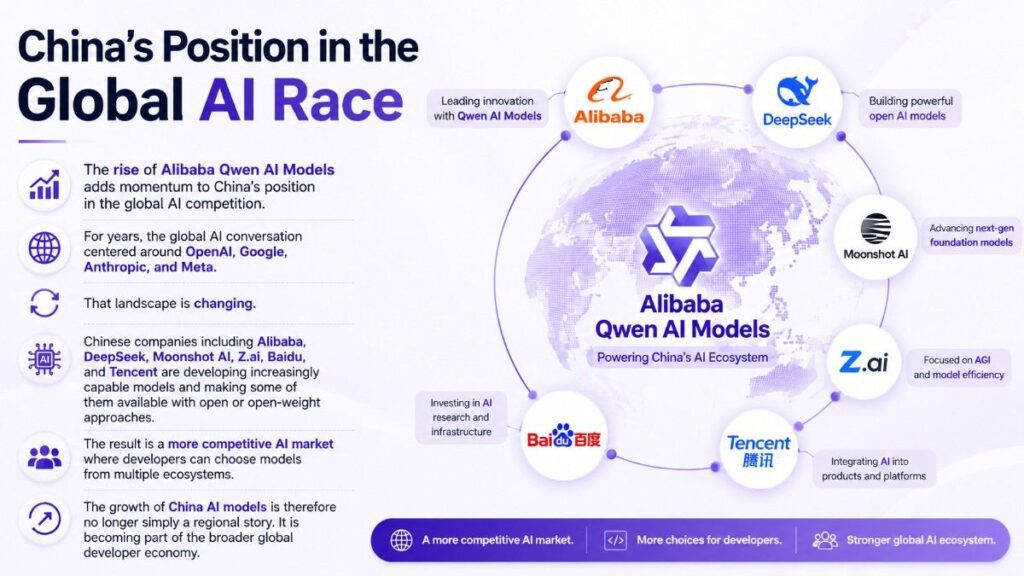
The rise of Alibaba Qwen AI Models also adds momentum to China’s position in the global AI competition.
For years, much of the global AI conversation centered around companies such as OpenAI, Google, Anthropic, and Meta.
That landscape is changing.
Chinese companies including Alibaba, DeepSeek, Moonshot AI, Z.ai, Baidu, and Tencent are developing increasingly capable models and making some of them available with open or open-weight approaches.
The result is a more competitive AI market where developers can choose models from multiple ecosystems.
The growth of China AI models is therefore no longer simply a regional story. It is becoming part of the broader global developer economy.
Open Weight vs. Open Source
| Aspect | Open-Weight AI Models | Open-Source AI Models |
|---|---|---|
| What is available? | Model weights/parameters are made available | Usually provides broader access to code and other components, depending on the license |
| Can developers download them? | Yes, depending on the model license | Generally yes, depending on the project and license |
| Can developers run them locally? | Often yes, if the hardware and license allow it | Often yes, depending on the project requirements |
| Can developers modify or fine-tune them? | Usually yes, subject to the specific license | Typically yes, subject to the project’s license |
| Is training data available? | Not necessarily | Not necessarily. Open source does not automatically mean the training data is publicly available |
| Is source code available? | Not necessarily | Usually more of the source code is available, depending on the project |
| Does the license matter? | Yes. Always check the specific model license before using it commercially | Yes. Always review the project’s license and usage conditions |
| Example | Qwen models are commonly described as open-weight AI models | Some AI projects provide source code and additional components under open-source licenses |
The Business Model Is Changing
Alibaba Qwen AI Models are expanding at a time when AI companies are experimenting with new ways to monetize open-weight technology.
Reuters reported earlier this month that Alibaba planned to monetize its upcoming Qwen3.8-Max model for major commercial users through a revenue-sharing approach. The strategy reflects a broader shift in the AI industry: companies can distribute models widely while monetizing cloud services, APIs, enterprise deployments, partnerships, and commercial usage.
This approach could become increasingly important.
Instead of treating the model itself as the only product, AI companies can use open-weight distribution to build a large developer community and then monetize the infrastructure surrounding that community.
What Developers Should Learn From Qwen
The growth of Alibaba Qwen AI Models offers a practical lesson for startups and developers: accessibility can be just as important as benchmark performance.
A startup building an internal AI assistant may not need the largest model available.
A developer may prefer a model that can run locally.
An enterprise may want to fine-tune an existing model instead of depending entirely on a closed API.
A specialized company may want control over its model deployment, data, and infrastructure.
This is where open-weight AI models become strategically important.
Developers can compare models, customize them, deploy them on different infrastructure, and build specialized systems around them.
The growing Qwen derivative ecosystem demonstrates how quickly this approach can spread.
What This Means for Google and Meta
The reported download advantage of Alibaba Qwen AI Models over Google and Meta’s open-model downloads is significant, but it should not be interpreted as a complete ranking of AI companies.
Google and Meta operate enormous AI ecosystems that include consumer applications, cloud infrastructure, proprietary research, hardware, enterprise products, and multiple model families.
Download statistics capture only one part of that landscape.
Still, the numbers reveal something important: developer distribution is becoming a competitive advantage.
Companies that make capable models easy to access, customize, and deploy can build influence beyond traditional consumer AI rankings.
The Bigger Picture
Alibaba Qwen AI Models reaching more than 3 billion reported downloads is ultimately an ecosystem story.
The headline number is impressive, but the deeper signal is the combination of model variety, developer accessibility, derivative models, cloud integration, and frequent releases.
The Qwen strategy demonstrates that an AI model can become more valuable when developers are allowed to build on top of it.
This is also where Alibaba AI is taking a different strategic path from companies that primarily monetize proprietary model access.
The global AI market is becoming increasingly fragmented. Developers can now choose between proprietary APIs, open-weight models, local deployments, cloud services, and hybrid architectures.
That flexibility could accelerate innovation.
For Alibaba, however, the next challenge is converting massive developer adoption into sustainable business value.
Why This Matters for the Global AI Industry
Alibaba Qwen AI Models show that the global AI race is increasingly becoming a race for ecosystems.
The companies with the strongest developer communities could have an advantage because every new application built on their models increases the ecosystem’s overall value.
Qwen’s growth also demonstrates how China’s AI strategy is evolving.
Instead of competing only through proprietary products, Chinese AI companies are increasingly using accessible models, developer communities, and cost-efficient infrastructure to expand globally.
That creates pressure on established AI leaders to think beyond model benchmarks.
Final Takeaway
Alibaba Qwen AI Models have moved from being a major Chinese AI project to becoming a significant global open-weight ecosystem.
The reported 3 billion-download milestone does not mean that Qwen has three billion unique users. It is better understood as a huge measure of model-download activity across developers, platforms, applications, and infrastructure.
But the combination of more than 460 models and 300,000-plus reported derivative models makes the story significant.
For Alibaba Qwen AI Models, the next challenge will be turning adoption into lasting commercial value.
For developers, the message is different: the future of AI may not belong only to the companies building the biggest models. It may belong to the companies whose models developers actually choose to build on.
Frequently Asked Questions
1. What are Alibaba Qwen AI Models?
Alibaba Qwen AI Models are a family of AI models developed by Alibaba for tasks including reasoning, coding, multilingual understanding, multimodal applications, and AI-powered workflows. The Qwen ecosystem includes models with different sizes and capabilities.
2. How many downloads have Alibaba Qwen AI Models reached?
Alibaba Qwen AI Models have reportedly crossed 3 billion downloads globally over a six-month period. The figure represents model-download activity rather than 3 billion unique users.
3. Why are Alibaba Qwen AI Models becoming popular?
Alibaba Qwen AI Models are gaining popularity because developers can access different model sizes, customize models, and use them for various applications. Their growing ecosystem also includes thousands of derivative models.
4. Are Alibaba Qwen AI Models open-source?
Alibaba Qwen AI Models are commonly described as open-weight AI models. However, developers should check the specific license of each Qwen model because open-weight does not necessarily mean that all source code, training data, or components are publicly available.
5. What are open-weight AI models?
Open-weight AI models make their trained model parameters or weights available to developers. Alibaba Qwen AI Models are a major example of this approach, allowing developers to download, run, customize, and build applications around eligible models subject to their licenses.
6. How do Alibaba Qwen AI Models compare with Google and Meta AI models?
Alibaba Qwen AI Models have reportedly recorded significantly higher model-download activity than Google and Meta models during the period covered by recent reports. However, downloads represent only one measure of AI adoption and should not be treated as a complete ranking of AI companies.
7. What does the growth of Alibaba Qwen AI Models mean for China AI models?
The growth of Alibaba Qwen AI Models highlights the increasing global influence of China AI models. Alibaba, alongside other Chinese AI companies, is building models and developer ecosystems that are increasingly competing on the international AI stage.
8. What is the future of Alibaba Qwen AI Models?
The future of Alibaba Qwen AI Models will likely depend on continued model improvements, developer adoption, enterprise use cases, and Alibaba’s ability to turn its growing open-weight ecosystem into sustainable commercial value.
Topics to follow on IAMVIEBR : Current Affairs & Insights Tech Innovation GenZ entrepreneurship Collaborative Fashion GEO SME