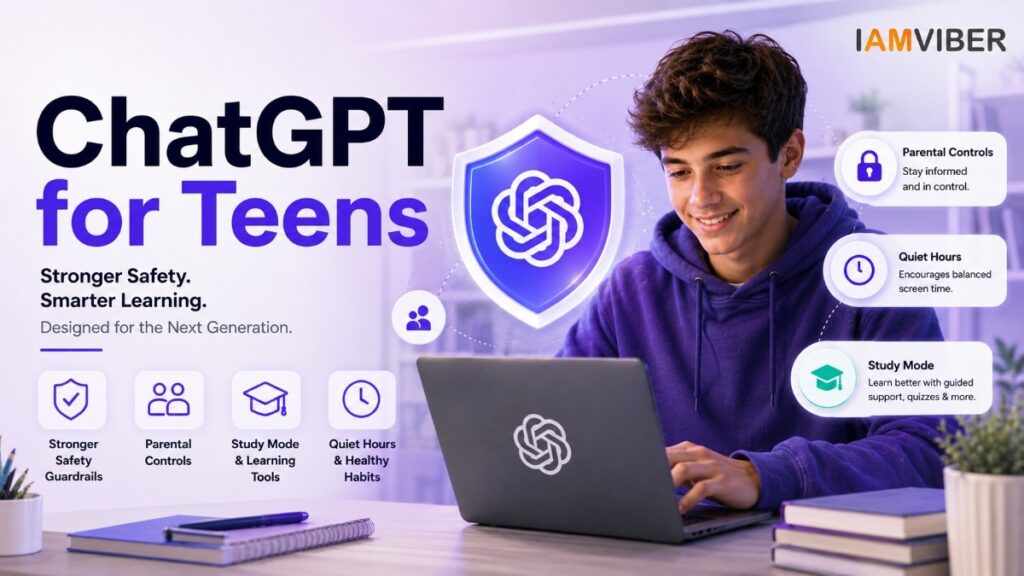
OpenAI has introduced ChatGPT for Teens, a new teen-focused experience designed for users aged 13 to 17, with stronger safety protections, parental controls and learning-focused features. The announcement comes as AI chatbots become increasingly common among younger users and concerns grow around how teenagers interact with generative AI.
OpenAI announced the new experience on August 18, 2026, positioning it as a safer way for teenagers to use AI for learning, productivity and everyday questions.
The launch of ChatGPT for Teens represents a broader shift in the AI industry: instead of treating every user the same, AI platforms are increasingly looking at age, developmental needs and different levels of risk.
What Is ChatGPT for Teens?
ChatGPT for Teens is designed specifically around the needs of teenagers between 13 and 17. OpenAI says the experience is intended to help young people learn, think critically, deepen their understanding and use AI more confidently.
The company is also using age-prediction technology to identify accounts that may belong to users under 18. When the system determines that someone is likely to be a teenager, age-appropriate protections can be applied automatically.
This is an important change because teenagers may use AI differently from adults. A chatbot that is acceptable for an adult could require additional restrictions when interacting with a younger user.
With ChatGPT for Teens, OpenAI is therefore moving toward a more age-aware AI experience rather than relying only on users to manage their own safety settings.
Stronger Safety Guardrails for Teen Users
One of the biggest elements of ChatGPT for Teens is its stronger approach to sensitive content.
OpenAI says teen accounts will receive additional protections around areas including graphic violence, self-harm content and sexual or romantic roleplay. The system can also provide safety information around sensitive subjects such as eating disorders.
These safeguards are part of OpenAI’s broader OpenAI teen safety strategy, which increasingly focuses on preventing harmful interactions while still allowing young people to benefit from AI.
The company has also emphasized that AI should not replace real-world relationships. That distinction is particularly important for younger users who may form strong emotional connections with conversational systems.
Rather than simply blocking teenagers from using AI, ChatGPT for Teens attempts to create an environment where AI remains useful while additional boundaries are applied.
ChatGPT Parental Controls Get More Important
Another major part of the update is ChatGPT parental controls.
Parents can link their accounts with their teenager’s account and manage specific settings. These controls can include Quiet Hours, which can help limit when the teen can use ChatGPT.
Parents can also receive safety notifications when the system detects certain high-risk situations. OpenAI says these notifications are designed to provide parents with information without simply exposing every private conversation.
This creates a middle ground between complete parental surveillance and completely independent AI use.
The idea behind ChatGPT parental controls is not necessarily to give parents access to everything a teenager says. Instead, the controls are designed to give families additional tools to establish boundaries and respond when serious safety concerns arise.
OpenAI had already introduced parental controls in 2025, including stronger protections for linked teen accounts. The new launch builds on that earlier work.
Designed More for Learning Than Homework Shortcuts
Education is another major focus of ChatGPT for Teens.
OpenAI says the experience includes features intended to encourage active learning instead of simply generating answers. These include Study Mode, quizzes, learning visualizations and responsible homework reminders.
The responsible homework functionality is particularly interesting. If the system identifies that a teenager may be trying to shortcut an assignment, it can redirect the user toward Study Mode rather than simply providing a finished answer.
This approach could make ChatGPT for students more useful in classrooms and at home.
Instead of functioning primarily as an answer machine, AI can become more like an interactive tutor that asks questions, explains concepts and helps students understand why an answer works.
For ChatGPT for Teens, that educational positioning could become one of its biggest advantages.
Study Mode and Responsible AI Use
Study Mode is not completely new to ChatGPT. OpenAI previously introduced the feature as an experience designed to guide students through problems step by step rather than immediately providing solutions.
However, integrating learning features more deeply into the teen experience changes how they are presented.
Users can establish study hours, while parents can also use controls to encourage more structured learning. This creates an interesting combination of AI assistance, productivity and digital wellbeing.
For ChatGPT for students, the bigger question is whether these tools can encourage genuine understanding rather than dependency.
That distinction matters because generative AI can make it extremely easy to complete assignments without actually learning the material.
OpenAI’s approach suggests that the company wants ChatGPT for Teens to become a learning companion rather than an automated homework-answering service.
Quiet Hours and Healthier AI Habits
Another notable feature is Quiet Hours.
Teenagers can spend significant amounts of time interacting with digital platforms, and AI introduces a different type of engagement because conversations can feel continuous and personalized.
With ChatGPT for Teens, Quiet Hours are intended to encourage healthier boundaries around usage. Break reminders and study schedules can also help reduce excessive or poorly timed interaction.
This is increasingly becoming part of AI safety for teenagers.
Safety is no longer only about blocking harmful content. It also involves thinking about how often users interact with AI, what role AI plays in their daily lives and whether technology is replacing important real-world activities.
OpenAI’s broader teen-safety work reflects this shift toward more holistic digital wellbeing.
Why This Launch Matters for the AI Industry
The introduction of ChatGPT for Teens is bigger than a simple product update.
It shows that age-specific AI experiences could become a standard part of the next generation of consumer AI products.
Social platforms have already introduced teen-specific experiences, restrictions and parental controls. AI companies now face a similar challenge: how can they provide powerful conversational systems while recognizing that younger users require additional safeguards?
The launch also comes amid growing scrutiny of AI’s effects on minors. Reuters reported that OpenAI is facing legal challenges related to alleged harms involving teenagers, adding further pressure around the company’s approach to youth safety.
Against that backdrop, ChatGPT for Teens can be viewed as both a product initiative and a response to a much larger industry debate.
Is ChatGPT for Teens Actually Safer?
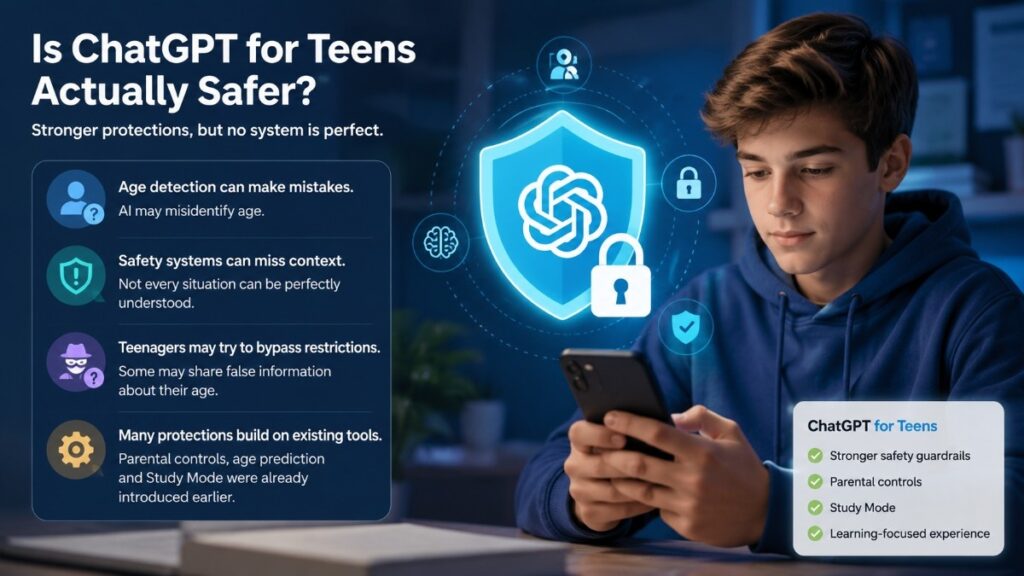
The answer is more complicated than simply saying yes.
The new protections are meaningful, but no automated safety system can eliminate every possible risk.
Age detection can make mistakes. Safety systems can miss context. Teenagers may also try to bypass restrictions or intentionally provide misleading information about their age.
The Verge also notes that some protections included in the new experience build on safeguards that OpenAI had already introduced, including parental controls, age prediction and Study Mode.
That means the significance of ChatGPT for Teens is not necessarily that every individual feature is brand new.
Instead, OpenAI is bringing multiple safety and learning mechanisms together into a dedicated teen experience.
What Parents Should Know
For parents, ChatGPT for Teens could provide more visibility and control over how their children interact with AI.
However, technology alone should not become the entire safety strategy.
Parents should still talk with teenagers about AI limitations, misinformation, privacy and emotional dependency. They should also encourage young users to verify important information rather than assuming every AI-generated response is correct.
OpenAI itself has previously emphasized that parental controls work best alongside family conversations and clear technology rules.
The goal of AI safety for teenagers therefore extends beyond software restrictions. It also requires digital literacy.
Teenagers need to understand that AI can sound confident while being wrong, that conversations may involve sensitive information and that AI should not replace trusted people, teachers or professional support.
The Bigger Future of AI for Young People
The arrival of ChatGPT for Teens signals where consumer AI could be heading next.
Instead of one general-purpose chatbot for everyone, future AI products may increasingly adapt based on age, context and user needs.
A student could receive a learning-focused experience. A professional could get workplace-oriented tools. A younger user could receive stronger safeguards by default.
That model could eventually become an important part of responsible AI design.
For ChatGPT for students, the opportunity is particularly significant. AI can provide personalized explanations, practice questions and interactive learning support at a scale traditional education systems may struggle to provide.
But the technology needs boundaries.
The success of ChatGPT for Teens will ultimately depend not only on how restrictive its guardrails are, but also on whether teenagers find the experience useful enough to keep using it responsibly.
Final Thoughts
OpenAI’s launch of ChatGPT for Teens marks an important moment in the evolution of consumer AI.
The product combines stronger safety protections, parental controls, learning tools, study features and digital-wellbeing settings into an experience designed specifically for teenagers.
The bigger story, however, is about how AI companies define responsible access for younger users.
As AI becomes increasingly embedded in education and everyday life, simply restricting access may no longer be enough. Companies will need to build systems that understand different users, provide age-appropriate safeguards and encourage healthier relationships with technology.
ChatGPT for Teens is OpenAI’s latest attempt to move in that direction.
Whether it becomes a model for the wider AI industry will depend on how effectively these safeguards work in real-world use — and how transparently OpenAI continues to report what it learns.
For now, the launch makes one thing clear: the next phase of AI isn’t only about making models smarter. It is also about making them safer and more appropriate for the people using them.
Frequently Asked Questions
1. What is ChatGPT for Teens?
ChatGPT for Teens is OpenAI’s age-appropriate ChatGPT experience designed for users aged 13–17, with stronger safety protections and parental controls.
2. Who can use ChatGPT for Teens?
The experience is designed for teenagers between 13 and 17 years old. OpenAI is also using age-prediction technology to help identify accounts belonging to younger users.
3. What parental controls does ChatGPT offer for teens?
ChatGPT parental controls allow parents to link their account with their teen’s account and manage features such as Quiet Hours. Parents can also receive notifications in certain high-risk safety situations.
4. Is ChatGPT for Teens safe for teenagers?
It includes additional safeguards around sensitive topics such as self-harm, graphic violence and sexual content. However, no AI safety system can eliminate every possible risk, so parental guidance remains important.
5. Does ChatGPT for Teens help with homework?
Yes. The teen experience includes learning-focused features such as Study Mode, quizzes and learning visualizations, designed to encourage understanding instead of simply providing answers.
6. What is Study Mode in ChatGPT?
Study Mode is designed to guide students through problems step by step, helping them understand concepts rather than immediately giving them the final answer.
7. Can parents read their teenager’s ChatGPT conversations?
OpenAI’s parental-control approach is designed around safety and settings rather than giving parents unrestricted access to every conversation. Certain high-risk situations may trigger safety notifications.
8. Why did OpenAI launch ChatGPT for Teens?
OpenAI launched the teen-focused experience to provide younger users with a more age-appropriate AI environment while addressing growing concerns around AI safety for teenagers, digital wellbeing and responsible AI use.
Topics to follow on IAMVIEBR : Current Affairs & Insights Tech Innovation GenZ entrepreneurship Collaborative Fashion GEO SME