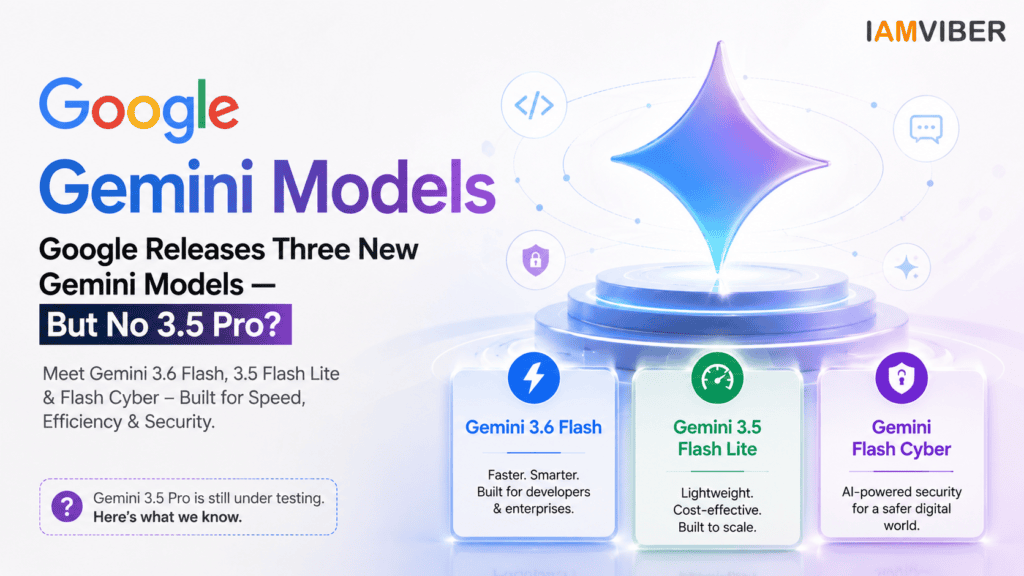
Google has expanded its AI portfolio once again by introducing three new Google Gemini Models aimed at improving speed, affordability, and specialized enterprise capabilities. While the announcement generated excitement across the AI industry, one question quickly dominated discussions: Where is Gemini 3.5 Pro?
Instead of unveiling its anticipated flagship model, Google introduced Gemini 3.6 Flash, Gemini 3.5 Flash Lite, and Gemini Flash Cyber. These new Google Gemini Models clearly indicate Google’s strategy of focusing on practical AI solutions rather than simply competing for benchmark scores.
So, why did Google skip Gemini 3.5 Pro, and what do these new models mean for businesses, developers, and everyday users? Here’s everything you need to know.
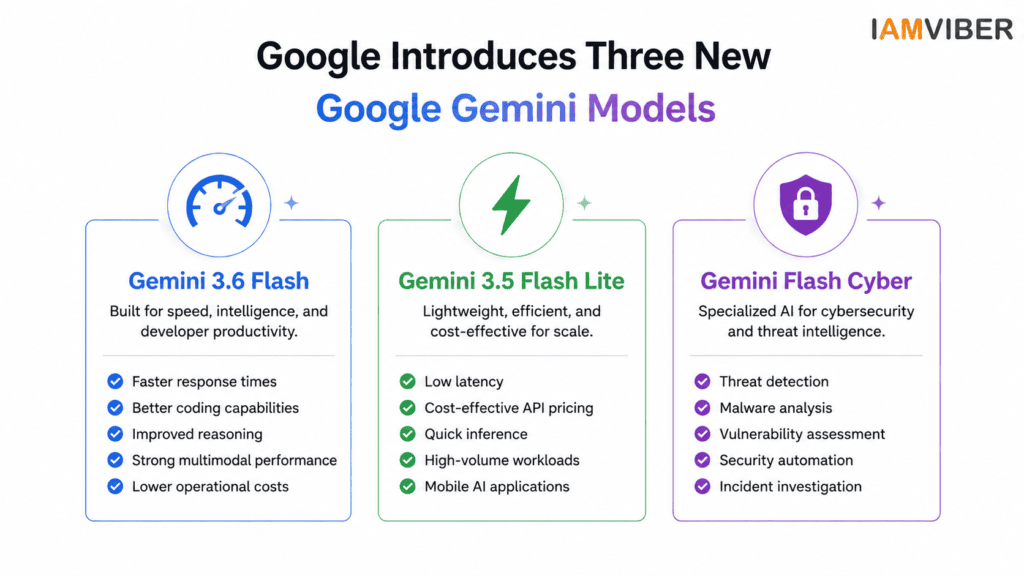
The latest launch adds three new members to the growing family of Google Gemini Models, each targeting a different audience.
1. Gemini 3.6 Flash
The biggest launch among the new Google Gemini Models is Gemini 3.6 Flash. Designed for developers and enterprise users, this model delivers:
- Faster response times
- Better coding capabilities
- Improved reasoning
- Strong multimodal performance
- Lower operational costs
Google says Gemini 3.6 Flash is built for applications requiring both speed and intelligence, making it ideal for AI assistants, customer support, software development, and workflow automation.
2. Gemini 3.5 Flash Lite
The second addition to the Google Gemini Models lineup is Gemini 3.5 Flash Lite. This lightweight version focuses on affordability and efficiency. Its strengths include:
- Low latency
- Cost-effective API pricing
- Quick inference
- High-volume workloads
- Mobile AI applications
Developers looking to deploy AI at scale without increasing infrastructure costs are likely to find Gemini 3.5 Flash Lite particularly attractive.
3. Gemini Flash Cyber
Among all new Google Gemini Models, Gemini Flash Cyber is perhaps the most specialized.
Unlike general-purpose AI models, it has been designed specifically for cybersecurity tasks such as:
- Threat detection
- Malware analysis
- Vulnerability assessment
- Security automation
- Incident investigation
As cyberattacks continue to rise globally, Google is positioning AI as a proactive security partner for enterprises.
But Where Is Gemini 3.5 Pro?
Despite introducing three impressive Google Gemini Models, Google did not launch Gemini 3.5 Pro.
The absence of Gemini 3.5 Pro immediately became one of the biggest talking points across the AI community.
Many developers had expected Google to release Gemini 3.5 Pro as its next flagship reasoning model, capable of competing directly with the latest offerings from OpenAI, Anthropic, and xAI.
Instead, Google appears to have delayed Gemini 3.5 Pro, suggesting that the company is taking additional time to improve reliability, coding performance, and enterprise readiness before making it publicly available.
While Google has not provided a confirmed release date for Gemini 3.5 Pro, the delay signals that quality is taking priority over speed.
Why Google Is Prioritizing Practical AI
The latest Google Gemini Models reveal an important shift in Google’s AI strategy.
Rather than releasing only the largest and most powerful model, Google is investing in AI systems that solve real business problems.
This reflects several industry trends:
- Faster AI adoption
- Lower infrastructure costs
- Better enterprise security
- Specialized AI solutions
- Scalable deployment
Businesses today often value reliability, affordability, and speed more than marginal improvements in benchmark performance.
That is exactly where these new Google Gemini Models fit.
What Makes Gemini 3.6 Flash Important?
Among all newly launched Google Gemini Models, Gemini 3.6 Flash is expected to become the default choice for many enterprise workloads.
Its advantages include:
- High-speed responses
- Better coding assistance
- Improved multimodal understanding
- Lower deployment costs
- Strong API performance
For developers building AI-powered applications, Gemini 3.6 Flash offers a compelling balance between performance and efficiency.
What This Means for Developers
Developers now have more flexibility than ever when selecting Google Gemini Models.
Instead of relying on one general-purpose AI model, organizations can choose a model tailored to their workload.
For example:
- Use Gemini 3.6 Flash for coding assistants and productivity tools.
- Use Gemini 3.5 Flash Lite for high-volume applications and mobile experiences.
- Use Gemini Flash Cyber for cybersecurity operations.
This specialized approach allows businesses to optimize both performance and costs.
How Google Competes in the AI Race
Competition among AI companies has intensified dramatically.
OpenAI continues to expand ChatGPT capabilities, Anthropic is pushing enterprise AI with Claude, and xAI is targeting real-time reasoning.
Instead of focusing solely on larger models, Google’s latest Google Gemini Models demonstrate a broader strategy: delivering AI that is practical, scalable, and commercially viable.
The eventual arrival of Gemini 3.5 Pro could strengthen Google’s position even further, but today’s announcement already shows that Google is thinking beyond traditional AI benchmarks.
Why the Missing Gemini 3.5 Pro Matters
The delay of Gemini 3.5 Pro is significant because flagship models often define the competitive landscape.
Developers expected Gemini 3.5 Pro to deliver stronger reasoning, advanced coding capabilities, and improved long-context performance.
However, delaying Gemini 3.5 Pro may ultimately benefit users if Google can release a more stable and capable model instead of rushing it to market.
For enterprise customers, reliability often matters more than being first.
Final Thoughts
The newest Google Gemini Models mark another important step in Google’s AI journey.
With Gemini 3.6 Flash, Gemini 3.5 Flash Lite, and Gemini Flash Cyber, Google is expanding its ecosystem with faster, more affordable, and more specialized AI solutions.
Although Gemini 3.5 Pro was noticeably absent, the company’s strategy suggests that it is prioritizing quality and enterprise readiness over rushing a flagship release.
For developers, startups, and businesses, these Google Gemini Models provide more choices than ever before. And when Gemini 3.5 Pro finally arrives, it could become Google’s most powerful AI offering yet.
Until then, Google’s latest releases reinforce one message: the future of AI is not just about bigger models—it’s about smarter, faster, and more practical ones.
Frequently Asked Questions (FAQs)
1. What are the new Google Gemini Models released by Google?
Google has launched three new Google Gemini Models: Gemini 3.6 Flash, Gemini 3.5 Flash Lite, and Gemini Flash Cyber. These models are designed to offer faster performance, lower costs, and specialized AI capabilities for developers and enterprises.
2. Why didn't Google launch Gemini 3.5 Pro?
Google has not officially announced why Gemini 3.5 Pro was excluded from the latest release. However, industry reports suggest the company is refining the model to improve reasoning, coding performance, and enterprise reliability before making it publicly available.
3. What is Gemini 3.6 Flash used for?
Gemini 3.6 Flash is built for high-performance AI applications such as coding assistants, AI chatbots, workflow automation, content generation, and multimodal tasks. It offers faster responses and better efficiency than previous Flash models.
4. What is the difference between Gemini 3.6 Flash and Gemini 3.5 Flash Lite?
While Gemini 3.6 Flash focuses on advanced performance, reasoning, and coding capabilities, Gemini 3.5 Flash Lite is optimized for speed, affordability, and high-volume AI workloads. Flash Lite is ideal for businesses looking to reduce API costs without sacrificing responsiveness.
5. What is Gemini Flash Cyber?
Gemini Flash Cyber is a specialized AI model developed for cybersecurity. It helps security teams with threat detection, vulnerability analysis, malware investigation, security automation, and incident response, making it suitable for enterprise security operations.
6. When will Gemini 3.5 Pro be released?
Google has not confirmed an official launch date for Gemini 3.5 Pro. The model is expected to arrive after additional testing and optimization, but no public release timeline has been announced.
7. Which Google Gemini Model is best for developers?
For most developers, Gemini 3.6 Flash is currently the best choice because it combines strong coding capabilities, multimodal understanding, fast inference, and cost-efficient performance. Developers with budget-focused applications may prefer Gemini 3.5 Flash Lite.
8. Why are the new Google Gemini Models important?
The latest Google Gemini Models demonstrate Google’s shift toward practical, specialized AI solutions. Instead of releasing only larger flagship models, Google is offering faster, more affordable, and purpose-built AI systems that help businesses scale applications while reducing infrastructure costs.
Topics to follow: Current Affairs & Insights Tech Innovation GenZ entrepreneurship Collaborative Fashion GEO AI Agentic SME