Anthropic Introduces Smarter AI Automation with Improved Reasoning and Multi-Agent Workflows
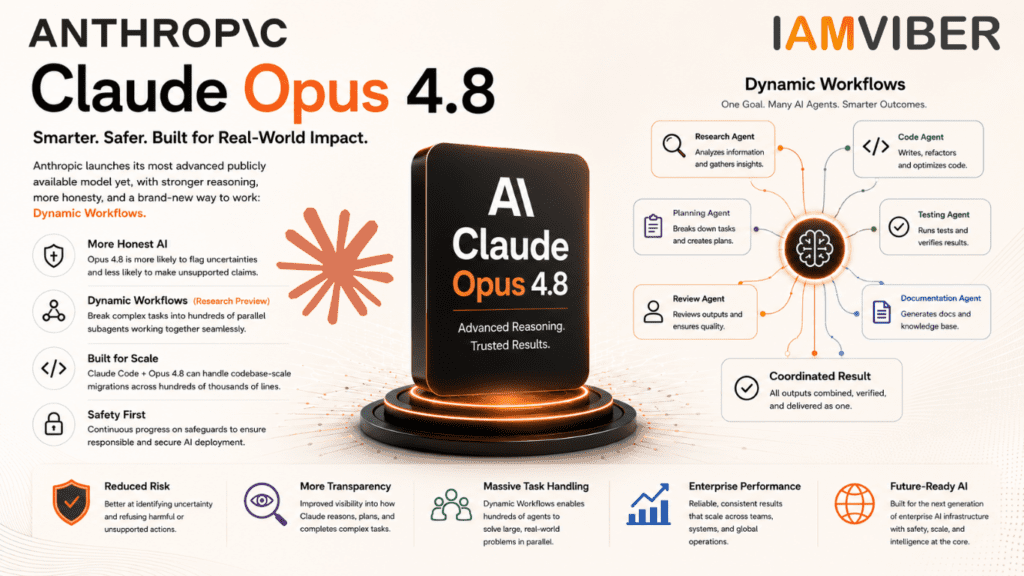
The AI race is moving faster than ever, and Anthropic has once again entered the spotlight with the release of Claude Opus 4.8. Announced on May 28, 2026, the company introduced not only its latest flagship AI model but also a brand-new feature called Dynamic Workflows — a system designed to manage large-scale tasks through multiple AI subagents working together.
The launch comes at a crucial time for the AI industry. Competition among companies like OpenAI, Google, and Anthropic is intensifying, with each company pushing faster updates, smarter reasoning, and better automation capabilities.
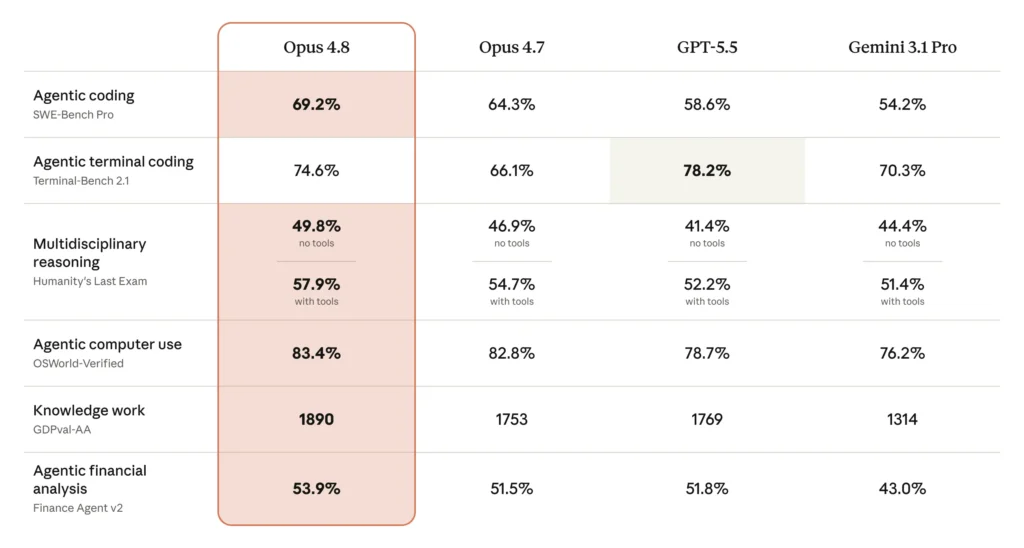
Claude Opus 4.8 is being positioned as Anthropic’s most advanced publicly available AI model yet. While benchmark scores remain impressive, the biggest conversation around this release is not just speed or intelligence — it is reliability, transparency, and enterprise-scale automation.
Claude Opus 4.8 is the latest version of Anthropic’s high-performance AI model family. It succeeds Opus 4.7, which was released only 41 days earlier, making this one of the fastest upgrade cycles the company has ever delivered.
Traditionally, Anthropic has maintained a slower release rhythm compared to competitors. However, rapid advancements from OpenAI’s Codex ecosystem and Google’s Gemini Flash models appear to have accelerated the pace of innovation. The new model focuses heavily on three major improvements:
- Better reasoning capabilities
- Improved handling of uncertain or incomplete information
- Enhanced large-scale workflow execution
- According to Anthropic, the model is specifically designed to reduce unsupported claims and hallucinations while improving trustworthiness in enterprise environments.
The fast release cycle surprised many in the AI community. Typically, major AI model updates take months. However, Opus 4.8 arrived just over a month after Opus 4.7. Industry analysts believe the reason may be linked to mixed reactions surrounding the previous version.
While Opus 4.7 performed well technically, some users expected stronger real-world reasoning improvements and more practical automation capabilities. At the same time, competitors continued shipping aggressive updates.
Pressure from OpenAI and Google
The AI industry is currently in one of its most competitive phases ever. Recent launches from companies like:
The Biggest Upgrade — More Honest AI Responses
One of the most important features of Claude Opus 4.8 is its improved ability to recognize uncertainty. Instead of confidently generating incorrect information, the model is now reportedly more likely to:
- Flag incomplete data
- Warn users about weak assumptions
- Highlight uncertainty in analysis
- Avoid unsupported conclusions
- This represents a significant shift in how AI systems interact with users.
Why This Matters for Businesses
In enterprise environments, incorrect AI outputs can create serious problems. For example:
- Financial analysis errors
- Legal misunderstandings
- Software bugs
- Faulty business recommendations
- Anthropic appears to be focusing heavily on reducing these risks. Investment management company Bridgewater Associates reportedly praised the model’s ability to proactively identify issues in both inputs and outputs — something many other AI systems still struggle with.
From “Confident AI” to “Responsible AI”
The industry is slowly moving away from AI systems that simply generate fast answers. Now, businesses are prioritizing:
- Transparency
- Explainability
- Reliability
- Risk management
- Claude Opus 4.8 reflects this transition by behaving more like a cautious research assistant rather than an overconfident chatbot.
What Are Dynamic Workflows?
Alongside Opus 4.8, Anthropic introduced a new feature called Dynamic Workflows. This feature is currently available in research preview and is designed to help AI systems handle extremely large and complex tasks.
How Dynamic Workflows Work
Instead of relying on a single AI process, Dynamic Workflows breaks a task into multiple smaller agents or “subagents.” Each subagent can:
- Analyze a specific part of the problem
- Work independently
- Verify outputs
- Collaborate with other agents
- The final system then combines all outputs into a coordinated result. This approach is similar to how human teams work inside large organizations.
Why Dynamic Workflows Could Change Software Development
Anthropic specifically highlighted coding and software migration as key use cases. According to the company, Claude Code paired with Opus 4.8 can now:
- Handle massive codebases
- Manage migrations across hundreds of thousands of lines of code
- Run tests automatically
- Detect failures
- Support large engineering teams
Enterprise Automation at a New Scale
This is important because traditional AI coding tools often struggle with:
- Context limitations
- Long-term memory
- Multi-file coordination
- Dependency management
- Dynamic Workflows attempts to solve these problems by distributing tasks across multiple coordinated AI agents. For enterprises managing large software infrastructures, this could become a major productivity breakthrough.
AI Subagents Could Become the Future of Work
The idea of AI subagents is becoming increasingly popular across the industry. Rather than one large AI doing everything, companies are experimenting with:
- Research agents
- Coding agents
- Testing agents
- Review agents
- Planning agents
Multi-Agent AI Systems
Experts believe multi-agent systems may eventually power:
- Autonomous businesses
- AI project managers
- Automated software teams
- Enterprise decision-making systems
- Anthropic’s Dynamic Workflows appears to be an early step toward that future.
What Happened to Anthropic’s Mythos Model?
Another major topic surrounding the launch is Anthropic’s mysterious Mythos model. The company previously previewed Mythos earlier this year, but access remained limited due to cybersecurity concerns.
Why Mythos Was Delayed
According to multiple reports, Anthropic decided to delay the wider release of its Mythos model in order to implement additional safety safeguards. The company reportedly had concerns related to offensive cyber capabilities, misuse risks, autonomous exploit generation, and advanced system manipulation. As AI models become increasingly powerful, these risks have become a major focus for developers and regulators alike. Anthropic stated that it is making rapid progress on the required safeguards and hinted that Mythos-class models could become available to customers within the coming weeks once the necessary protections are fully in place.
Safety Is Becoming a Competitive Advantage
Unlike some AI companies focused purely on performance, Anthropic continues positioning itself as a safety-first AI company. This strategy may become increasingly important as governments worldwide begin discussing AI regulation and enterprise compliance requirements.
What This Means for the AI Industry
The launch of Claude Opus 4.8 shows that the AI race is entering a new phase. The focus is no longer only about:
- Bigger models
- Faster responses
- Higher benchmark scores
- Now the conversation includes:
- Reliability
- Collaboration between AI agents
- Enterprise scalability
- Safer automation
The Rise of AI Infrastructure Wars
Companies are now competing on infrastructure-level capabilities. This includes:
- AI orchestration
- Agent collaboration
- Workflow management
- Autonomous execution systems
- Dynamic Workflows may become one of the most important developments in enterprise AI if it performs as promised.
Final Thoughts
Claude Opus 4.8 represents far more than just another AI model upgrade. It signals a broader shift toward responsible AI behavior, multi-agent collaboration, enterprise-grade automation, and safer large-scale reasoning systems. While benchmark scores and raw performance still remain important, businesses today are increasingly focused on whether AI systems can operate reliably, detect problems independently, manage massive workflows, and scale effectively across real-world operations. With the introduction of Dynamic Workflows and major improvements in transparency and reasoning reliability, Anthropic is clearly positioning itself as a key leader in the next generation of enterprise AI infrastructure. At the same time, competition between Anthropic, OpenAI, and Google continues to intensify, showing that the pace of AI innovation is only accelerating further.