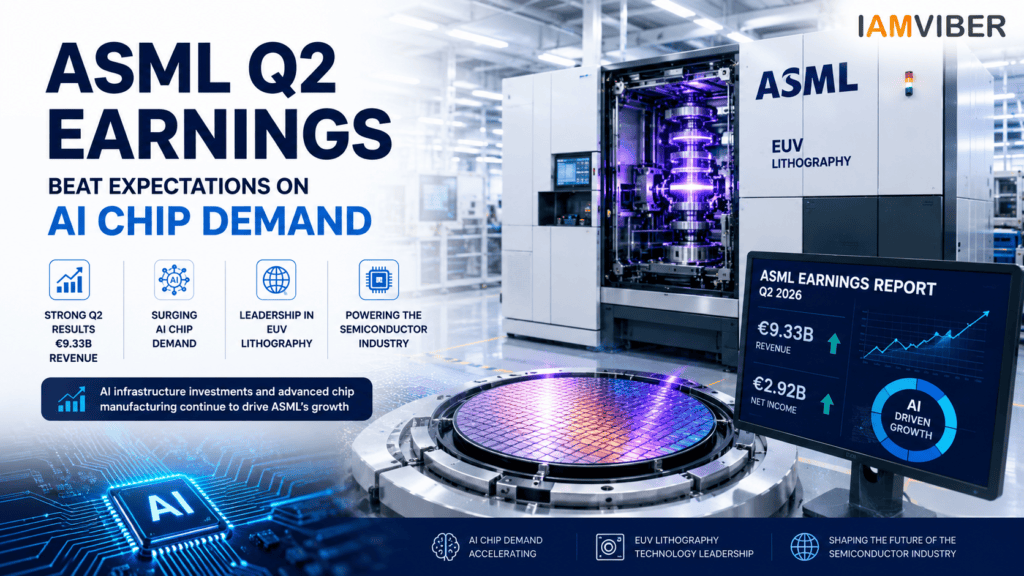
ASML’s Q2 earnings continued to showcase the thriving global AI-hardware industry. The Dutch semiconductor equipment company posted Q2 results above analyst expectations, due to the rapidly increasing AI semiconductor demand and continued investments in emerging chip fabrication.
The latest ASML earnings report exceeded analyst expectations on both revenue and profit, reinforcing the company’s central role in the AI revolution. As demand for advanced chips grows across cloud computing, generative AI, and data centers, ASML remains one of the most important companies in the semiconductor industry.
The latest ASML Q2 earnings showed impressive financial performance during the second quarter of 2026. Key highlights include:
- Revenue reached €9.33 billion, beating analyst estimates of approximately €8.80 billion.
- Net income came in at €2.92 billion, exceeding expectations.
- Gross margins remained healthy despite ongoing geopolitical uncertainty.
- Strong customer investments continued across advanced semiconductor manufacturing.
- These results demonstrate that AI chip demand remains one of the biggest growth drivers for the company.
One of the biggest reasons behind the strong ASML Q2 earnings is the explosion in AI chip demand.
Companies including NVIDIA, AMD, Intel, TSMC, Samsung, SK Hynix, and Micron are investing billions of dollars to expand production capacity for AI accelerators and high-performance computing chips.
Every advanced chip requires highly sophisticated manufacturing equipment, and ASML is the only company capable of producing cutting-edge EUV lithography systems that enable these chips.
Without these machines, producing the world’s most advanced processors would be nearly impossible.
A major reason investors closely watch ASML Q2 earnings is the company’s dominance in EUV lithography.
Extreme Ultraviolet (EUV) lithography enables chipmakers to manufacture smaller, faster, and more power-efficient semiconductors.
The latest generation of AI processors depends heavily on this technology because it allows manufacturers to:
- Increase transistor density
- Improve computing performance
- Reduce power consumption
- Produce chips at advanced process nodes
- ASML remains the global leader in this critical technology, giving it a significant competitive advantage.
AI Infrastructure Spending Continues to Rise
Another takeaway from the latest ASML Q2 earnings is that global AI infrastructure spending is far from slowing down.
Major technology companies continue investing aggressively in AI data centers and next-generation computing infrastructure.
As cloud providers expand AI capabilities, chip manufacturers must order more production equipment, creating a long-term growth cycle that benefits ASML.
The latest ASML earnings report reflects this trend, showing continued customer confidence despite broader economic uncertainty.
What the Semiconductor Industry Can Learn
The strong ASML Q2 earnings send a positive signal across the entire semiconductor industry.
Rather than indicating a short-term spike, these results suggest that AI infrastructure investments remain a multi-year opportunity. The semiconductor industry continues shifting its priorities toward:
- AI processors
- High-bandwidth memory
- Advanced packaging
- Next-generation manufacturing technologies
- Because ASML supplies critical equipment used across these areas, it remains one of the industry's most strategic companies.
Why Investors Are Watching ASML Closely
Many investors consider ASML Q2 earnings an early indicator of future chip demand. Unlike chip designers, ASML sits at the beginning of the semiconductor supply chain.
When customers increase equipment orders, it usually signals stronger production plans months before finished chips reach the market. This makes every ASML earnings report particularly important for analysts tracking AI growth.
Intel's High-NA EUV Milestone
The latest ASML Q2 earnings also highlighted continued adoption of High-NA EUV lithography systems. Intel confirmed progress toward using ASML’s newest lithography technology for future Panther Lake processors.
High-NA EUV represents the next generation of semiconductor manufacturing and is expected to improve chip density and production efficiency even further. This milestone strengthens ASML’s leadership position within the semiconductor industry.
Challenges Still Remain
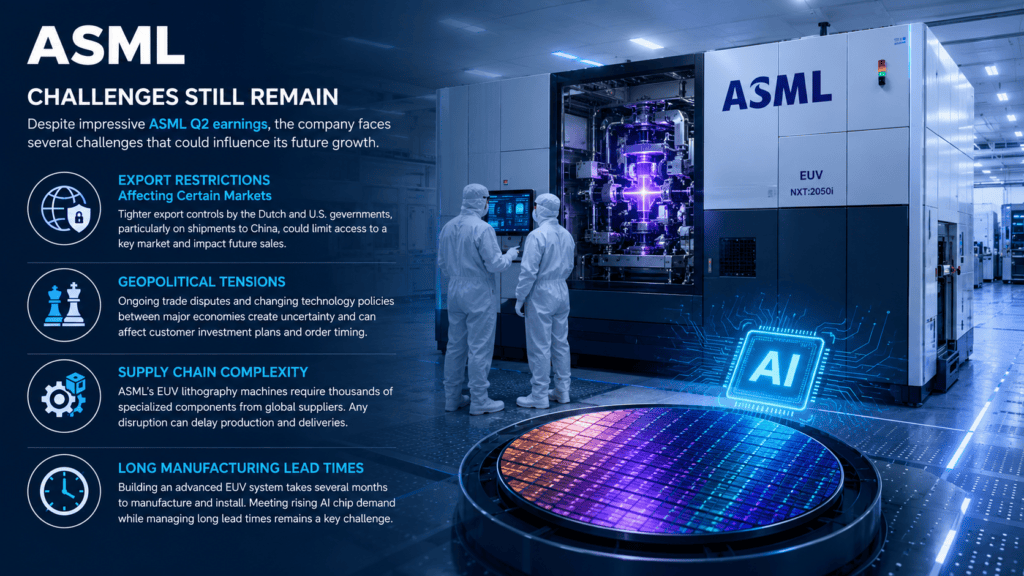
Despite impressive ASML Q2 earnings, several risks remain. The company continues navigating:
Export Restrictions Affecting Certain Markets
ASML continues to face export restrictions, particularly on shipping its most advanced EUV lithography systems to China. These regulations, introduced by the Dutch and U.S. governments, limit access to one of the world’s largest semiconductor markets. While ASML still serves customers in many regions, tighter export controls could affect future revenue opportunities.
Geopolitical Tensions
Rising geopolitical tensions between major economies, especially the United States and China, continue to create uncertainty for the global semiconductor industry. Changes in trade policies, technology regulations, and international relations can influence customer investment decisions and delay large semiconductor projects.
Supply Chain Complexity
ASML’s machines are among the most advanced manufacturing systems ever built, consisting of thousands of precision components sourced from suppliers worldwide. Any disruption in the global supply chain—whether caused by logistics issues, material shortages, or supplier delays—can impact production schedules and equipment deliveries.
Long Manufacturing Lead Times
Manufacturing an advanced EUV lithography system is a highly complex process that takes several months from production to installation. As AI chip demand continues to rise, managing long lead times while meeting increasing customer orders remains one of ASML’s biggest operational challenges.
Despite these headwinds, ASML’s technological leadership and strong demand from leading chipmakers position the company well for long-term growth.
What This Means for the Future
The latest ASML Q2 earnings reinforce a simple reality: AI is no longer just about software. Every breakthrough in generative AI depends on increasingly powerful chips, and those chips require advanced manufacturing equipment.
As long as AI chip demand continues growing, companies like ASML will remain central to the future of computing. The latest ASML earnings report confirms that the AI infrastructure boom is still creating enormous opportunities throughout the semiconductor industry.
Conclusion
The strong ASML Q2 earnings demonstrate that the AI hardware boom is still gaining momentum.
With continued AI chip demand, leadership in EUV lithography, and an essential position within the global semiconductor industry, ASML continues to benefit from one of technology’s biggest long-term trends.
While economic and geopolitical risks remain, the latest ASML earnings report shows that demand for advanced chip manufacturing equipment remains remarkably resilient.
For businesses, investors, and technology leaders, ASML Q2 earnings offer valuable insight into where the AI economy is heading next.
Frequently Asked Questions
1. What were the highlights of ASML Q2 earnings?
ASML Q2 earnings exceeded analyst expectations, reporting €9.33 billion in revenue and €2.92 billion in net income. The strong performance was largely driven by continued investments in AI infrastructure and advanced chip manufacturing.
2. Why is AI chip demand important for ASML?
Growing AI chip demand increases the need for advanced semiconductor manufacturing equipment. Since ASML supplies the world’s most advanced lithography machines, higher AI chip production directly benefits the company.
3. What is EUV lithography?
EUV lithography (Extreme Ultraviolet Lithography) is a cutting-edge chip manufacturing technology that enables chipmakers to produce smaller, faster, and more power-efficient processors used in AI, smartphones, and high-performance computing.
4. Why does the semiconductor industry follow ASML closely?
The semiconductor industry closely watches ASML because its equipment is essential for manufacturing advanced chips. Strong orders for ASML machines often indicate rising demand across the entire chip market.
5. Which companies are ASML's biggest customers?
ASML’s major customers include TSMC, Samsung, Intel, SK Hynix, and Micron. These companies rely on ASML’s advanced lithography systems to manufacture next-generation semiconductor chips.
6. How does ASML benefit from the AI boom?
The rapid growth of artificial intelligence is increasing demand for high-performance chips used in AI data centers and cloud computing. As chipmakers expand production, they require more ASML equipment, creating long-term growth opportunities for the company.
7. What challenges could affect ASML's future growth?
ASML faces several challenges, including export restrictions to certain markets, geopolitical tensions, complex global supply chains, and long manufacturing lead times for its advanced lithography systems.
8. What does ASML's strong Q2 performance mean for investors?
Strong ASML Q2 earnings suggest that AI infrastructure spending remains robust and demand for advanced chipmaking equipment continues to grow. Many investors view ASML’s results as a positive indicator for the future of the global semiconductor market.
Topics to follow: Current Affairs & Insights Tech Innovation GenZ entrepreneurship Collaborative Fashion GEO AI Agentic SME