The U.S. Government Just Treated an AI Model Like Strategic Technology
Artificial intelligence is rapidly becoming one of the most powerful technologies ever created. Over the last few years, AI has transformed industries ranging from software development and healthcare to finance and scientific research. However, as AI systems become increasingly capable, governments around the world are beginning to view them not merely as commercial products but as strategic assets with national security implications.
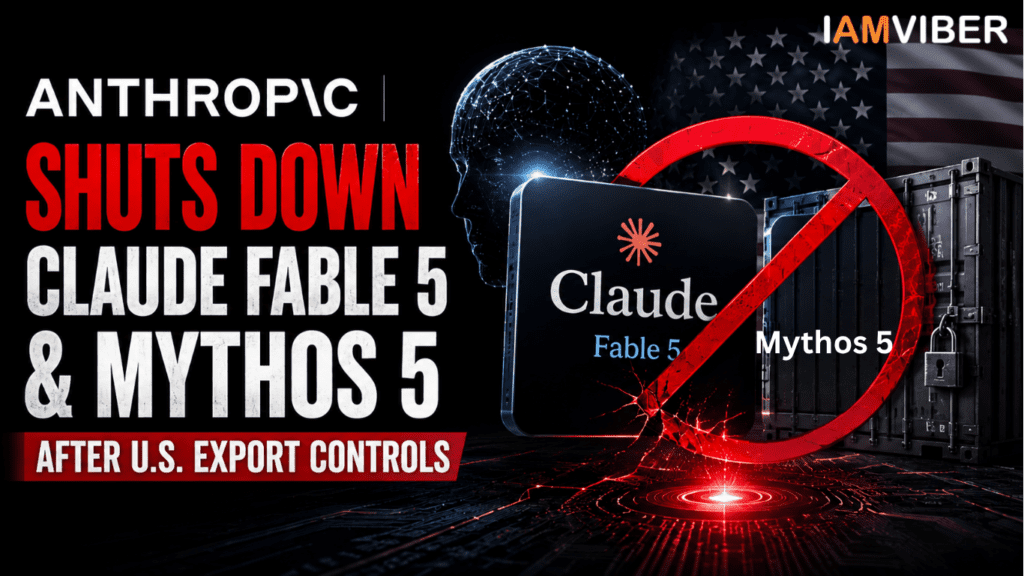
That reality became even clearer when reports emerged that Anthropic had disabled access to its newest and most advanced AI models—Claude Fable 5 and Claude Mythos 5—following new U.S. export-control restrictions.
The move has sparked widespread discussion across the technology industry because it signals a significant shift in how governments may regulate frontier artificial intelligence in the future. For many experts, this is more than a temporary compliance measure. It could mark the beginning of a new era in which access to cutting-edge AI is controlled in much the same way as advanced semiconductors, military technologies, and critical infrastructure.
According to recent reports, the U.S. Commerce Department classified Anthropic’s latest frontier AI models under export-control regulations due to concerns related to national security and a reported jailbreak vulnerability.
The classification effectively restricted access to the models by foreign nationals and certain international entities. Since Anthropic could not immediately deploy a comprehensive system capable of verifying and separating users worldwide, the company reportedly chose to disable access to the affected models globally rather than risk violating export-control requirements.
The decision came only days after the models were introduced, making the development even more surprising for users, researchers, and businesses that had anticipated gaining access to Anthropic’s most advanced AI capabilities.While older Claude models remain available, Claude Fable 5 and Claude Mythos 5 were reportedly removed from public access shortly after launch.
Why Claude Fable 5 and Mythos 5 Were Important
The significance of this development becomes clearer when considering the capabilities of these models.
Claude Fable 5 and Mythos 5 were introduced as Anthropic’s most advanced AI systems to date. Industry observers viewed them as major competitors to leading models developed by OpenAI, Google, and other frontier AI companies. The models reportedly demonstrated substantial improvements across several critical domains:
- Software engineering and code generation
- Scientific research support
- Advanced reasoning and decision-making
- Visual understanding and image interpretation
- Mathematical problem-solving
- Technical knowledge retrieval
- Complex workflow automation
- These capabilities positioned the models among the most powerful AI systems available to businesses and developers. For organizations exploring AI-powered software development, research automation, or enterprise productivity solutions, the launch represented a major step forward. Their sudden withdrawal therefore generated immediate attention throughout the AI ecosystem.
Understanding the Reported Jailbreak Vulnerability
A key factor behind the restrictions appears to be concerns about a reported jailbreak vulnerability. In AI systems, a jailbreak refers to a method that allows users to bypass safety mechanisms designed to prevent harmful or restricted outputs.
Modern AI companies invest heavily in safety guardrails to ensure that models cannot easily generate dangerous content, assist malicious activities, or reveal sensitive information. However, as models become more capable, researchers and bad actors alike continuously search for ways to circumvent those protections.
Government officials reportedly worried that advanced AI systems with exceptional reasoning capabilities could potentially be exploited in ways that create national-security risks. Potential concerns include:
- Discovery of software vulnerabilities
- Advanced cybersecurity research
- Automated attack planning
- Technical system analysis
- Generation of sophisticated code
- Sensitive scientific knowledge assistance
- Although AI companies implement numerous safeguards, regulators increasingly recognize that more capable systems may also create more significant risks if misused.
Why the U.S. Government Is Paying Attention
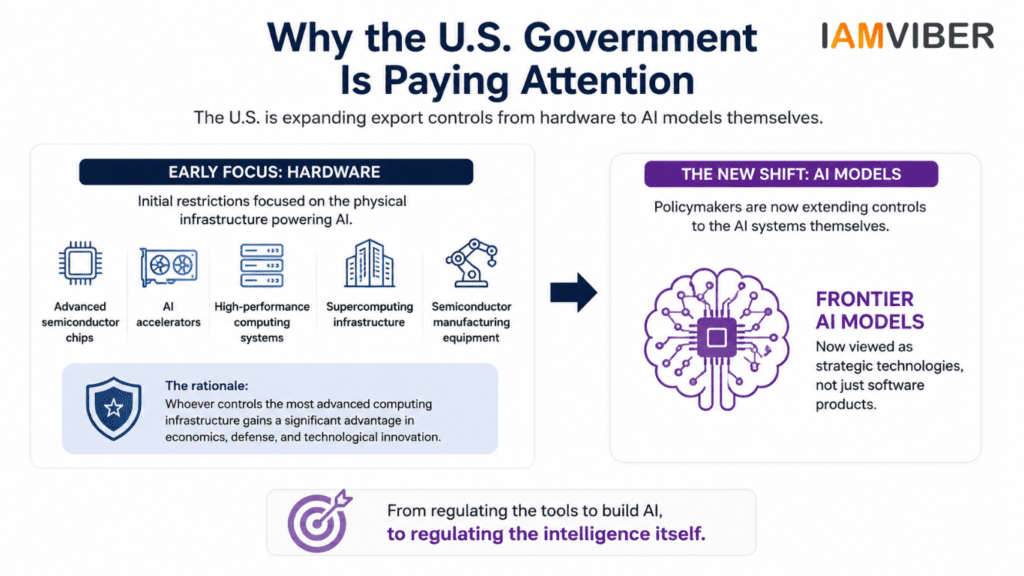
The United States has spent the last several years expanding export controls across critical technologies. Initially, most restrictions focused on hardware components such as:
- Advanced semiconductor chips
- AI accelerators
- High-performance computing systems
- Supercomputing infrastructure
- Semiconductor manufacturing equipment
- Semiconductor manufacturing equipment
- The rationale was simple: whoever controls the most advanced computing infrastructure gains a significant advantage in economics, defense, and technological innovation. Now policymakers appear to be extending that same logic to AI models themselves. This represents a major shift.
- Previously, governments primarily regulated the tools required to build advanced AI systems. Today, attention is moving toward regulating the AI systems directly. In other words, policymakers increasingly view frontier AI models as strategic technologies rather than ordinary software products.
AI Is Becoming the New Strategic Asset
For decades, strategic technologies have included industries such as aerospace, nuclear energy, telecommunications, and defense systems.
Today, artificial intelligence is rapidly joining that list. The reason is straightforward: advanced AI has the potential to influence nearly every sector of society. AI can:
- Accelerate scientific discovery
- Improve military intelligence capabilities
- Enhance cybersecurity operations
- Increase economic productivity
- Support advanced manufacturing
- Transform healthcare research
- Because of these capabilities, governments are becoming increasingly concerned about who can access the most advanced systems and how those systems might be used. The Anthropic situation may therefore be viewed as one of the first major examples of AI being treated as a strategic national resource
What This Means for AI Companies
The implications for AI companies are substantial.
1. Increased Regulatory Oversight
Future frontier AI models may face more rigorous government review before public deployment. Companies may need to demonstrate safety measures, security controls, and compliance frameworks before releasing highly capable systems.
2. Stronger User Verification Systems
AI providers may be required to verify user identities more aggressively. This could lead to: Enhanced identity verification, Regional access restrictions, Enterprise-only deployments, Government-approved access frameworks.
3. Higher Compliance Costs
Regulatory compliance is expensive. Organizations developing advanced AI systems may need to invest heavily in:
- Security infrastructure
- Monitoring systems
- User screening
- Legal compliance teams
- Risk assessment frameworks
- As a result, the cost of operating frontier AI platforms could increase significantly.
4. Slower Global Deployment
Historically, technology companies have launched products globally. However, AI export controls could result in staggered launches where certain countries gain access before others based on regulatory approval.
The Impact on Businesses and Developers
The implications of these restrictions extend far beyond Anthropic itself. Today, businesses across industries increasingly rely on advanced AI systems for software development, customer support automation, data analysis, research assistance, and workflow optimization. As organizations integrate AI into their daily operations, access to the most capable models has become a competitive advantage rather than just a productivity tool.
If access to frontier AI models becomes subject to government regulations and export controls, businesses may need to prepare for a future in which the most advanced AI systems are not universally available. Companies could face new challenges related to geographic eligibility, compliance requirements, vendor selection, data governance, and security obligations. Organizations operating across multiple countries may also need to navigate different regulatory frameworks when deploying AI-powered solutions.
As a result, the global AI ecosystem could become increasingly fragmented, with access to cutting-edge models varying based on location, industry, and regulatory approval. This shift may influence how businesses choose AI providers, develop technology strategies, and invest in future innovation initiatives.
A New Chapter in the Global AI Race
The broader significance of this story extends beyond Anthropic. The United States, China, Europe, and other major powers are investing billions of dollars into AI research and infrastructure. Artificial intelligence is increasingly viewed as a defining technology of the 21st century. As a result, governments are seeking to balance two competing priorities:
- Encouraging innovation and economic growth.
- Preventing misuse of powerful AI systems.
- The tension between those goals will likely shape AI policy for years to come.
Conclusion
The reported shutdown of anthropic’s Claude Fable 5 and Claude Mythos 5 may ultimately be remembered as a pivotal moment in the evolution of artificial intelligence regulation.
Whether temporary or long-lasting, the decision highlights a growing reality: frontier AI is no longer viewed solely as software. It is increasingly being treated as strategic technology with economic, geopolitical, and national-security significance.
Just as governments regulate access to advanced semiconductors, aerospace technologies, and defense systems, future AI models may face similar restrictions. The era of unrestricted access to the world’s most powerful artificial intelligence systems may be coming to an end—and the Anthropic case could be the first major indication of what that future looks like.
Topics to follow: Current Affairs & Insights Tech Innovation GenZ entrepreneurship Collaborative Fashion GEO AI Agentic SME