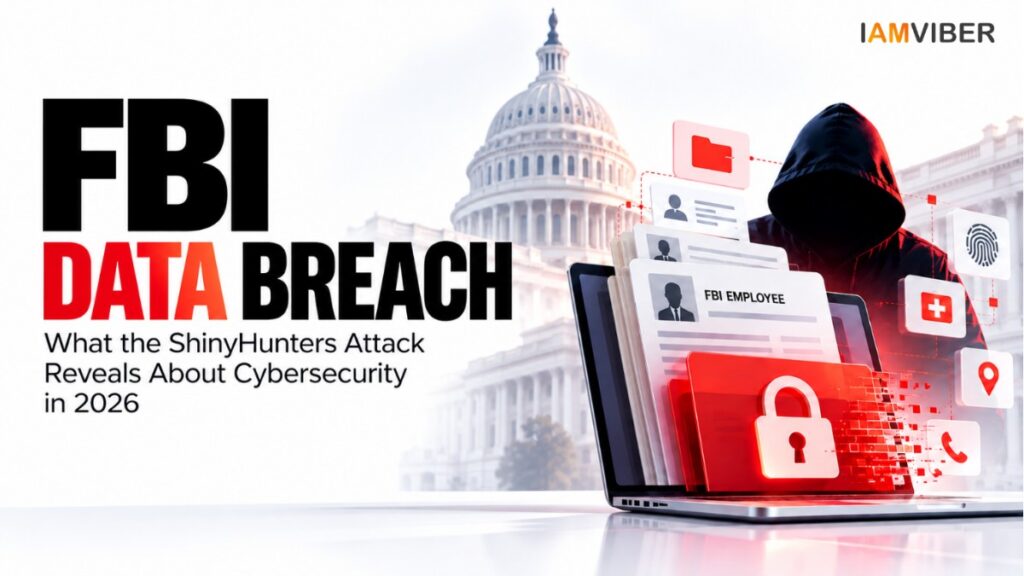
A new data breach involving the FBI is putting cybersecurity, employee privacy and enterprise software security back into the global spotlight.
On September 22, 2026, the cybercriminal group ShinyHunters claimed that it had compromised systems connected to the FBI’s jobs and recruitment infrastructure and stolen sensitive information relating to current and former FBI personnel and applicants. The FBI has confirmed that it is investigating claims of unauthorized activity affecting FBIJobs.gov, but it has not independently confirmed the full scope of the alleged breach.
The incident has become particularly significant because the alleged attack involves Oracle PeopleSoft, an enterprise platform widely used for human-resources and financial-management functions.
At the same time, Google’s cybersecurity researchers have reported that ShinyHunters-linked actors have renewed exploitation of a vulnerability in Oracle PeopleSoft, expanding attacks against organizations around the world.
That combination has turned this data breach into a much bigger cybersecurity story than a single compromised website.
What happened in the FBI data breach?
The incident began when ShinyHunters claimed it had gained access to FBI-related systems and stolen information belonging to employees and job applicants.
The group subsequently defaced the FBI’s jobs website and published messages directed at FBI officials. The agency’s recruitment website was taken offline while the investigation continued.
ShinyHunters claimed to have obtained between 2 and 3 terabytes of data relating to FBI and Justice Department workers. The group said the access involved systems associated with areas including human resources and employee-related services. However, those claims have not been independently verified in their entirety.
This distinction is important.
A cybercriminal group’s claim of a data breach does not automatically establish that every claimed record came from the organization named by the attackers.
The FBI has said the point of compromise was still being determined and that investigators were working with third-party providers supporting FBIJobs.gov.
That means the investigation is still critical to determining exactly what happened, what systems were affected and how much information may have been exposed.
What information may have been exposed?
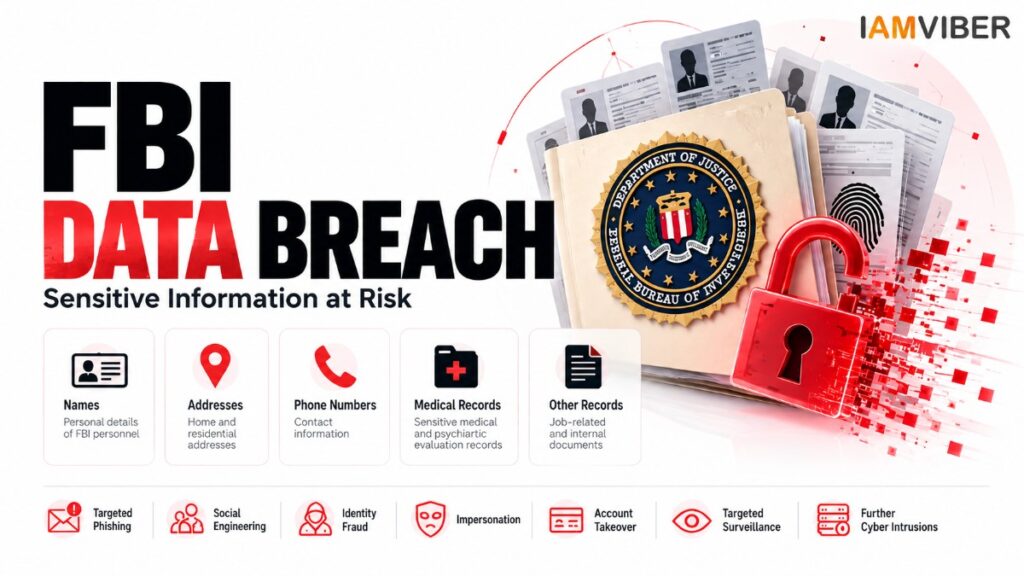
The potential sensitivity of this data breach comes from the type of information reportedly involved.
Reports based on samples supplied by the attackers say some records appeared to correspond to real FBI or Justice Department personnel. 404 Media reported that a sample of thousands of alleged records contained names, addresses and phone numbers, among other information.
Reported that materials supplied by the hackers included sensitive medical and psychiatric evaluation records, although the origin and complete scope of the dataset remain under investigation.
If verified, exposure of this type of information could create risks that extend beyond ordinary identity theft.
Employee information can potentially be used for:
–
- Targeted phishing
- Social engineering
- Identity fraud
- Impersonation
- Account takeover attempts
- Targeted surveillance
- - Further cyber intrusions
For law-enforcement personnel, the consequences of exposed personal information could be particularly sensitive because criminals may attempt to use employee or family information to establish credibility in targeted attacks.
Cybersecurity researchers quoted by Recorded Future News have also raised concerns about stolen information being sold or reused by other criminal or state-linked actors.
Why ShinyHunters is at the center of the story
The ShinyHunters name has appeared in multiple major cyber incidents involving large organizations.
The group has been associated with attacks involving corporate platforms, cloud services and large-scale data theft. Security researchers often describe ShinyHunters not as one completely fixed organization but as a shifting ecosystem of actors.
That makes attribution and verification especially important.
The group has also been involved in a broader campaign targeting enterprise applications.
In September 2026, Google’s cybersecurity team reported that ShinyHunters-linked actors had resumed mass exploitation of an Oracle PeopleSoft vulnerability. Google said attackers were modifying their techniques to bypass defenses introduced after earlier attacks.
This development is important because PeopleSoft is not simply a consumer-facing website.
It is enterprise infrastructure.
Organizations use platforms like PeopleSoft for highly sensitive business processes, including human resources, payroll and financial management.
That makes an Oracle PeopleSoft vulnerability potentially valuable to attackers because compromising one enterprise application can provide a pathway to information far beyond a single public webpage.
The Oracle PeopleSoft vulnerability connection
One of the biggest unanswered questions surrounding the FBI data breach is exactly how attackers obtained access.
ShinyHunters claimed that a previously unknown vulnerability in Oracle PeopleSoft was involved.
Reported that the hackers said they used a new PeopleSoft vulnerability, while the FBI said the point of compromise had not yet been determined.
Google’s threat-intelligence team has separately documented exploitation of an Oracle PeopleSoft zero-day by ShinyHunters-linked actors.
Google’s cybersecurity unit said the group had renewed mass exploitation of the vulnerability and was targeting organizations globally.
The timing has naturally increased scrutiny around the FBI incident.
However, it is important not to automatically conclude that the same vulnerability definitively caused the FBI compromise.
That connection remains an investigative question.
Why this data breach matters beyond the FBI
The bigger lesson from this data breach is about the security of enterprise software.
Modern organizations often depend on dozens or hundreds of third-party platforms.
A company may have strong internal security controls while still relying on external systems for:
- Human resources
- Payroll
- Recruitment
- Customer management
- Cloud infrastructure
- Authentication
- Financial operations
- Data storage
This creates a complicated security environment.
A vulnerability in one widely deployed enterprise product can potentially affect many organizations simultaneously.
That is exactly why the renewed PeopleSoft campaign is receiving attention from cybersecurity researchers.
Google has reported that ShinyHunters-linked actors have expanded their attacks against organizations using PeopleSoft, demonstrating how quickly attackers can move from one vulnerable technology ecosystem to another.
The FBI incident therefore becomes part of a broader story about cybersecurity supply chains and enterprise software.
Data breach vs. cyber attack: what's the difference?
The terms are often used interchangeably, but they describe different things.
A cyber attack refers broadly to an attempt to compromise a computer system, network, application or organization.
A data breach specifically concerns unauthorized access to or exposure of information.
A cyber attack can happen without confirmed data theft.
Similarly, information can be exposed through misconfiguration, insider activity, compromised credentials or a third-party provider without a conventional malware attack.
In the FBI case, investigators are still determining the exact mechanism and scope of the incident.
That distinction matters because understanding how an attacker entered a system determines what organizations need to change to prevent similar incidents.
What organizations can learn from the FBI incident
The emerging story provides several practical cybersecurity lessons.
1. Third-party security is part of your security
Organizations cannot treat vendors as completely separate from their own cybersecurity strategy.
If a third-party platform handles employee or customer information, its security architecture becomes part of the organization’s risk profile.
2. Patch management needs to move quickly
Zero-day vulnerabilities create an especially difficult challenge because defenders may have little or no warning before exploitation begins.
Organizations need processes that allow security teams to identify affected systems and deploy mitigations quickly.
3. Sensitive data needs additional protection
Not every database should be treated equally.
Employee addresses, contact information, identity documents and medical information require stronger controls than ordinary operational data.
4. Monitoring should extend beyond the network
Attackers increasingly combine technical compromises with social engineering.
Monitoring suspicious logins, unusual downloads, privilege changes and unexpected access patterns can help organizations identify attacks earlier.
5. Incident response must include employees
When sensitive employee information is potentially exposed, organizations need to communicate quickly.
Employees may become targets for phishing, impersonation and other attacks following a major data breach.
What happens next?
The most important development will be the FBI’s investigation into the alleged data breach.
The agency has said it is working with third-party providers while investigating unauthorized activity connected to FBIJobs.gov.
There are several questions that remain unanswered:
- Was the FBI’s internal infrastructure directly compromised?
- Was a third-party provider the entry point?
- How much data was actually accessed?
- How many individuals are affected?
- Was Oracle PeopleSoft directly involved?
- What information can be independently verified?
- Will additional data be published?
Until investigators establish those facts, some of the most dramatic claims surrounding the incident should be treated as allegations rather than confirmed findings.
That is especially important in cybersecurity reporting, where attackers sometimes exaggerate the scale of their access to pressure victims or attract attention. The FBI itself warned earlier in 2026 that actors using the ShinyHunters name may make real or exaggerated claims about access.
The bigger cybersecurity warning
The latest data breach story demonstrates how cybersecurity is changing.
The biggest risk is no longer limited to a hacker breaking into one company’s internal network.
Modern attacks can involve cloud platforms, enterprise software, third-party vendors, stolen credentials and interconnected systems.
One compromised technology provider can potentially become the starting point for attacks against multiple organizations.
That makes software security, vendor risk management and continuous monitoring increasingly important.
The FBI investigation will ultimately determine what happened in this specific case.
But the wider lesson is already clear: organizations need to assume that attackers will look for the weakest connection in their technology ecosystem.
And as enterprise applications become more interconnected, the consequences of a single vulnerability can travel much further than the original system.
Final takeaway
The FBI data breach claims involving ShinyHunters remain under investigation, and the full scope of the incident has not yet been independently established.
What is confirmed is that the FBI has acknowledged investigating unauthorized activity affecting its jobs website, while cybersecurity researchers have simultaneously documented renewed ShinyHunters-linked exploitation of Oracle PeopleSoft vulnerabilities.
For organizations, the story is a reminder that cybersecurity cannot stop at the company firewall.
Employees, vendors, enterprise software and sensitive databases are all part of the modern attack surface.
And in 2026, protecting data means protecting the entire ecosystem through which that data moves.
Topics to follow on IAMVIEBR : AI & Tech, Startup, AI Creative, Agentic AI, Current Affairs & Insights, Collaboration