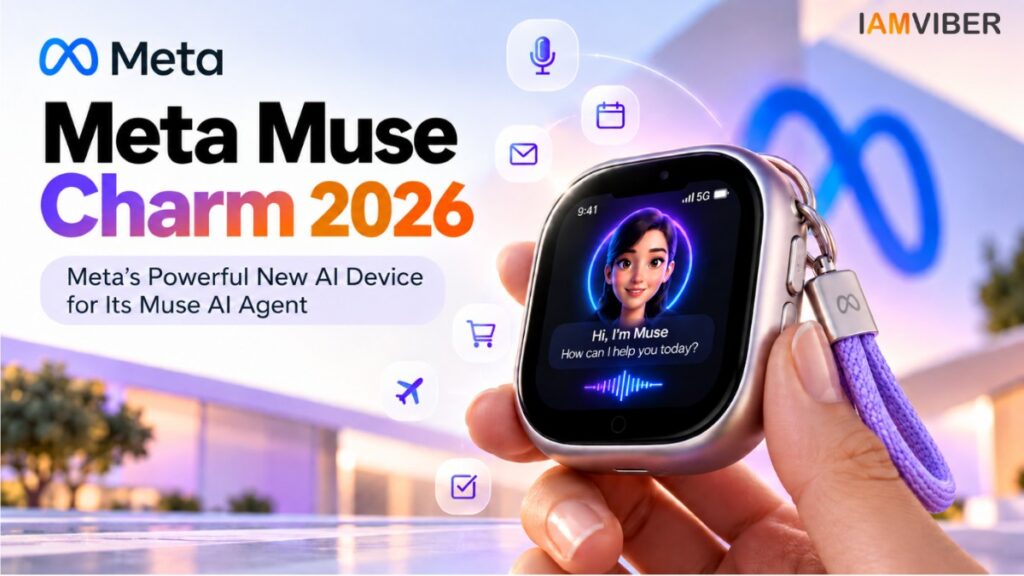
Meta Muse Charm is one of the most interesting hardware announcements from Meta Connect 2026, giving Meta’s newly launched personal AI agent a dedicated physical device. Meta says the product brings Muse and its latest real-time voice technology into a pocket-sized form factor, while Reuters reports that it is roughly the size of an Apple AirPods case, includes a roughly 2-inch touchscreen and has built-in 5G connectivity. Meta is targeting the holiday season in December 2026 for shipping, although it has not announced an official price yet.
The bigger story behind Meta Muse Charm is not simply the hardware itself. Meta is experimenting with a new way to access a personal AI agent without depending entirely on a conventional phone app.
What Is Meta Muse Charm?
Meta Muse Charm is a compact hardware device designed specifically for interacting with Meta’s Muse AI agent. Meta describes it as a device that brings the power of Muse and a state-of-the-art real-time voice model into something small enough to fit in a pocket. Meta’s official Connect recap says more information about the product will be shared later this year.
The device was revealed during the final part of Meta Connect 2026. Reported that the gadget is approximately the size of an AirPods case, features a roughly 2-inch touchscreen and includes a built-in 5G connection.
That positioning is important. This is not being presented as another general-purpose smartphone or tablet. Instead, the device is designed primarily as a dedicated gateway to a Muse AI agent.
Why Did Meta Build Meta Muse Charm?
To understand the thinking behind Meta Muse Charm, it helps to understand what Meta is trying to make Muse itself.
Meta launched Muse on September 8, 2026, describing it as a personal AI agent that can do more than answer questions. According to Meta, Muse can send emails, book travel, open a browser, fill out forms, help with long-term goals and continue working on tasks after a user closes the app. It can also return for approval before sensitive actions such as sending an email or making a purchase.
That means the most important product is not necessarily the device. It is the Meta AI agent running behind it.
Meta Muse Charm gives that agent a physical access point. The concept is straightforward: instead of unlocking your phone, opening an app and starting a conversation, you could interact with Muse through a device that is already nearby or attached to your keys.
How Does Meta Muse Charm Work?
Meta has not yet released the complete final technical specification, so some details remain unconfirmed.
What is clear is that the device is centered around voice interaction, a small screen and direct access to Muse. Reports from the event also describe fingerprint-based activation, allowing users to wake the device and begin talking to the assistant without opening a phone app.
The built-in 5G connection is another notable part of the hardware. Reuters says Meta’s device includes 5G, which suggests the company is aiming for a more independent connected experience rather than a simple Bluetooth accessory.
The broader idea is bigger than convenience.
Meta is testing whether an AI agent can become something people access as naturally as they access a phone, earbuds or keys.
Meta Muse Charm Features
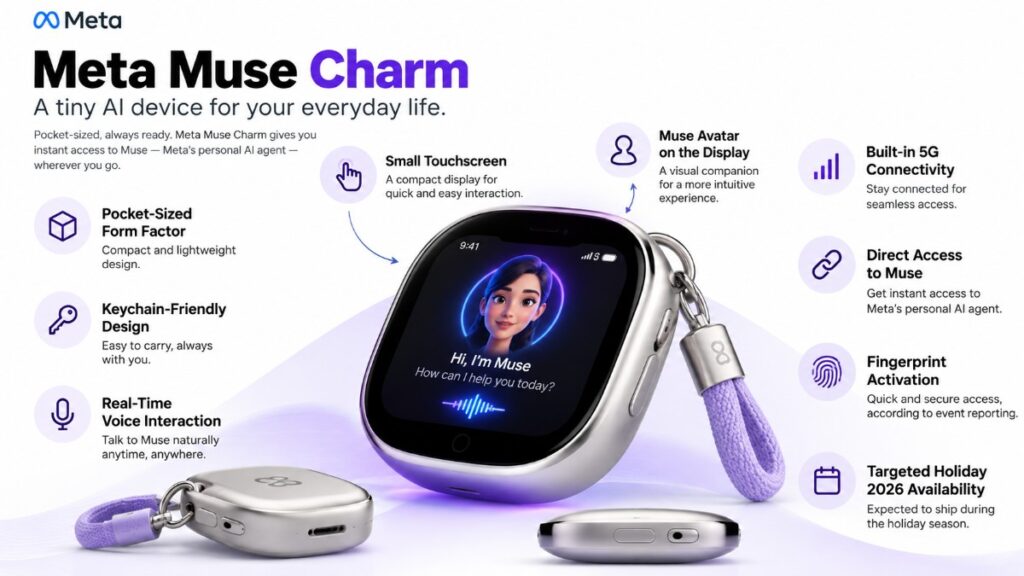
Based on Meta’s announcement and current reporting, the main known or reported features include:
- Pocket-sized form factor
- Keychain-friendly design
- Real-time voice interaction
- Small touchscreen
- Muse avatar on the display
- Built-in 5G connectivity
- Direct access to Muse
- Fingerprint activation, according to event reporting
- Targeted holiday 2026 availability
Meta has not yet disclosed the complete battery specification, final materials, official retail markets or final pricing. That means current reports should be treated as an early look at the product rather than a complete retail specification sheet.
Meta Muse Charm Price: How Much Will It Cost?
That is currently one of the biggest unanswered questions around the product. Meta is still finalizing parts of the hardware and has said additional details will come later this year.
There are already discussions online about where the device could sit in the market, but those are estimates rather than an official Meta figure.
For consumers searching for Meta Muse Charm price, the most accurate answer right now is simple: price not announced.
That also creates a natural opportunity for this article to be updated once Meta confirms pricing.
Meta Muse Charm Release Date
The current Meta Muse Charm release date is targeted around the holiday season in December 2026.
Reports that Meta plans to have the device ready to ship for the December holidays. Reported that Zuckerberg said the company still needed to finalize the component layout before the device was ready for shipment.
For now, December 2026 is the safest release window to report.
What Can Meta Muse AI Actually Do?
The hardware becomes much more interesting when connected to Meta Muse AI.
Meta says Muse is designed to act rather than simply respond. It can work with connected apps, use a browser, fill out forms, help coordinate goals and take actions on a user’s behalf. For longer tasks, it can continue working after the user leaves the app and return when a decision or approval is needed.
Meta also says Muse runs through Muse Secure VM, a dedicated cloud environment that contains the agent and user data. The environment includes its own browser, while a separate Sentinel system controls internet access and approval flows. Users can decide which apps Muse connects to and how much access it receives.
That architecture is what makes the device more than a traditional voice assistant.
The hardware is simply the interface. The intelligence and task execution come from the underlying Muse AI agent.
How Meta Is Expanding Its Muse AI Agent
Meta used Connect 2026 to expand the capabilities around its AI agent as well.
The company announced new features, connectors and updates to the model powering Muse. Meta’s Connect recap highlights a growing ecosystem covering shopping, travel and productivity, with services and partners including Shopify, Walmart, Best Buy, Sephora, Wayfair, Notion, GitHub, Granola and Box.
Muse is also accessible through multiple surfaces, including the Muse app, WhatsApp, the web and a Mac desktop version. Meta says its goal is to let people work with their personal AI across the devices and services they already use.
This ecosystem makes the hardware more interesting because the AI doesn’t have to stay trapped inside one application.
Meta Muse Charm and the Rise of AI Companion Devices
The arrival of Meta Muse Charm places Meta inside a rapidly developing category of AI companion device hardware.
The idea is different from a conventional smartwatch or smart speaker. An AI companion device is designed around continuous interaction with an AI system that can understand context and potentially perform actions.
Meta Muse Charm fits that model closely.
Instead of being built around dozens of traditional apps, its main purpose is to provide a quick path to an intelligent assistant.
That distinction could become increasingly important as agentic AI develops. Today’s AI products are often built around prompts. Tomorrow’s products may be built around delegation.
You don’t simply ask:
“What should I do?”
You ask:
“Do this for me.”
That is the shift Meta is trying to capture with Muse.
Why Meta Muse Charm Could Matter for Startups
For startups, the more interesting aspect of Meta Muse Charm may actually be the architecture behind the hardware.
AI companies are increasingly experimenting with agents that can search, plan, use tools and perform multi-step actions. Hardware creates an additional entry point for those agents.
That could eventually support products in areas such as:
- Travel planning
- Shopping automation
- Personal productivity
- Customer service
- Research
- Sales automation
- Enterprise copilots
- Personal finance workflows
The device doesn’t have to contain all of the intelligence locally.
It can function as a lightweight interface connected to powerful cloud-based AI.
That model could inspire a wider generation of AI-native products: small hardware, powerful models and agentic software working together.
Meta Muse Charm vs a Normal AI App
A traditional AI application usually requires the user to open an app, type or speak a request and wait for an answer.
Meta Muse Charm is attempting to reduce that friction.
A dedicated device can stay nearby, provide a persistent interface and make access to an AI agent feel closer to having a personal assistant available at any moment.
But the business case still depends on whether users feel the convenience is worth carrying additional hardware.
A smartphone already provides access to multiple AI assistants. So Meta has to prove that a dedicated AI companion device can create enough additional value to justify itself.
Will People Pay for a Dedicated AI Device?
This may be the biggest question around the launch.
People already have AI on smartphones, computers, browsers and messaging platforms. A new device therefore needs to provide something those existing products do not provide as effectively.
Meta appears to be betting on instant accessibility.
Instead of thinking about AI as a destination you visit, Meta wants users to think about it as something that is simply there.
The missing pieces are still important, however.
Price, battery life, final specifications, connectivity details and retail availability have not been fully disclosed.
Until those details arrive, it is too early to judge the consumer proposition.
What Happens Next?
The immediate milestone is the December 2026 holiday target.
Before that, Meta is expected to reveal more information about pricing, hardware specifications, availability and the final software experience.
The company could also add more capabilities and integrations to Muse before the device ships.
That matters because the usefulness of the hardware depends heavily on how capable the Meta AI agent becomes.
If Muse continues gaining the ability to coordinate more complex tasks, the dedicated device may become more useful.
If the software remains limited, the hardware may feel less necessary.
The Bigger Story Behind Meta Muse Charm
Meta Muse Charm arrives at a moment when AI is moving from conversational systems toward systems that can actually execute work.
Meta launched Muse only recently, but it has already positioned the product around task completion, long-term goals and personal context. Meta says users can tell Muse what needs to be done and allow it to take action with appropriate permissions.
That is a major conceptual change.
A chatbot is something you ask.
An agent is something you delegate to.
The new device simply makes that delegation more physical.
Meta Muse Charm therefore represents more than another piece of AI hardware. It is a test of whether personal AI can move from a screen-based experience into an always-available computing interface.
Final Takeaway
Meta Muse Charm is a small device built around a much larger idea: personal AI that is available whenever people need it.
Meta is combining a pocket-sized form factor, real-time voice interaction and its Muse personal AI agent into one dedicated interface. The company is targeting holiday shipping in December 2026, while official pricing and several final technical details are still pending.
The most important part of the story isn’t just the gadget. It is what the gadget represents.
AI agents are increasingly being designed to perform tasks, interact with services and manage workflows. Meta Muse Charm gives one of those agents a physical home.
And that could be an early sign of where personal AI hardware is heading next.
Frequently Asked Questions
1. What is Meta Muse Charm?
Meta Muse Charm is a compact hardware device designed to let users interact directly with Meta’s Muse personal AI agent.
2. When will Meta Muse Charm launch?
Meta is targeting the holiday season in December 2026, although an exact launch date has not been announced.
3. How much will Meta Muse Charm cost?
Meta has not announced an official price yet.
4. What can Meta Muse AI do?
Meta says Muse can handle tasks including email, travel planning, browser-based actions, shopping and longer-term goals, with permissions for sensitive actions.
5. Is Meta Muse Charm a smartphone?
No. It is a dedicated AI companion device designed primarily as an access point to the Muse AI agent.
6. Does Meta Muse Charm have 5G?
The device includes built-in 5G connectivity.
7. What is the Muse AI agent?
Muse is Meta’s personal AI agent designed to take actions on a user’s behalf rather than simply answer questions.
8. Why is Meta building a dedicated AI device?
The device gives users a direct, physical way to access Muse without relying entirely on a traditional smartphone app interface.
Topics to follow on IAMVIEBR : AI & Tech, Startup, AI Creative, Agentic AI, Current Affairs & Insights, Collaboration