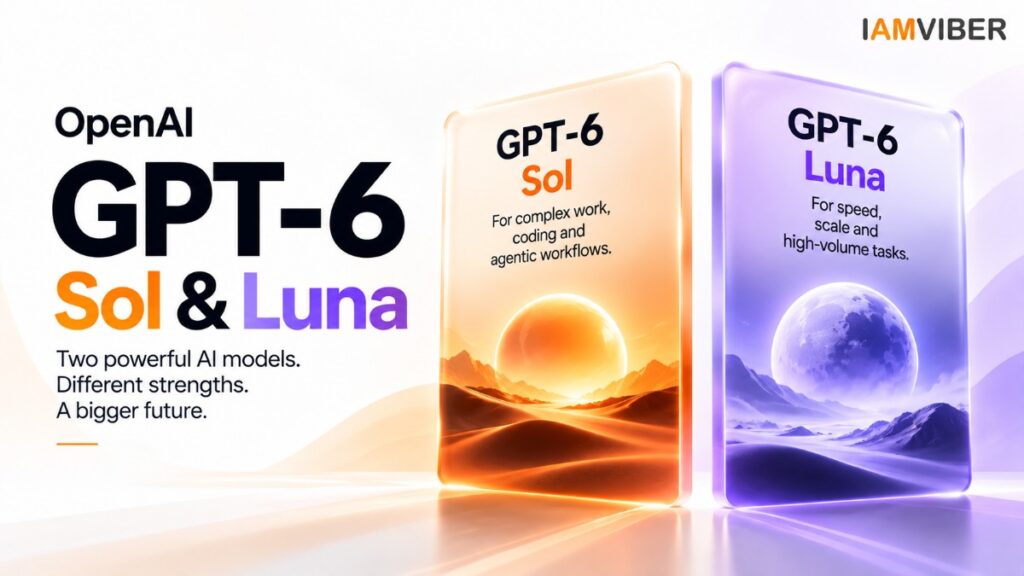
OpenAI has expanded its latest model family with GPT-6 Sol and GPT-6 Luna, two new AI models designed to bring advances from GPT-6 Astra into faster and more cost-efficient models. OpenAI announced both models on September 22, 2026, with availability across ChatGPT Work, Codex and the API.
The launch makes GPT-6 more than a single flagship model. Instead, OpenAI is building a broader family where different models can be selected according to the complexity, speed and cost of a task.
GPT-6 Sol is designed for complex professional work, coding and agentic workflows, while GPT-6 Luna is focused on fast, high-volume tasks such as summarisation, extraction and quick questions. OpenAI has also reduced the standard API pricing of both models by 50% compared with their GPT-5.6 counterparts.
For developers, startups and businesses, this may be one of the most important parts of the new release.
What Is GPT-6?
GPT-6 is OpenAI’s latest model generation, following the introduction of GPT-6 Astra earlier in September 2026. OpenAI introduced Astra on September 3 and described it as its most capable broadly deployed model. The company then expanded the family with Sol and Luna on September 22.
The GPT-6 family can now be understood as a portfolio rather than one model built for every situation.
Astra is positioned for the most demanding workloads. Sol brings advanced capabilities to complex work at lower cost, while Luna is designed for high-volume workloads where speed and economics are more important.
That makes GPT-6 particularly relevant for the next generation of AI applications, where companies may need several models working together rather than relying on one expensive model for every request.
Why Is GPT-6 Suddenly Trending?
The current interest around GPT-6 is being driven by a combination of new model releases, AI competition and growing interest in AI agents.
Google Trends reporting around the September 3 Astra launch showed “gpt 6” rising sharply, with more than 200,000 U.S. searches reported around the launch period. Related searches included “gpt 6 astra.”
That does not mean the same search volume exists in India today, and it should not be treated as a current India monthly-volume figure. However, it does show how quickly interest can surge around major OpenAI announcements.
The new Sol and Luna release has now created another search wave around queries such as GPT-6 Sol, GPT-6 Luna, pricing, API access and model differences.
GPT-6 Sol: Designed for Complex AI Work
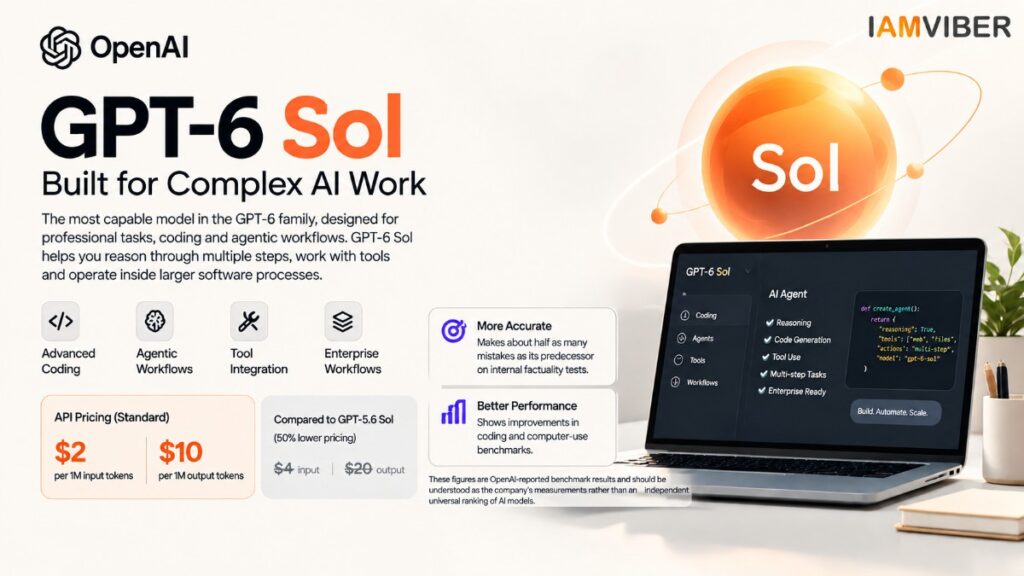
GPT-6 Sol is the more capable of the two newly introduced models.
OpenAI positions Sol for difficult professional tasks, coding and agentic workflows. These are use cases where an AI system may need to reason through multiple steps, work with tools or operate inside larger software processes.
The pricing is also designed to make those workloads more accessible. OpenAI lists GPT-6 Sol at:
- $2 per 1 million input tokens
- $10 per 1 million output tokens
That compares with $4 input and $20 output for GPT-5.6 Sol, representing a 50% reduction in standard token pricing.
OpenAI also says Sol makes about half as many mistakes as its predecessor on its internal factuality evaluation.
The company reports improvements in coding and computer-use benchmarks as well. These figures are OpenAI-reported benchmark results, so they are best understood as the company’s measurements rather than an independent universal ranking of AI models.
GPT-6 Luna: Built for Speed and Scale
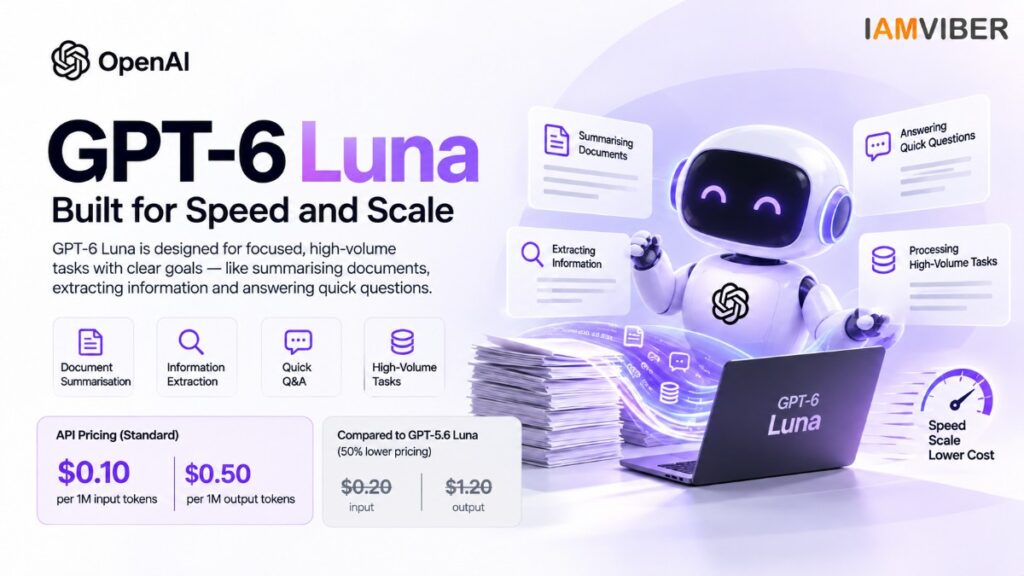
While Sol focuses on more complex workloads, GPT-6 Luna takes a different approach.
OpenAI describes Luna as a model for focused, high-volume tasks with clear goals. Examples include summarising documents, extracting information and answering quick questions.
Its pricing is significantly lower:
- $0.10 per 1 million input tokens
- $0.50 per 1 million output tokens
That is down from $0.20 input and $1.20 output for GPT-5.6 Luna.
For AI startups, this is important.
Imagine an application processing hundreds of thousands of customer messages, documents or structured data requests every month. Using a very expensive model for every request can quickly increase operating costs.
A low-cost model such as Luna can be used for routine workloads, while a more capable model can be reserved for difficult tasks. That creates the foundation for AI model routing.
GPT-6 vs GPT-5.6: What Has Changed?
The most noticeable changes are not only about intelligence. They are also about efficiency and cost.
OpenAI says Sol and Luna were trained with methods similar to those behind Astra, carrying over improvements in professional work, factuality, coding, computer use and alignment.
The other major difference is price.
Both models are officially listed at approximately 50% lower standard API pricing than their GPT-5.6 equivalents.
That could matter enormously for companies moving AI from experimentation into production. Lower model costs can allow businesses to:
- run more AI experiments
- process larger workloads
- increase automation
- build AI agents at lower cost
- support more users
- improve margins on AI-powered products
Of course, token pricing is not the complete cost of an AI product. Infrastructure, storage, retrieval, tool calls, engineering, monitoring and user behaviour can all contribute to total operating costs.
Still, lower inference pricing can change the economics of building with AI.
Is GPT-6 Available in ChatGPT?
There is an important distinction here.
According to OpenAI’s current rollout information, GPT-6 Sol and GPT-6 Luna are available in ChatGPT Work and Codex for Plus, Pro, Business, Enterprise and Edu users. Free and Go users can access Luna in the desktop app.
However, OpenAI says these models are not yet available in the regular Chat experience.
So someone searching for ChatGPT GPT-6 may expect to see Sol and Luna in the normal ChatGPT model picker and may instead find that availability depends on the product or workspace they are using.
Through the API, developers can access the models using: gpt-6-sol, gpt-6-luna
GPT-6 API: Why Developers Are Paying Attention
The API release may ultimately be more important for startups than the ChatGPT rollout.
The GPT-6 API gives developers access to Sol and Luna directly inside their own applications, platforms and automated workflows.
The lower pricing allows companies to think differently about architecture. For example, an AI startup could use Sol for:
- complex coding tasks
- difficult reasoning
- agentic workflows
- advanced professional processes
And Luna for:
- classification
- document extraction
- summarisation
- repetitive queries
- high-volume processing
This approach can reduce the cost of running AI applications because the most expensive model does not need to handle every request.
For SaaS companies, customer-support platforms, coding tools and AI agents, that type of model routing could become increasingly common.
Why GPT-6 Sol and Luna Matter for AI Agents
One of the biggest trends across the AI industry is the move from simple chatbots toward agentic AI.
An AI agent does more than generate an answer. It can potentially plan steps, interact with tools, navigate software and complete multi-stage workflows.
That changes what companies need from models.
They need models that can reason.
They need models that can use computers.
They need models that can work with tools.
And they need models that can do all of this at a sustainable cost.
GPT-6 Sol is specifically positioned around complex coding and agentic workflows, while OpenAI continues to position Astra as its strongest option for computer use.
This makes the GPT-6 family interesting for companies building AI employees, autonomous software workflows and intelligent business systems.
GPT-6 Sol vs GPT-6 Luna
The easiest way to understand the difference is to think about workload, not simply “which model is smarter.”
GPT-6 Sol is aimed at complex work, advanced coding, professional workflows and agentic tasks.
GPT-6 Luna is aimed at faster, focused and high-volume tasks where cost efficiency is critical.
For example, a developer working on a difficult software problem might choose Sol.
A company processing thousands of short documents may prefer Luna. A startup could potentially use both. This is why the new generation is less about choosing one universal AI model and more about selecting the right model for each task.
What GPT-6 Could Mean for Startups
For startups, the importance of GPT-6 goes beyond model performance.
The biggest opportunity could be the economics of AI.
When inference becomes cheaper, founders can experiment with more automated workflows without immediately facing large model bills.
This could support products such as:
AI customer-service agents, coding assistants, enterprise search tools, research automation, sales agents, document-processing platforms and vertical AI applications.
The result could be a broader shift from “AI feature” to AI-native product.
A company no longer has to use AI only as a chatbot sitting inside its software. AI can become part of the underlying workflow itself.
The Future of ChatGPT and OpenAI Models
The Sol and Luna launch also points toward a more specialised future for OpenAI.
Instead of using one model for every situation, users and companies can choose between models based on reasoning requirements, speed, task complexity and cost.
This approach makes sense as AI moves into coding, enterprise operations, research and autonomous software workflows.
In that environment, raw intelligence is only one part of the equation.
Cost per task, speed, reliability and tool usage can be equally important.
That is where the latest generation of GPT-6 models becomes interesting.
Final Takeaway
The latest OpenAI release expands the GPT-6 family beyond Astra with two models built around different workloads.
GPT-6 Sol targets complex professional, coding and agentic tasks, while GPT-6 Luna focuses on fast, high-volume workloads. OpenAI says both models bring improvements from Astra while cutting standard API pricing by 50% compared with the corresponding GPT-5.6 models.
For everyday users, access and model availability will be the biggest questions.
For developers and startups, the bigger opportunity may be cost-efficient AI at scale.
The next phase of the AI race is therefore not only about building more capable models. It is also about making useful intelligence cheap enough, fast enough and reliable enough to become part of everyday software.
And that is why the current GPT-6 conversation is much bigger than just another model launch.
Frequently Asked Questions
1. What is GPT-6?
GPT-6 is OpenAI’s latest model family, which currently includes GPT-6 Astra, GPT-6 Sol and GPT-6 Luna. The models are designed for different balances of capability, speed and cost.
2. What is GPT-6 Sol?
GPT-6 Sol is designed for complex professional work, coding and agentic workflows. OpenAI also highlights improvements in factuality, coding and computer-use capabilities.
3. What is GPT-6 Luna?
GPT-6 Luna is built for focused, high-volume tasks where speed and cost efficiency matter, including workloads such as summarization and information extraction.
4. What is the difference between GPT-6 Sol and GPT-6 Luna?
GPT-6 Sol targets more complex reasoning, coding and agent workflows, while GPT-6 Luna is optimized for faster and more cost-efficient high-volume tasks.
5. How much does the GPT-6 API cost?
OpenAI lists GPT-6 Sol at $2 per 1 million input tokens and $10 per 1 million output tokens. GPT-6 Luna is listed at $0.10 per 1 million input tokens and $0.50 per 1 million output tokens.
6. Is GPT-6 available in ChatGPT?
OpenAI’s current announcement says GPT-6 Sol and Luna are available through ChatGPT Work and Codex, with availability varying by plan. The models are also available through the API.
7. Is GPT-6 better for coding and AI agents?
GPT-6 Sol is specifically positioned for coding and agentic workflows, and OpenAI reports improvements on its coding and agent benchmarks compared with earlier models.
8. What is GPT-6 API used for?
The GPT-6 API allows developers to integrate Sol and Luna into their own applications, AI agents, automation systems and business workflows, choosing a model based on task complexity and cost requirements.
Topics to follow on IAMVIEBR : AI & Tech, Startup, AI Creative, Agentic AI, Current Affairs & Insights, Collaboration