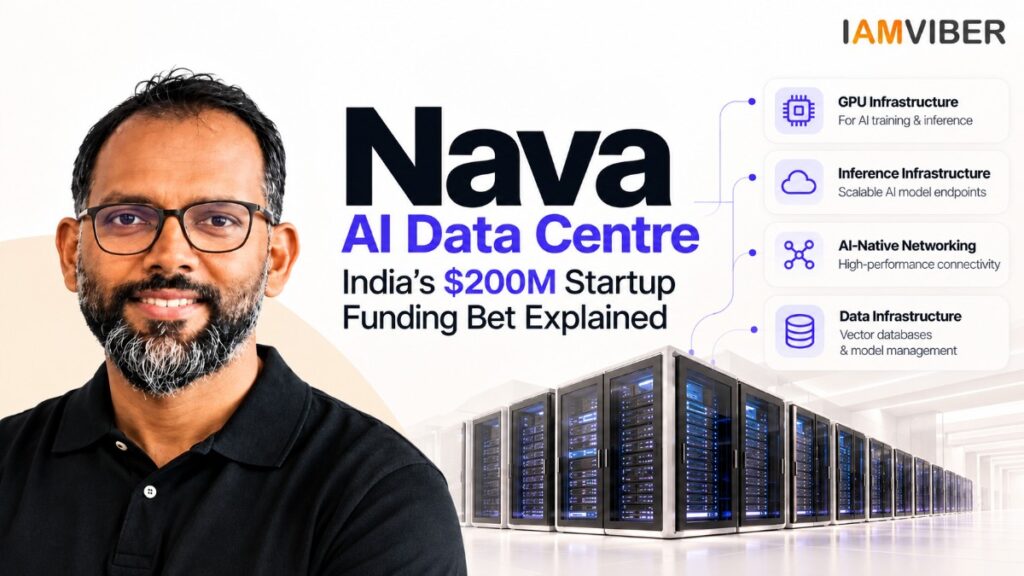
India’s artificial intelligence boom is entering a new phase. The opportunity is no longer limited to AI models, applications and SaaS products. Behind every advanced AI system is another layer that needs massive computing power, networking, storage, cooling and specialized infrastructure.
That is where Nava AI Data Centre is attracting attention.
According to a September 24, 2026 reports, Bengaluru-based Nava AI Data Centre, founded by former OYO executive Abhinav Sinha, is in talks to raise around $200 million (approximately ₹1,900 crore) from existing investor Greenoaks. The company is reportedly being valued at around $750 million (₹7,125 crore) in the ongoing discussions. The deal has not yet been formally announced, and the final terms could change.
If completed, the transaction would place Nava AI Data Centre among the notable recent funding stories in India’s AI and data-centre ecosystem.
What Is Nava AI Data Centre?
Nava AI Data Centre is an AI-native cloud and infrastructure company focused on providing infrastructure designed specifically for modern AI workloads.
On its official website, Nava describes itself as a cloud platform built for AI systems, with capabilities spanning AI factories, inference services, platform services, GPU infrastructure, networking and data platforms. Its stated mission is to build intelligent infrastructure for AI at scale.
The business was previously known as Kluisz before adopting the Nava identity as it expanded its ambitions around a full-stack “neo cloud” platform across APAC.
The company is therefore not simply another AI application startup. It is targeting the infrastructure layer underneath AI.
That distinction helps explain why Nava AI Data Centre has become interesting to investors at a time when computing demand is accelerating.
Why Is Nava Reportedly Raising $200 Million?
The main driver is the rapidly increasing infrastructure requirement created by artificial intelligence.
Training and serving advanced AI systems requires specialized GPUs, high-speed networking, large amounts of storage, electricity, cooling systems and software capable of coordinating compute resources.
Nava is building specifically around those requirements.
Its platform includes GPU infrastructure, AI-native networking, inference services and data capabilities designed for AI workloads. Nava says its GPU fabric is optimized for distributed training and inference, while its inference platform is designed to dynamically scale and balance model requests.
This gives Nava AI Data Centre a different positioning from a conventional cloud or data-centre business.
The opportunity is increasingly about making AI compute available as a managed, specialized infrastructure layer.
Who Founded Nava?
The founding team behind Nava AI Data Centre combines experience from enterprise technology, consulting, cloud infrastructure and large-scale operations.
Abhinav Sinha is CEO and co-founder. Nava’s official website identifies him as former COO and CPO at OYO, with previous experience at BCG and an academic background including Harvard and IIT Kharagpur.
Co-founder Vamshidhar Reddy is described by Nava as a former McKinsey partner and former AMD executive, with Stanford and IIT Kharagpur listed in his background.
Co-founder Abhijeet Singh is a former VP of Cloud Infrastructure at Jio and has also worked at AT&T, according to Nava.
For Nava AI Data Centre, that combination of cloud, infrastructure, semiconductor and enterprise experience forms an important part of its positioning.
Nava Startup Funding: From Earlier Capital to a Potential $200M Round
The latest story becomes more significant when viewed through the company’s previous fundraising.
In March 2026, Moneycontrol reported that the then-Kluisz was in advanced discussions to raise around $25 million from Greenoaks and other investors.
Later, Abhinav Sinha publicly said the company had raised approximately $22 million led by Greenoaks, with continued support from RTP Global and Unicorn India Ventures. He also said the business was expanding toward a full-stack neo-cloud platform across APAC and hiring in areas including AI data-centre architecture, power and cooling, GPU engineering, networking and orchestration.
That earlier round gives context to the latest Nava funding 2026 story.
The reported $200 million transaction would represent a substantial step up in the amount of capital being considered for the company.
Reported that if the transaction materializes, it could become one of the larger recent Indian startup fundraises in AI and data-centre infrastructure.
What Does Nava Actually Build?
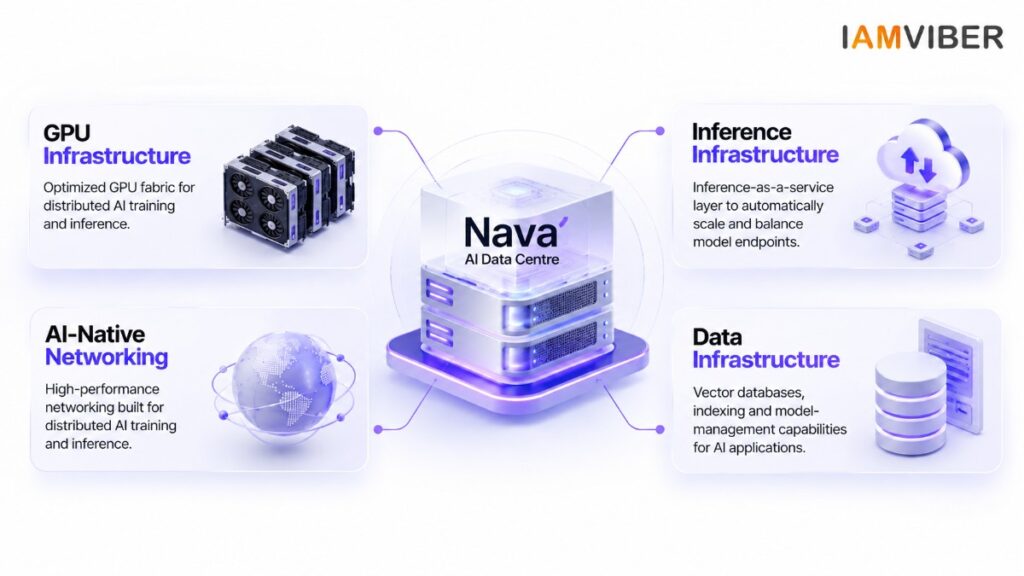
At the product level, Nava AI Data Centre is aiming to provide several layers of the infrastructure required to build and operate AI systems.
GPU Infrastructure
AI models depend heavily on specialized processors. Nava’s official platform describes a GPU fabric optimized for distributed AI training and inference.
Inference Infrastructure
Once AI models are deployed, they need to respond to user requests quickly and efficiently. Nava describes an inference-as-a-service layer designed to automatically scale and balance model endpoints.
AI-Native Networking
Large AI workloads often require multiple GPUs and machines to communicate rapidly. Nava says its networking infrastructure is designed specifically for distributed AI training and inference.
Data Infrastructure
Nava also provides data-platform capabilities including vector databases, indexing and model-management functionality for AI applications.
This means Nava AI Data Centre is pursuing a broader infrastructure stack rather than focusing on only physical server capacity.
Why AI Data Centres in India Are Becoming Important
The rise of AI data centres in India is closely connected to the growth of AI adoption.
An AI application may look like a software product to the end user, but behind it are physical machines consuming power, cooling capacity and network resources.
As Indian companies deploy AI agents, enterprise models and AI-powered applications, the demand for reliable compute infrastructure can increase.
That is creating a market for specialized infrastructure providers.
Recent financing activity supports the broader trend. The National Bank for Financing Infrastructure and Development has sanctioned more than ₹3,000 crore each to at least four data-centre projects, according to Economic Times, as AI-related capital expenditure accelerates.
In this environment, Nava AI Data Centre is targeting enterprises that want secure, scalable and AI-specific infrastructure.
The Greenoaks Connection
The potential transaction is also notable because Greenoaks is already an investor in Nava.
The reported deal therefore fits a follow-on investment pattern rather than being a first-time entry.
Greenoaks has previously increased its exposure to Indian companies after participating in earlier rounds, including investments involving companies such as Zetwerk, OYO and CRED.
For Nava AI Data Centre, a much larger follow-on round would provide access to significant new capital for infrastructure expansion.
However, it is important not to treat the reported investment as finalized. Moneycontrol said Greenoaks and Nava had not responded to its queries at the time of publication.
What Could $200 Million Mean for Nava?
If the reported transaction closes at approximately $200 million, Nava AI Data Centre could have substantially more resources to expand its AI-native cloud platform.
Potential areas of investment could include GPU capacity, data-centre infrastructure, networking, engineering, power and cooling systems and international expansion.
These are logical infrastructure requirements based on Nava’s existing product direction, although the company has not publicly announced the exact use of proceeds for the reported round.
India AI Infrastructure Is Becoming a Startup Opportunity
The broader India AI infrastructure story may be even more significant than the individual fundraising.
Historically, India’s startup ecosystem has been strongly associated with SaaS, consumer internet, fintech and software services.
AI is expanding that opportunity into physical infrastructure.
That includes GPU clouds, specialized data centres, networking platforms, inference infrastructure, energy systems, cooling technology and AI-focused software layers.
The funding being discussed for Nava AI Data Centre reflects this wider transition.
Reported that several $100 million-plus Indian startup rounds in 2026 have been concentrated around AI and data-centre infrastructure, suggesting that investors are becoming more comfortable making large bets in the category.
At the global level, the trend is even more visible.
Reported this month that AI infrastructure company Crusoe raised $3.9 billion at a $30.9 billion valuation, showing the scale at which capital is moving toward infrastructure supporting AI workloads.
How Is Nava Different From a Traditional Data Centre?
A conventional data centre primarily provides physical facilities for servers, power, cooling and connectivity.
Nava AI Data Centre is positioning itself as something broader: an AI-native cloud platform combining compute infrastructure with software services built around AI workloads.
Its platform covers GPUs, networking, inference, data management and security.
That matters because AI workloads have requirements that are not identical to traditional enterprise computing.
Model training can demand extremely high bandwidth between processors, while inference can require low latency and intelligent resource allocation.
Nava’s product architecture is designed around these requirements.
The Bigger AI Infrastructure Race
The rise of Nava AI Data Centre is part of a global race to build the infrastructure behind artificial intelligence.
Hyperscalers, semiconductor companies, cloud providers and specialized infrastructure startups are investing heavily in AI compute capacity.
The question is increasingly shifting from “Who has the best AI model?” to another important question:
Who can provide the infrastructure needed to run AI reliably and at scale?
India is now participating in that race through both infrastructure investment and startup development.
That makes Nava AI Data Centre relevant beyond its reported funding number. It represents an Indian startup attempt to build deeper into the technology stack that powers AI.
What Happens Next?
For Nava AI Data Centre, the key development to watch is whether the reported Greenoaks negotiations turn into a completed funding round and what the final valuation and terms look like.
If the transaction closes, it could give Nava additional capital to expand its AI-native cloud platform and infrastructure footprint across India and potentially other APAC markets.
Until an official announcement is made, however, the $200 million and $750 million valuation figures should be described as reported figures from ongoing negotiations rather than confirmed transaction terms.
That distinction is especially important for readers searching for Nava startup funding, because a reported deal and a closed funding round are not the same thing.
Conclusion: Why Nava Matters for India’s AI Future
Nava AI Data Centre is emerging at a time when the AI industry is moving beyond applications and into infrastructure.
The company is building an AI-native cloud platform covering GPUs, networking, inference, data services and enterprise infrastructure. Its founding team brings backgrounds from OYO, Jio, AMD, McKinsey and other technology and consulting environments.
The latest report says Nava AI Data Centre is in talks to raise around $200 million from existing investor Greenoaks at a reported valuation of around $750 million.
If completed, the deal would be another major signal that AI infrastructure is becoming a significant startup investment category in India.
More importantly, Nava AI Data Centre represents a shift in where Indian technology startups can create value: not only by building AI applications, but by building the computing infrastructure underneath them.
As demand for AI continues to expand, Nava AI Data Centre will be one company worth watching in the next chapter of India’s AI infrastructure story.
Topics to follow on IAMVIEBR : AI & Tech, Startup, AI Creative, Agentic AI, Current Affairs & Insights, Collaboration