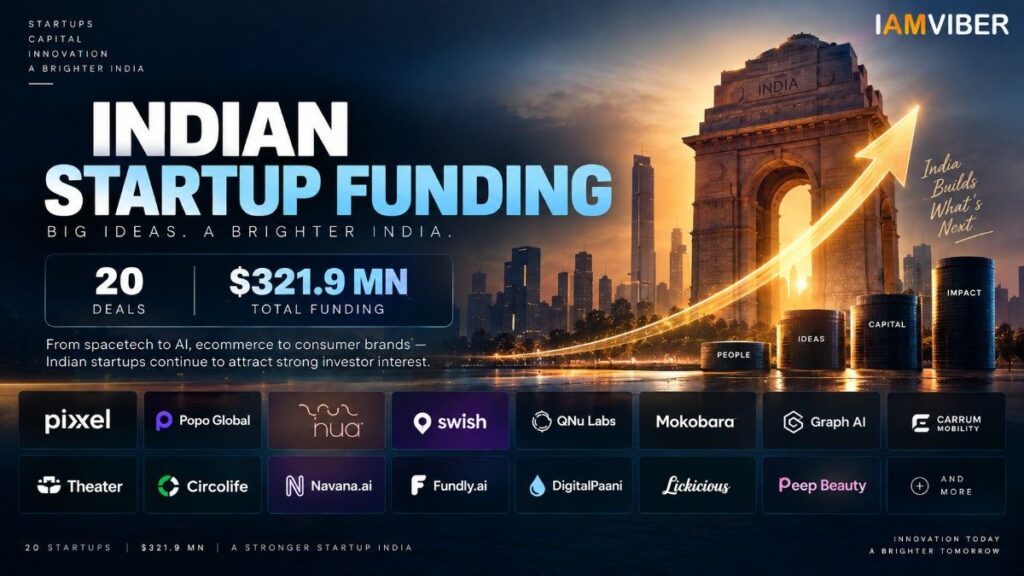
India’s startup ecosystem witnessed a sharp rebound in Indian startup funding during the second week of September 2026, as 20 startups collectively raised $321.9 million between September 7 and September 11.
The weekly funding pool was significantly higher than the $176.5 million raised by 22 startups during the previous week, marking an 82.4% increase in capital raised.
However, the headline number tells only part of the story.
The latest Indian startup funding data shows that investors are concentrating capital around companies operating in areas such as spacetech, advanced technology, ecommerce, artificial intelligence, quick commerce, cleantech and consumer services.
The biggest deal of the week came from spacetech company Pixxel, which raised $100 million. Ecommerce startup Nua followed with a $50 million round, while Popo Global raised $56 million.
This distribution provides an interesting picture of where investors are currently seeing growth opportunities in India’s startup ecosystem.
Indian Startup Funding: September 7–11, 2026
The following table provides a snapshot of the major Indian startup funding deals announced or recorded during the week.
| Date | Startup | Sector | Subsector | Funding | Round | Key Investors |
|---|---|---|---|---|---|---|
| 7 Sep 2026 | Pixxel | Advanced Hardware & Technology | Spacetech | $100 Mn | Series C | Temasek, Seraphim, 360 ONE Asset, IMM Investment, Radical Ventures, growX Ventures |
| 11 Sep 2026 | Popo Global | Foodtech | F&B | $56 Mn | — | Artal Asia |
| 7 Sep 2026 | Nua | Ecommerce | D2C | $50 Mn | Series C | Peak XV Partners, Filter Capital, Mirabilis Investment Trust, Footpath Ventures, Kae Capital, Lightbox VC |
| 10 Sep 2026 | Swish | Consumer Services | Quick Commerce | $24 Mn | — | Bertelsmann India Investments, Accel, Bain Capital Ventures, Hara Global |
| 9 Sep 2026 | QNu Labs | Advanced Hardware & Technology | — | $21 Mn | Series A | National Quantum Mission, Speciale Invest, Sony Innovation Fund, Gaja Capital, Artha Ventures |
| 5 Sep 2026 | Mokobara | Ecommerce | D2C | $18 Mn | Series C | Sauce.vc, Peak XV Partners, AYRA Ventures, Niveshaay Investment |
| 10 Sep 2026 | Graph AI | AI | Application Layer | $13.3 Mn | Series A | Insight Partners, Bessemer Venture Partners |
| 9 Sep 2026 | Carrum Mobility | Travel Tech | Electric MaaS | $10 Mn | Series B | Uber |
| 10 Sep 2026 | Theater | Ecommerce | D2C | $7.8 Mn | Series A | Niveshaay, Physis Capital, Prath Ventures |
| 8 Sep 2026 | Circolife | Clean Tech | Climate Tech | $4.5 Mn | Pre-Series A | Bharat Jaisinghani, Intelliquity Ventures, Param Capital, Sky Impact Capital, others |
| 7 Sep 2026 | Navana.ai | AI | Application Layer | $4.2 Mn | Series A | Ronnie Screwvala, Antler India, Sharad Sanghi, Sandeep Singhal |
| 8 Sep 2026 | Fundly.ai | AI | Application Layer | $4 Mn | Pre-Series A | Accel, Multiply, Rajeev Ahuja |
| 8 Sep 2026 | DigitalPaani | Clean Tech | Climate Tech | $2.3 Mn | — | Navam Capital, Enzia Ventures, Chakra Growth Capital, 3one4 Capital, others |
| 7 Sep 2026 | Lickicious | Ecommerce | D2C | $2.1 Mn | — | Prath Ventures, ISV Capital |
| 11 Sep 2026 | Peep Beauty | Ecommerce | D2C | $1.2 Mn | — | Triptii Dimri, Sadev Ventures, iSeed, ISV, TDV Partners |
| 8 Sep 2026 | Iztri | Consumer Services | Hyperlocal Services | $1.2 Mn | Seed | All In Capital, Suashish Group, Kunal Shah, Anupam Mittal, Tanmay Bhat, others |
| 9 Sep 2026 | ARC | Media & Entertainment | Gaming | $1.1 Mn | Pre-seed | Chimera VC, MIXI Global Investments, Dhruv Vohra |
| 8 Sep 2026 | Sorry Sugar | Ecommerce | D2C | $1 Mn | Seed | Dhanuka Family, Amishi London |
| 10 Sep 2026 | Dialflo | AI | Application Layer | $178K | _ | ajvc, Afsar Ahmad, Arpit Dave |
| 8 Sep 2026 | TrueFan AI | AI | Application Layer | Undisclosed | — | Bajaj Finserv |
The source notes that some transactions involve primary/secondary components, larger rounds, or deals announced earlier.
The table makes one thing clear: Indian startup funding was not driven by a single category. Instead, capital moved across technology, consumer businesses, ecommerce, foodtech and emerging sectors.
Pixxel Leads Indian Startup Funding With a $100 Mn Round
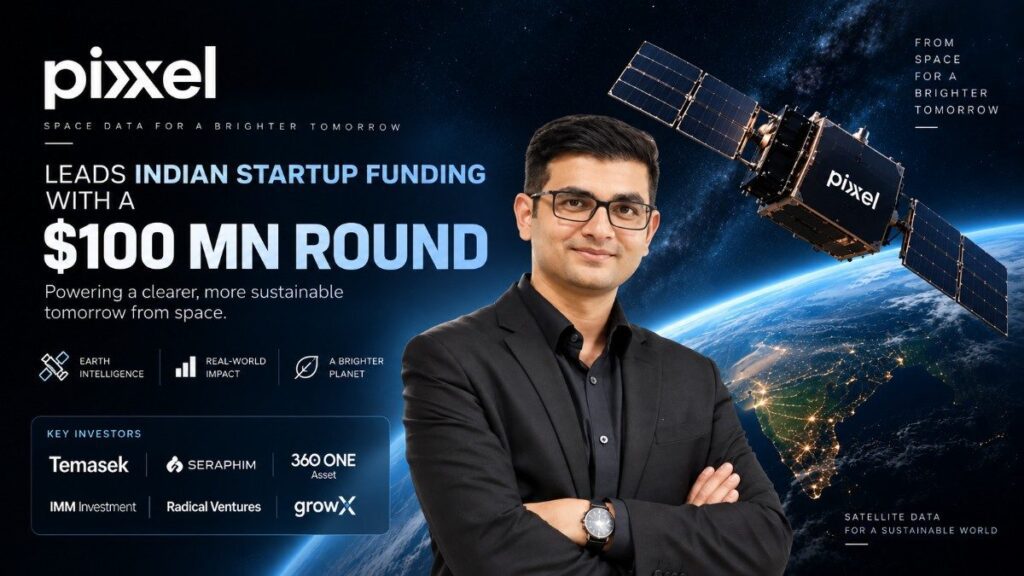
The biggest development in this week’s Indian startup funding activity was Pixxel’s $100 million Series C round.
The spacetech startup raised the capital from a group of investors including Temasek, Seraphim, 360 ONE Asset, IMM Investment, Radical Ventures and growX Ventures.
The round alone represented nearly one-third of the week’s total startup funding.
Pixxel’s fundraise also helped make advanced hardware and technology the most-funded sector during the period.
Two companies in the sector—Pixxel and QNu Labs—raised a combined $121 million.
This is an important signal for startup funding trends India because it shows that investor interest is extending beyond conventional consumer internet businesses.
Spacetech, quantum technology and other advanced technology businesses require significant capital, but they can also address large infrastructure and industrial opportunities.
Pixxel’s large round therefore represents more than a single company’s fundraising success. It highlights growing investor attention toward technology-intensive businesses emerging from India.
Ecommerce Becomes the Second-Biggest Funding Sector
Ecommerce was another major contributor to Indian startup funding during the week.
According to the weekly data, six ecommerce startups collectively raised $80 million, making ecommerce the second-largest funded sector.
A major portion of this capital came from Nua, which raised $50 million.
Other ecommerce startups in the week’s funding list included Mokobara, Theater, Lickicious, Peep Beauty and Sorry Sugar.
The diversity of these businesses is noteworthy.
Rather than capital flowing into just one ecommerce model, funding reached several D2C brands operating across different consumer categories.
This suggests that India’s consumer market continues to provide opportunities for brands capable of building differentiated products, strong distribution and repeat customer relationships.
For anyone tracking startup funding news India, the ecommerce numbers are particularly relevant because consumer brands remain an important part of the country’s venture capital ecosystem.
Foodtech Records a $56 Mn Deal
Foodtech recorded one of the largest individual deals of the week through Popo Global, which raised $56 million from Artal Asia.
Despite having only one deal listed in the week’s funding data, foodtech ranked among the top sectors because of the size of this transaction.
This highlights an important characteristic of Indian startup funding September 2026: the total amount raised by a sector can be heavily influenced by a small number of large rounds.
Therefore, looking only at deal count may not provide a complete picture of investor interest.
A sector with one large growth-stage transaction can raise more capital than a sector containing several smaller seed deals.
Quick Commerce Remains on Investors' Radar
Quick commerce also featured in this week’s Indian startup funding activity through Swish.
Swish raised $24 million in a funding round involving Bertelsmann India Investments, Accel, Bain Capital Ventures and Hara Global.
The company operates within India’s rapidly developing convenience and quick-commerce ecosystem.
The funding comes at a time when investors continue to examine businesses based not only on growth but also on operational efficiency, customer retention and unit economics.
For startups operating in competitive consumer categories, raising capital is increasingly about demonstrating the ability to turn growth into a sustainable business model.
AI Funding Continues Across Multiple Startups
Artificial intelligence remained another important theme in Indian startup funding during the week.
The funding table includes Graph AI, Navana.ai, Fundly.ai, Dialflo and TrueFan AI.
Graph AI raised $13.3 million in a Series A round, while Navana.ai and Fundly.ai raised $4.2 million and $4 million respectively. Dialflo raised $178,000, while TrueFan AI received strategic backing from Bajaj Finserv.
The distribution is notable because AI capital was spread across several companies rather than being dominated by one mega-round.
This indicates that startup funding trends India continue to include AI as a significant investment theme, but investors appear to be evaluating individual businesses based on their specific products, use cases and growth potential.
AI therefore remains an important part of the Indian startup funding landscape without necessarily translating into equally large rounds for every company.
Clean Technology and Climate Tech Also Attract Capital
Clean technology startups also participated in this week’s Indian startup funding activity.
Circolife raised $4.5 million, while DigitalPaani secured $2.3 million. Both companies are classified under clean tech and climate tech in the funding data.
Although these rounds were much smaller than Pixxel’s $100 million raise, they show that climate-focused businesses continue to find investors within India’s broader technology ecosystem.
The presence of cleantech alongside AI, spacetech and ecommerce makes the weekly funding picture more diverse than the headline number might initially suggest.
Early-Stage Startup Funding Remains Weak
One of the biggest takeaways from the latest Indian startup funding figures is the difference between large growth rounds and early-stage capital.
The source data states that only three startups raised a combined $3.3 million across pre-seed and seed rounds, representing approximately 1% of the week’s $321.9 million total.
This means that the sharp increase in overall funding should not necessarily be interpreted as an across-the-board recovery.
Large and established startups attracted substantial capital, while early-stage businesses received a relatively small share.Large and established startups attracted substantial capital, while early-stage businesses received a relatively small share.
For founders, this is an important distinction.
A strong weekly funding number can create the impression that capital is widely available, but the underlying deal distribution suggests that investors remain selective.
Companies with proven traction, strong technology, differentiated products or clearer paths to scale may continue to have an advantage when raising larger rounds.
Which Investors Were Most Active?
Investor activity provides another useful angle when analysing Indian startup funding.
Peak XV Partners, Accel and Prath Ventures were among the most active investors during the week, with each participating in two deals.
Peak XV participated in Nua and Mokobara, while Accel participated in Swish and Fundly.ai. Prath Ventures invested in Theater and Lickicious.
Their activity covers multiple sectors, including ecommerce, consumer services and AI.
This diversification indicates that major venture capital firms are continuing to evaluate opportunities across different segments rather than relying on a single investment theme.
Top sectors in Indian startup funding
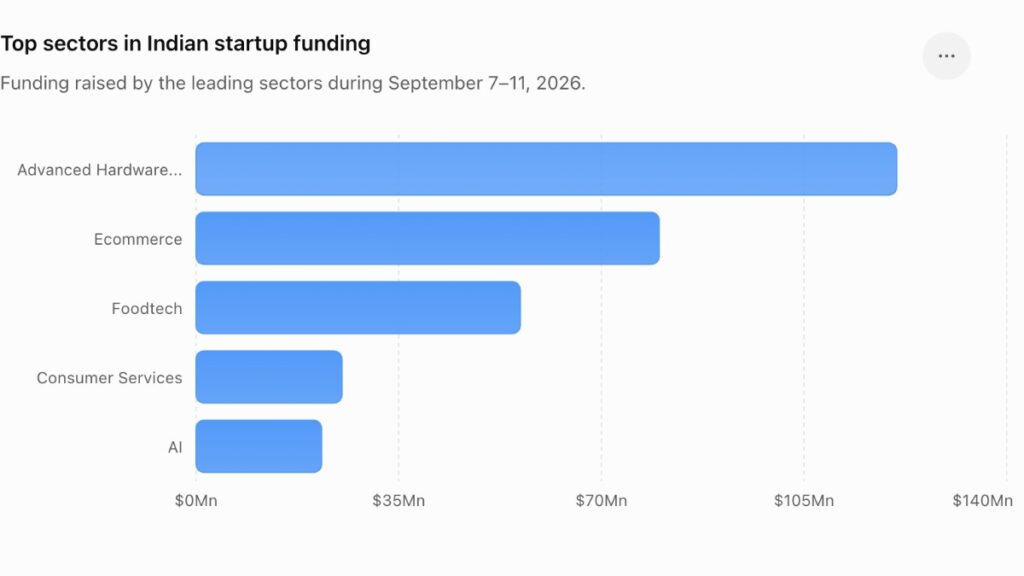
Advanced Hardware & Technology led the funding activity with $121 million raised across two deals, followed by ecommerce at $80 million across six deals. Foodtech ranked third with $56 million, largely driven by Popo Global’s funding round. Together, advanced hardware & technology and ecommerce accounted for $201.1 million, or 62.5% of the total funding raised during the week.
This concentration is one of the most significant insights from the week’s Indian startup funding data.
What This Indian Startup Funding Data Means for Founders
The latest Indian startup funding numbers provide several lessons for entrepreneurs.
1. Large technology opportunities can attract large capital
Pixxel’s $100 million round shows that investors can commit substantial amounts when they see a large technology and infrastructure opportunity.
2. Consumer brands continue to attract capital
Nua, Mokobara, Theater, Lickicious, Peep Beauty and Sorry Sugar demonstrate continued activity in India’s D2C ecosystem.
3. AI remains an important investment theme
Multiple AI companies raised capital during the week, confirming that artificial intelligence continues to feature in investor portfolios.
4. Funding is not evenly distributed
The contrast between $321.9 million in total funding and only $3.3 million in seed and pre-seed capital highlights the uneven nature of the current market.
5. Investors remain selective
The week’s startup funding news India shows that capital is available, but companies still need compelling business fundamentals to attract significant investment.
Indian Startup Funding: The Bigger Picture
The September 7–11 funding activity suggests that India’s startup ecosystem is experiencing renewed momentum, but the recovery is not uniform.
The $321.9 million headline figure is impressive, yet a significant portion of the money came from a handful of large transactions.
Pixxel’s $100 million round alone represented a substantial share of the total, while Popo Global and Nua added another $106 million.
Consequently, the latest startup funding trends India should be interpreted with some context.
The ecosystem is clearly capable of producing large funding rounds, particularly in technology, spacetech and established consumer businesses. However, early-stage founders may still face a more challenging fundraising environment.
The data also suggests that investors are balancing two different priorities: backing large, scalable technology opportunities while continuing to search for consumer businesses capable of building strong brands and sustainable demand.
Conclusion
The latest Indian startup funding figures show a strong rebound in India’s startup ecosystem.
Between September 7 and September 11, 20 startups collectively raised $321.9 million, representing an 82.4% increase from the $176.5 million raised by 22 startups during the previous week.
Pixxel led the funding charts with a $100 million round, helping advanced hardware and technology become the week’s most-funded sector. Ecommerce followed with $80 million across six startups, while Popo Global’s $56 million deal made foodtech another major contributor.
At the same time, AI, cleantech, quick commerce, travel tech, gaming and consumer services continued to attract capital.
The bigger story behind this week’s Indian startup funding is therefore not simply that more money was raised. It is that investor interest is spreading across deep technology, consumer brands, AI and emerging infrastructure opportunities, while early-stage funding remains comparatively limited.
For founders and investors tracking startup funding trends India, the coming weeks will be important in determining whether this September rebound develops into a broader recovery or remains concentrated around a few large transactions.
Topics to follow on IAMVIEBR : Current Affairs & Insights Tech Innovation GenZ entrepreneurship Collaborative Fashion GEO SME