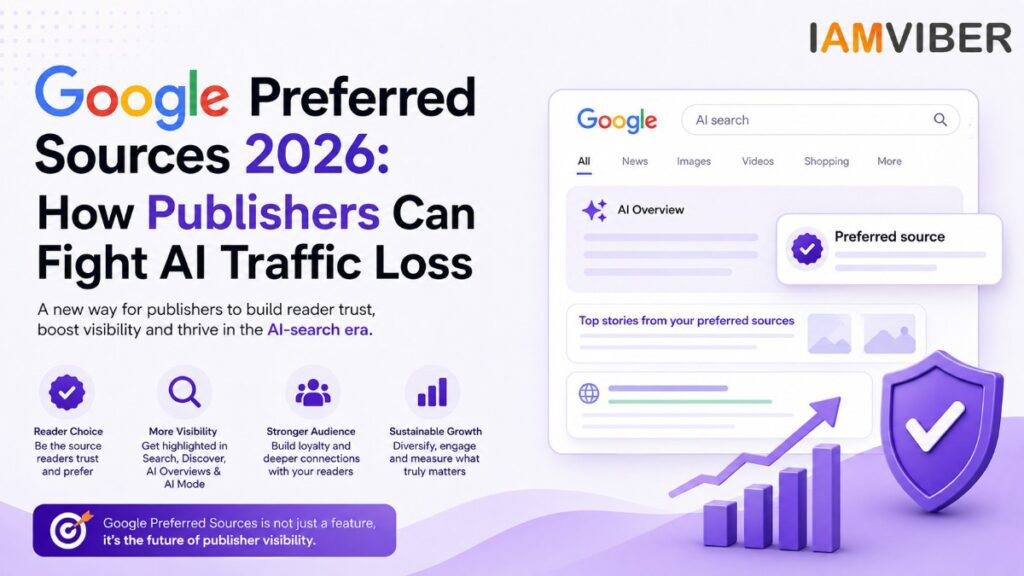
Google Preferred Sources is becoming one of the most important new developments for publishers trying to survive the AI-search era. Google has introduced a button that publishers can place on their websites, allowing readers to mark that publication as a preferred source. Once selected, the publisher can be surfaced more prominently across Google Search, Discover and Google News, including areas influenced by AI.
For publishers, the timing matters. Google Preferred Sources arrives at a moment when every additional source of qualified traffic matters. Search is changing from a list of links into an answer engine. AI Overviews and AI Mode increasingly answer questions directly, which can reduce the need for users to visit the websites that produced or reported the information.
Google Preferred Sources does not reverse that structural change, but it gives publishers a new way to build a stronger relationship with readers inside Google’s ecosystem.
What Is Google Preferred Sources?
Google Preferred Sources is essentially a reader-controlled preference system. A publisher can add a button to its website. When a reader selects the publication, Google saves that source as preferred for that user.
Google says preferred sources can be highlighted in Top Stories and can receive a preferred badge in AI Overviews and AI Mode for users who have selected them. The feature is therefore different from traditional SEO. Instead of asking publishers to compete only for rankings, it creates a mechanism where a reader can explicitly tell Google, “I want this source.”
That distinction could become increasingly important as search becomes more personalized. Google Preferred Sources is built around that personalization.
Why Google Is Making This Move Now
The change comes as Google itself pushes deeper into AI search, making Google Preferred Sources part of a much larger Search transition. Google said in May that AI Overviews had more than 2.5 billion monthly active users, while AI Mode had passed one billion monthly active users. AI Mode queries were also more than doubling every quarter.
That scale creates a complicated situation for the publishing industry. More people may be using Google Search, but more searches can also end without a traditional website click when an AI-generated answer satisfies the user’s question.
A recent preregistered field experiment involving 1,100 participants found that removing AI Overviews and AI Mode increased click-through rates to publishers. The researchers concluded that generative AI in search can reduce downstream publisher referrals.
This is the environment in which Google Preferred Sources arrives. Google Preferred Sources does not promise publishers more clicks, but it can strengthen source preference.
Google is not abandoning AI search. Instead, it is adding a mechanism that can help users keep specific publishers in their information diet.
The Bigger Shift From SEO to Audience Preference
For years, publishers have focused on ranking for keywords. The basic model was straightforward: create content, optimize it, earn links and authority, rank in Google, and receive traffic.
AI search complicates that model.
When Google answers a query directly, the traditional blue-link journey can become shorter. A reader may consume the information without opening several articles. That means publishers increasingly need to think beyond ranking and toward recognition.
Google Preferred Sources fits into this shift because it gives readers an explicit role in deciding which publishers they want Google to surface.
This could push publishers to build stronger brands rather than relying entirely on search demand. A reader who remembers a publication, trusts its reporting and actively selects it as a preferred source has a different relationship with that publisher than someone who arrives from a random keyword.
For media brands, that distinction is huge. Google Preferred Sources gives that relationship a visible signal inside Search.
What It Means for AI Overviews and AI Mode
Google Preferred Sources is especially interesting because it extends publisher preference into Google’s AI experiences.
Google’s own documentation says that when a user selects a site as a preferred source, content from that site can be highlighted with a preferred badge in AI Overviews and AI Mode.
The important point is that the feature does not mean Google will simply reproduce a publisher’s article in an AI answer. Instead, it creates a stronger signal around which sources a user wants to see.
For publishers, that could make brand-building and direct reader loyalty part of their AI-search strategy.
Google Preferred Sources could, however, make audience loyalty more valuable. In that sense, Google Preferred Sources is less about old-school rankings and more about reader intent.
What Publishers Should Do Next
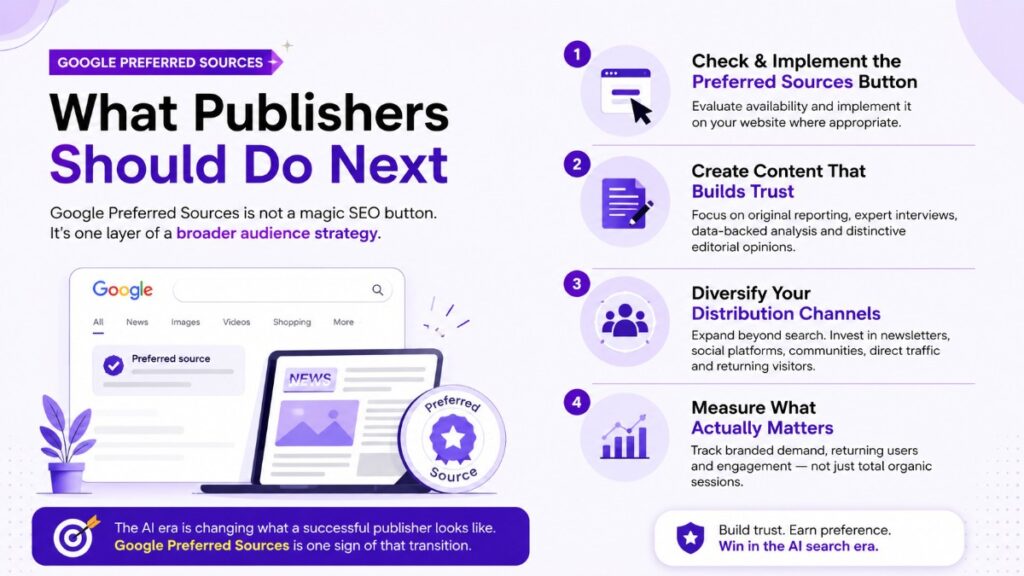
Publishers should not look at Google Preferred Sources as a magic SEO button. It is better understood as one layer of a broader audience strategy.
First, publishers should evaluate whether the button is available to them and implement it where appropriate.
Second, they should strengthen content that gives readers a reason to trust the brand. Original reporting, expert interviews, data-backed analysis and distinctive editorial opinions are harder to replace with generic AI summaries.
Third, publishers should diversify distribution. Search should remain important, but newsletters, social platforms, communities, direct traffic and returning visitors are becoming increasingly valuable.
Fourth, publishers should measure branded demand, returning users and engagement rather than looking only at total organic sessions.
The AI era is changing what a successful publisher looks like. Google Preferred Sources is one sign of that transition.
Is Google Solving the Traffic Problem?
Not exactly.
Google Preferred Sources is useful, but it does not eliminate the fundamental tension created by AI search. If a user gets an answer without clicking through, publishers can still lose a visit.
The new feature is better viewed as a bridge between Google’s AI-first search experience and the open web. Google is effectively giving users a way to say which publishers matter to them.
That may help some publications recover visibility, but it does not guarantee that the overall economics of web publishing will return to the old model.
The question for publishers is no longer simply, “How do we rank?”
It is increasingly, “How do we become the source people choose?”
The Future of Publisher Traffic
Google Preferred Sources points toward a future where search visibility may depend on more than relevance and ranking. Personal preference could become another layer of discovery.
That matters because AI search is increasingly personalized. Google is building search experiences that understand context, summarize information and adapt results to individual users. In that environment, being a trusted source could be more valuable than simply being a high-ranking source.
For publishers, the lesson is clear: do not build a media brand that exists only because Google sends traffic to it.
Build a publication readers actively choose.
Google Preferred Sources may help Google deliver that preference, but publishers still have to earn it. Google Preferred Sources works best when reader trust already exists.
The winning strategy will likely combine strong SEO, original journalism, recognizable editorial voices, direct audience relationships and content designed to be useful both to humans and modern search systems.
AI may be changing how people discover information. But trust still has to come from somewhere.
Frequently Asked Questions
1. What is Google Preferred Sources in 2026?
Google Preferred Sources is a feature that lets users select publishers they prefer to see across Google Search, Discover, Google News, AI Overviews and AI Mode.
2. How does Google Preferred Sources work?
Users can select a website as a preferred source. Google can then give that source additional visibility in relevant search experiences, including a preferred-source indicator.
3. How can publishers use Google Preferred Sources?
Publishers can add Google’s Preferred Sources button to their websites, allowing readers to select their publication as a preferred source.
4. Does Google Preferred Sources increase website traffic?
It can potentially improve visibility and help publishers attract more qualified clicks, but Google does not guarantee a specific increase in website traffic.
5. Does Google Preferred Sources work with AI Overviews?
Yes. Google says preferred sources can receive a preferred badge in AI Overviews and AI Mode when their content is relevant to a user’s search.
6. Is Google Preferred Sources a replacement for SEO?
No. It should be viewed as an additional discovery and audience-preference signal rather than a replacement for traditional SEO, quality content or website authority.
7. Why is Google introducing Preferred Sources for publishers?
The feature gives users more control over the sources they see while helping publishers build stronger visibility and reader preference as Google Search becomes increasingly AI-powered.
8. Can Google Preferred Sources help publishers fight AI traffic loss?
It may help publishers maintain visibility within Google’s AI-driven search experiences, but it does not completely solve the broader challenge of declining referral traffic caused by AI-generated search answers.
Topics to follow on IAMVIEBR : Current Affairs & Insights Tech Innovation GenZ entrepreneurship Collaborative Fashion GEO SME