OpenAI vs Anthropic: The IPO Battle That Could Create the First Trillion-Dollar AI Company
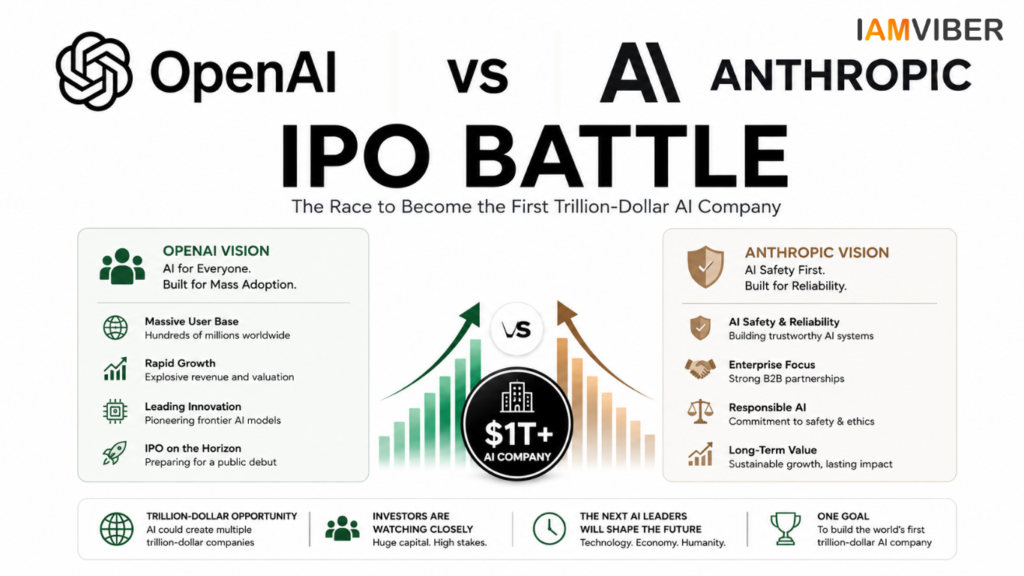
The OpenAI vs Anthropic rivalry is rapidly becoming the most important battle in the artificial intelligence industry. As both companies move closer to public markets, the OpenAI vs Anthropic debate is no longer just about technology—it’s about business dominance, investor confidence, and the future of AI.
Artificial intelligence has officially entered a new era. For the past few years, the industry has been obsessed with model performance, benchmark scores, and chatbot capabilities. Every major headline revolved around which company had built the smartest AI system. But in 2026, the conversation has changed dramatically. The race is no longer just about technology. It is about business dominance, market leadership, and ultimately, who will become the first trillion-dollar AI company.
At the center of this battle are two names that have come to define the modern AI revolution: OpenAI and Anthropic. Both companies have transformed from ambitious research labs into global technology powerhouses. Now, with reports indicating that both firms are preparing for public market debuts, the rivalry is entering its most significant chapter yet. Investors, entrepreneurs, and technology enthusiasts around the world are closely watching what could become the biggest IPO showdown in Silicon Valley history.
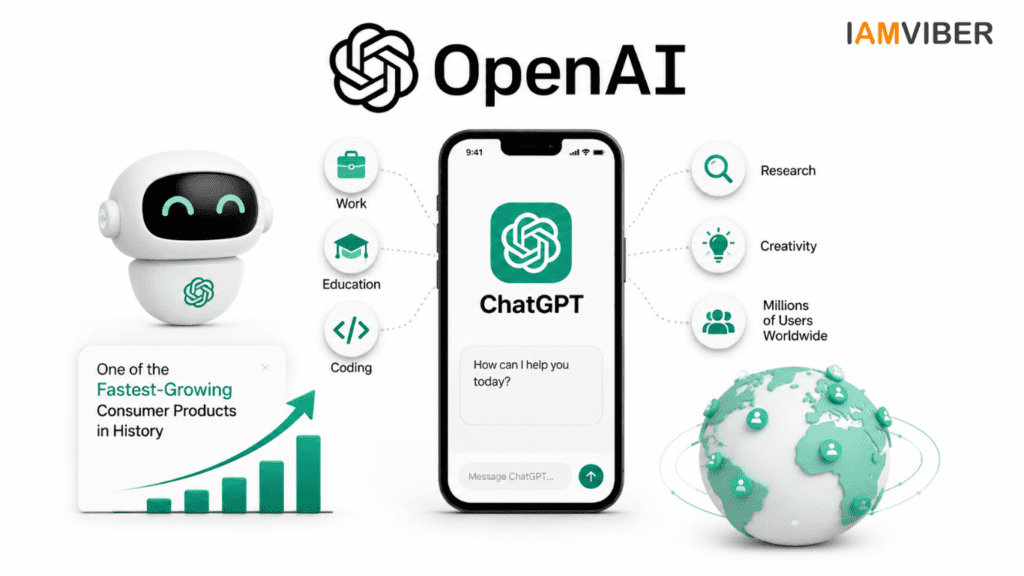
The story of this rivalry begins long before IPO discussions entered the picture. OpenAI captured the world’s attention when ChatGPT exploded into mainstream consciousness. What started as an experimental conversational AI quickly became one of the fastest-growing consumer products in history. Millions of people began using ChatGPT for work, education, coding, research, and creativity. Businesses rushed to integrate AI into their workflows, and suddenly artificial intelligence was no longer a futuristic concept—it was a daily tool.
As OpenAI became the face of the AI revolution, another company was quietly building its own empire. Anthropic, founded by former OpenAI researchers, took a different approach. Instead of focusing on mass consumer adoption, the company prioritized AI safety, enterprise reliability, and responsible deployment. Its Claude family of models quickly earned a reputation for producing thoughtful, accurate, and business-friendly outputs. While OpenAI dominated headlines, Anthropic steadily built trust among enterprises, developers, and organizations looking for advanced AI solutions.
Today, both companies stand at the forefront of one of the fastest-growing industries in human history. The global AI market is expected to generate trillions of dollars in economic value over the next decade. Every major technology company is investing aggressively in AI, governments are creating national AI strategies, and startups are being built entirely around artificial intelligence. In many ways, AI has become what the internet was in the late 1990s—a transformational technology with the potential to reshape nearly every industry.
This is precisely why the IPO race matters so much.
Historically, companies went public after achieving stable revenue growth and predictable business models. AI companies are different. Investors are not simply evaluating current earnings; they are betting on future influence. They are investing in the belief that artificial intelligence will become the foundational layer of the global economy. The company that controls that layer could achieve a valuation unlike anything the technology world has seen before.
OpenAI enters this race with perhaps the most valuable asset in modern business: brand recognition. ChatGPT has become synonymous with artificial intelligence. For many people, AI and ChatGPT are almost interchangeable terms. This level of consumer awareness is incredibly difficult to achieve and even harder to replicate. The company has successfully positioned itself not just as a software provider but as the gateway to AI for millions of users worldwide.
Beyond consumer adoption, OpenAI has built a massive ecosystem. Developers rely on its APIs, enterprises use its business solutions, and startups build products on top of its infrastructure. The company’s influence extends across industries, making it one of the most strategically positioned organizations in the technology sector. Investors often reward companies that become foundational platforms, and OpenAI appears determined to become the operating system of the AI era.
Anthropic, however, possesses a different type of advantage. While OpenAI dominates public attention, Anthropic has become increasingly respected within enterprise circles. Many organizations view Claude as one of the most dependable AI assistants available today. The company’s emphasis on safety, alignment, and transparency has resonated strongly with businesses that require trustworthy AI systems for sensitive operations.
This distinction may prove critical in the long run. As artificial intelligence moves beyond experimentation and becomes embedded into critical industries such as healthcare, finance, legal services, and government operations, trust will become an increasingly important competitive advantage. Enterprises are not simply looking for the most powerful model; they are looking for systems they can rely on. Anthropic’s strategy positions it perfectly for that future.
The OpenAI vs Anthropic competition represents two different approaches to building the future of artificial intelligence. While OpenAI focuses on mass adoption, Anthropic prioritizes safety and enterprise trust.
The Trillion-Dollar Opportunity: Why Investors Are Watching Closely
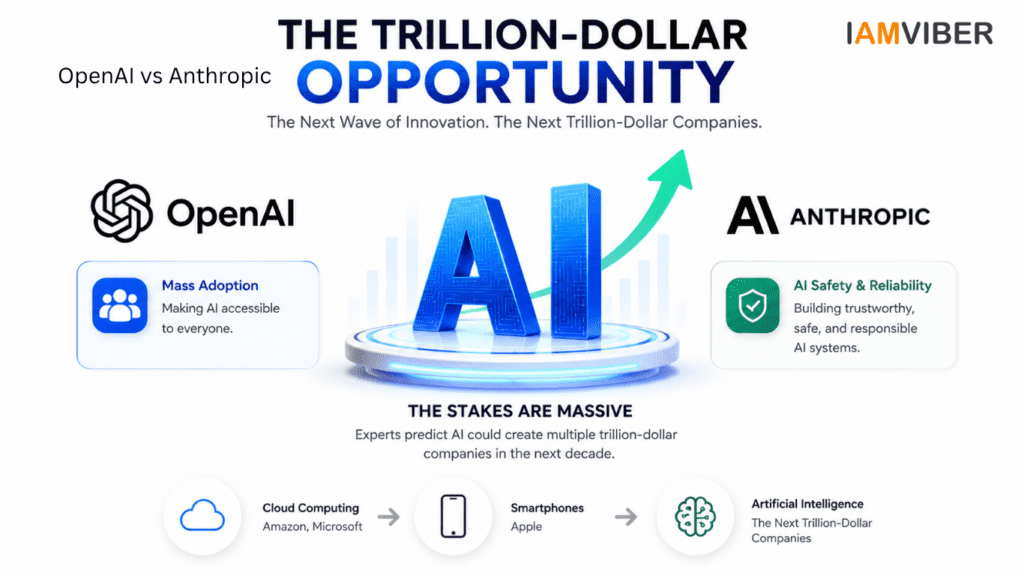
What makes this rivalry so compelling is that OpenAI and Anthropic are pursuing two very different visions of artificial intelligence. OpenAI focuses on mass adoption, aiming to make AI accessible to everyone, while Anthropic has built its reputation around AI safety, reliability, and responsible deployment. Both approaches have found success, but the real question is which vision public markets will value more in the years ahead.
The stakes couldn’t be higher. Industry experts believe AI could create multiple trillion-dollar companies over the next decade. Just as cloud computing fueled the rise of Amazon and Microsoft, and smartphones propelled Apple to unprecedented heights, artificial intelligence is expected to become the next major technological revolution. The companies leading this shift stand to become some of the most valuable businesses in history.
Investor confidence in AI remains at an all-time high. Startups continue to secure multi-billion-dollar funding rounds, while demand for AI infrastructure, cloud services, and advanced chips keeps growing rapidly. From data centers and GPUs to enterprise software, AI is no longer a niche industry—it’s becoming one of the biggest investment themes in the global economy.
For investors, the appeal goes beyond current revenue. They’re betting on a future where AI becomes as essential as electricity, cloud computing, or the internet itself. If that vision becomes reality, today’s AI leaders could dominate entire industries tomorrow.
The Challenges That Could Shape the AI Race
Despite the excitement, building cutting-edge AI is incredibly expensive. Training and operating advanced models requires billions of dollars in computing infrastructure, specialized hardware, and energy resources. The race for innovation is relentless, forcing companies to invest heavily just to stay competitive.
At the same time, regulators around the world are paying closer attention to AI. Governments are exploring policies related to privacy, safety, competition, and national security. For companies preparing to go public, balancing innovation with compliance could become just as important as building better technology.
Competition is another major factor. OpenAI and Anthropic may dominate headlines, but Google, Meta, Amazon, Microsoft, Apple, and dozens of emerging startups are all investing aggressively in AI. The battle for AI leadership is far bigger than a two-company race.
Why This Matters for Startups and the Future of AI
The outcome of this IPO battle could influence the entire startup ecosystem. A successful public debut would likely attract more investment into AI startups, encourage innovation, and create new opportunities for founders. Conversely, weaker-than-expected performances could make investors more cautious and reshape funding trends across the industry.
More importantly, the next phase of AI competition won’t be won solely through better technology. Success will depend on trust, adoption, and daily usage. The company that becomes deeply embedded in people’s workflows and businesses may ultimately hold the strongest advantage.
As OpenAI & Anthropic move closer to public markets, they are doing more than preparing for IPOs—they are helping define the future of artificial intelligence. Whether OpenAI wins through scale and mainstream adoption or Anthropic succeeds through enterprise trust and safety-first innovation, one thing is certain: the race to build the first trillion-dollar AI company is already underway.
Ultimately, the OpenAI vs Anthropic race could determine which company becomes the first trillion-dollar AI giant. For investors, founders, and technology leaders, the OpenAI vs Anthropic story may be the defining business narrative of this decade.
Frequently Asked Questions (FAQs)
1. Why are OpenAI and Anthropic preparing for IPOs?
Both companies are looking to raise capital, expand their AI infrastructure, and strengthen their positions in the rapidly growing artificial intelligence market. An IPO would also allow public investors to participate in the AI boom.
2. Which company is bigger: OpenAI or Anthropic?
OpenAI currently has stronger global brand recognition thanks to ChatGPT and its massive consumer user base. Anthropic, however, has gained significant traction in the enterprise AI market with its Claude models and focus on AI safety.
3. Could OpenAI or Anthropic become the first trillion-dollar AI company?
Many analysts believe it is possible. As AI adoption accelerates across industries, companies leading the AI revolution could achieve valuations similar to or even greater than today’s biggest technology giants.
4. What is the biggest difference between OpenAI and Anthropic?
OpenAI focuses on broad AI adoption and consumer accessibility, while Anthropic emphasizes AI safety, reliability, and enterprise-grade solutions. Their different strategies are shaping one of the most important rivalries in the AI industry.
5. Why does the OpenAI vs Anthropic IPO battle matter for startups?
A successful IPO from either company could boost investor confidence in the AI sector, attract more venture capital funding, and create new opportunities for AI startups and entrepreneurs worldwide.
Topics to follow: Current Affairs & Insights Tech Innovation GenZ entrepreneurship Collaborative Fashion GEO AI Agentic SME