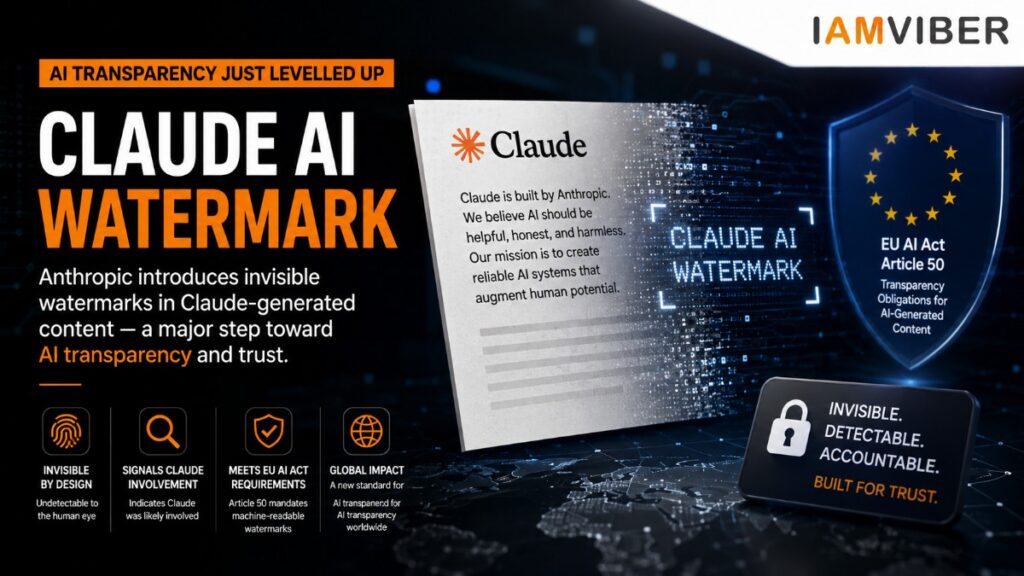
Claude’s Invisible Watermark Is Changing the AI Content Debate
Claude AI watermark is now one of the most discussed changes around Anthropic’s AI assistant. On August 14, Anthropic explained that future Claude models will generate text containing an invisible watermark designed to indicate that Claude was likely involved in producing or processing the content.
The Anthropic watermark announcement matters because it arrives just after the EU AI Act’s transparency rules became applicable on August 2, 2026. The European Commission says providers must use machine-readable marks to make AI-generated or manipulated content detectable. Anthropic says its approach is part of its effort to comply with those rules.
What Is the Claude AI Watermark?
The AI text watermark is not a visible label, a hidden character, or metadata inserted into ordinary text. Anthropic says it uses a statistical technique that subtly influences word choices during generation. To a reader, the text should look normal. But a system with the appropriate detection key can test whether Claude was likely involved.
That distinction is important. The Claude AI watermark does not prove that Claude wrote an entire document. Anthropic explicitly says it cannot distinguish between text Claude wrote and text Claude heavily edited. In other words, the signal is about Claude’s involvement, not authorship.
How Does the Claude AI Watermark Work?
Anthropic has not published the exact detection key or full algorithm. It says the technique does not add tokens, hidden characters, or identifying information, and is designed to have no practical impact on output quality.
The Claude watermark is also intended to survive common forms of handling. Anthropic says copied text can retain the signal, and translations produced by Claude are also watermarked because Claude chooses the translated words. That makes the system different from traditional file metadata, which can disappear when content is copied into another document.
Why Is Anthropic Doing This Now?
The biggest driver is regulation, especially the EU AI Act. Article 50 of the EU AI Act applies from August 2, 2026. The European Commission says providers of generative AI systems must add machine-readable marks that enable AI-generated or manipulated content to be detected.
The Claude AI watermark therefore arrives at a moment when AI transparency is moving from voluntary best practice toward a regulatory requirement in Europe.
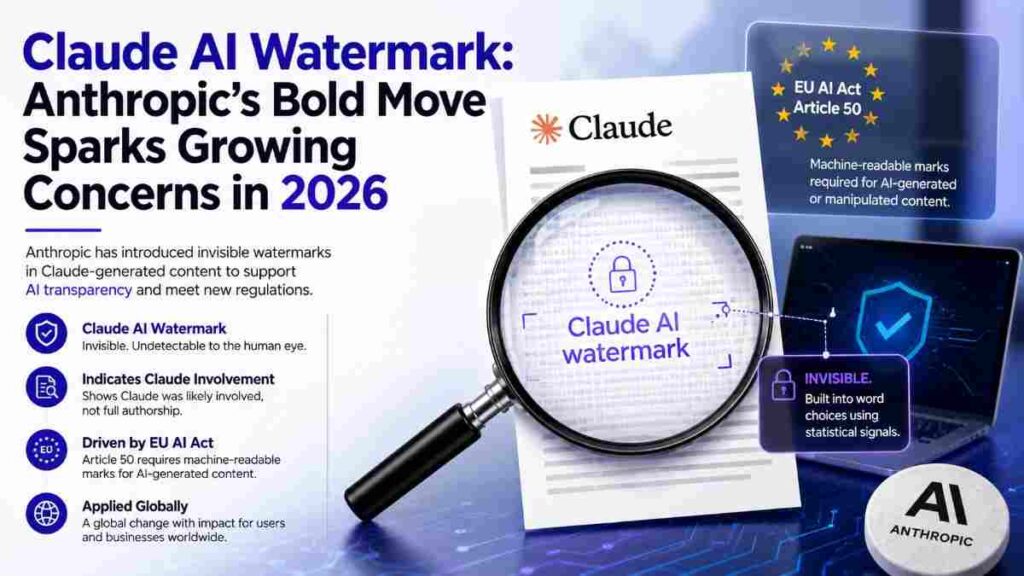
Anthropic is applying the change globally rather than creating a Europe-only version of Claude. That is significant for users outside the EU because a regulatory requirement in one major market can influence how a global AI product is designed for everyone.
What Does the Claude AI Watermark Actually Prove?
This is where headlines can become misleading. A Claude watermark does not mean a document was completely written by AI. It does not establish who authored the document. It does not identify the person who used Claude.
The Claude AI watermark only helps establish that Claude was likely involved at some point. Someone could write a report themselves, ask Claude to improve several sections, and end up with a document carrying the signal. Conversely, significant human rewriting may affect how reliably the watermark can be detected.
Anthropic also says watermarking does not change ownership or legal responsibility under its terms. That makes it more accurate to think of the system as a provenance signal rather than an authorship certificate.
Why Are Some Claude Users Unhappy?
The Claude AI watermark has triggered a backlash among some users, particularly people who use AI as an editing or productivity tool. Recent reports have described users worrying that watermarked text could be treated as fully AI-written even when a human did most of the work.
That concern is easy to understand. Modern AI use is often collaborative. A writer might brainstorm with Claude, ask it to tighten language, translate a paragraph, check structure, or rewrite a few sentences. If a detection system later says “Claude was involved,” that signal could be interpreted more broadly than Anthropic intends.
Some users also question whether invisible watermarking could affect creative freedom or whether organizations might use it as a simplistic replacement for human review.
The Claude AI watermark debate is therefore bigger than Anthropic. It raises a question that the entire AI industry will have to answer: how do we disclose AI assistance without pretending that every piece of AI-assisted work has a single machine author?
Could the Watermark Affect Claude’s Quality?
This is one of the most interesting technical questions. Any system that changes token selection has the potential to influence generation. Anthropic, however, says the difference between watermarked and un-watermarked text should not be distinguishable to readers and that the method has no practical impact on quality or content.
The Claude AI watermark is designed to work within the model’s existing generation process rather than adding visible markers after the response is produced.
Independent long-term testing will be more important than the announcement itself. If users notice meaningful differences in writing quality, style, or creativity, the debate will become much bigger. For now, Anthropic’s position is that the impact is effectively invisible.
What About Older Claude Models?
The Claude AI watermark rollout is not identical for every model. Anthropic says models launched before August 2, 2026 have a transition period under the EU rules, and the company is working to add watermarking to those models over the coming months.
Is This the Future of AI Content Detection?
The Claude AI watermark may become an important part of the wider shift from probabilistic AI detection toward provider-backed provenance.
Traditional AI detectors generally look for patterns in writing style. Anthropic points out that those systems do not have its private watermarking key. A watermark, by contrast, is intentionally embedded during generation and can be checked using the appropriate detection mechanism.
But watermarking is not a magic solution. It can indicate that a particular AI system was involved; it cannot automatically explain how much AI was used, who used it, why it was used, or whether the final work reflects substantial human contribution.
The Claude AI watermark therefore works best as one piece of evidence, not as a final verdict on authorship.
What This Means for Creators and Businesses
For creators, the practical lesson is simple: keep records of how AI is used in your workflow. If Claude helps with research, translation, editing, coding, or drafting, documenting that assistance can provide useful context later.
For businesses, the Claude AI watermark could make internal AI governance easier. Companies may eventually be able to distinguish between content generated by employees, content processed by AI, and content that came from other sources. That could help with compliance, publishing workflows, and provenance.
For publishers, the bigger challenge will be interpretation. A watermark should not automatically become a “this article was written by AI” stamp. Anthropic itself says the signal cannot distinguish writing from heavy editing.
The Claude AI watermark could ultimately push organizations toward more nuanced AI policies: disclose AI involvement, preserve human review, and avoid treating automated detection as proof of misconduct.
The Bigger Picture
Anthropic’s move is an important signal for where AI transparency is heading. The EU AI Act has created a regulatory push, but the underlying problem is global: AI-generated content is becoming harder to distinguish from human-created work.
The Claude AI watermark is also a signal that AI provenance is becoming a product requirement, not just a research idea.
The Claude AI watermark offers one possible answer. Instead of asking readers to guess whether text “sounds like AI,” providers can build provenance into the generation process.
That could improve transparency, but it also creates new questions about privacy, false positives, editing, authorship, and who gets to control the interpretation of an AI signal.
Anthropic has not simply added a technical feature to Claude. It is testing a new model for how AI-generated work could be identified in a world where human and machine creativity increasingly overlap.
The Claude AI watermark may become normal across AI platforms if regulators and users accept the approach. Or it could trigger a push for better, more nuanced provenance standards. Either way, the conversation has moved beyond “Can AI write this?” to a much harder question: “How should we know when AI helped create it?”
For now, the Claude AI watermark is best understood as a provenance experiment with regulatory momentum behind it.
Key Takeaway
Anthropic’s move is not simply about detecting AI-written text. It is about establishing a machine-readable trail showing that Claude was involved.
That distinction will become increasingly important as AI-assisted writing becomes normal across journalism, marketing, education, software development and business.
The bigger question is no longer whether AI was involved.
It is how much AI involvement should matter — and who gets to decide?
Frequently Asked Questions
1. What is the Claude AI watermark?
The Claude AI watermark is an invisible statistical signal embedded in Claude-generated text to help determine whether Claude was likely involved in creating the content.
2. Can readers see the Claude AI watermark?
No. The watermark is designed to be invisible to normal readers and works through subtle changes in word selection rather than visible labels or characters.
3. Does the Claude AI watermark prove that Claude wrote the entire content?
No. It indicates likely Claude involvement, but it does not prove that Claude wrote the entire document or establish authorship.
4. Why is Anthropic adding watermarks to Claude?
Anthropic says the move is part of its effort to comply with AI transparency requirements under the EU AI Act, which include machine-readable marking of AI-generated content.
5. Does the Claude AI watermark affect writing quality?
Anthropic says its watermarking method is designed to have no practical impact on the quality or content of Claude’s output.
6. Can Claude watermarks survive copied or translated text?
Anthropic says the watermark can persist when text is copied, and Claude-generated translations can also contain the watermark because Claude selects the translated wording.
7. Does the EU AI Act require Anthropic to use this exact watermark?
No. The EU AI Act requires applicable AI-generated content to carry machine-readable marks that enable detection, but it does not prescribe Anthropic’s exact technical watermarking method.
8. What does the Claude AI watermark mean for businesses and creators?
It could make AI-content provenance and compliance easier, but businesses and publishers should not treat a watermark as automatic proof that an entire piece was AI-written. It indicates AI involvement rather than complete authorship.
9. Do watermarks apply to translations?
Yes. A translation produced by Claude carries a watermark, because in this case every word is chosen by Claude.
Topics to follow on IAMVIEBR : Current Affairs & Insights Tech Innovation GenZ entrepreneurship Collaborative Fashion GEO SME