
The One-Operator Company: Why AI Agents Are Rewriting Team Economics
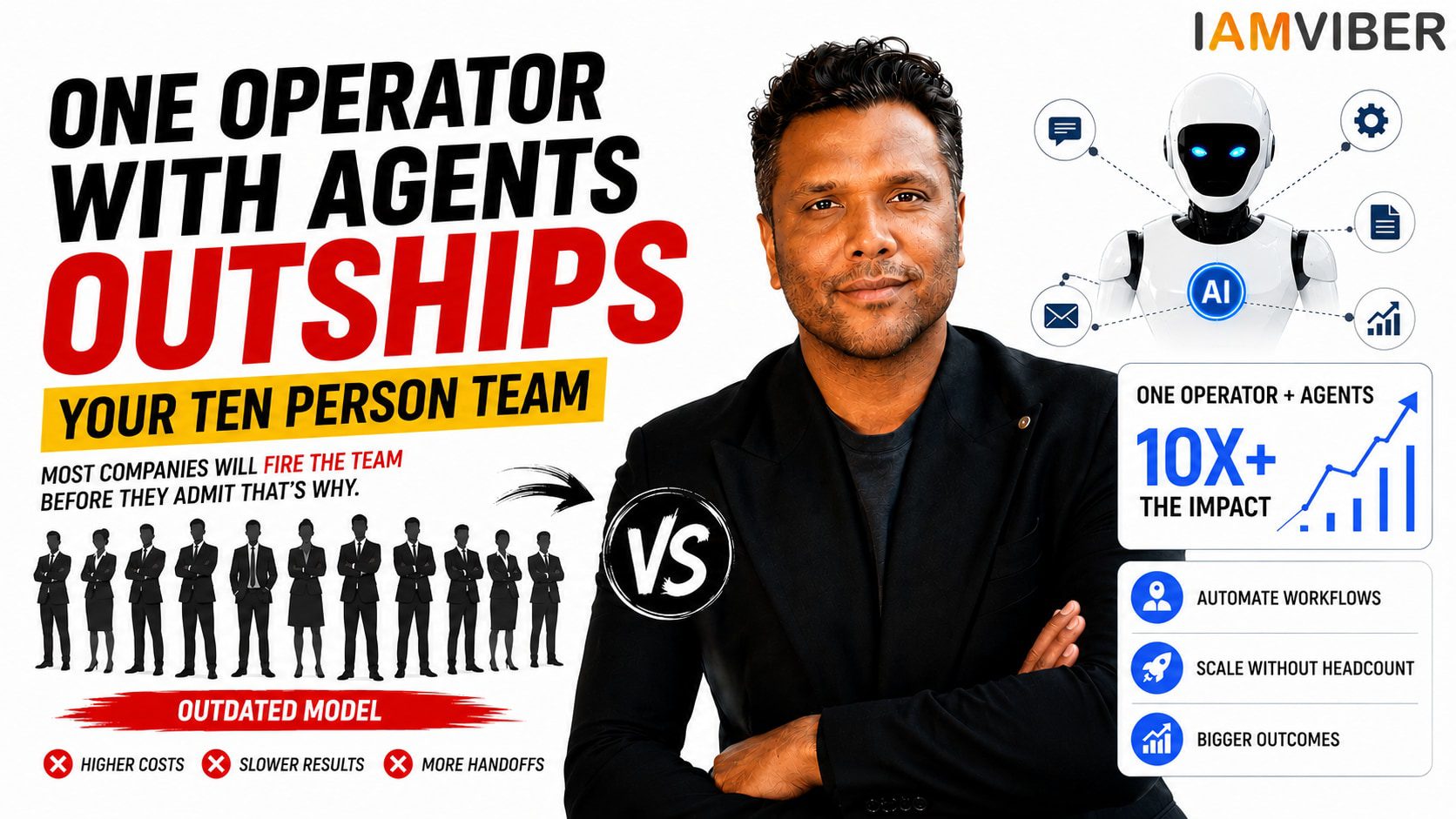
For decades, the formula for scaling a business was simple: hire more people, build larger teams, and divide work across specialized roles. Marketing needed marketers. Support needed agents. Engineering needed layers of developers, QA engineers, and managers.
Artificial intelligence is breaking that equation.
Today, a single skilled operator equipped with AI agents can often accomplish what previously required an entire department. This isn’t because AI has suddenly become perfect. It’s because AI dramatically reduces the coordination costs that have quietly consumed modern organizations for years.
The companies leading the AI era aren’t just growing faster. They’re generating unprecedented revenue per employee, forcing executives to rethink one of business’s oldest assumptions: Do you actually need a bigger team to build a bigger company?
The Revenue Per Employee Revolution
One statistic captures this shift better than any prediction.
Cursor reportedly crossed $2 billion in annual recurring revenue (ARR) with roughly 50 employees, translating to nearly $40 million in revenue per employee.
That’s not just impressive. It’s historically abnormal. Other AI-native companies tell a similar story:
| Company | Revenue per Employee |
| Cursor | ~$40M |
| Midjourney | ~$4.7M |
| OpenAI | ~$1.5M |
| Anthropic | >$1M |
| Perplexity | >$1M |
| Runway | >$1M |
Compare that with traditional SaaS businesses, where $200,000–$400,000 revenue per employee has long been considered healthy.
This isn’t a marginal improvement. It’s an entirely different operating model.
The difference isn’t simply better software. AI-native companies are designed around automation from day one, allowing a handful of operators to execute work that once demanded dozens of specialists.
AI Isn’t Just Improving Teams—It’s Compressing Them
Revenue metrics are one thing. Operational results tell an even stronger story.
Klarna’s Customer Support Experiment
In early 2024, Klarna deployed an AI customer service assistant across its support operations. Within the first month alone, the AI handled:
- 2.3 million customer conversations
- Approximately 67% of all support interactions
- A workload equivalent to roughly 700 full-time support agents
By 2025, the company stated the system was performing work equivalent to 853 employees while contributing to approximately $60 million in annual savings. That’s not incremental automation. That’s organizational redesign.
Salesforce Made the Shift Public
Salesforce provided another revealing example. CEO Marc Benioff openly stated that AI agents were allowing the company to operate with significantly fewer support employees.
Reportedly:
- Support headcount declined from roughly 9,000 to 5,000 employees
- Support costs dropped around 17%
- AI agents handled approximately 1.5 million customer conversations
- Human agents handled roughly the same volume
- Customer satisfaction remained comparable
That final point matters most. Historically, automation always came with a noticeable quality tradeoff. Increasingly, that gap is disappearing.
AI Is Becoming Company Policy
The biggest change isn’t technological. It’s managerial. Several major technology companies have already changed how hiring decisions are made.
Shopify
CEO Tobi Lütke instructed managers that before requesting additional headcount, they must first demonstrate why AI cannot accomplish the work. AI proficiency is now considered during performance evaluations.
Amazon
CEO Andy Jassy has similarly stated that AI-driven efficiency gains are expected to reduce portions of Amazon’s corporate workforce over time. These aren’t speculative forecasts. They’re hiring policies already shaping organizational decisions. Instead of automatically replacing employees who leave, many companies are asking a different question:
Can AI absorb this workload instead? That single question changes how organizations grow.
The Layoff Numbers Tell Only Part of the Story
Public layoffs receive headlines. Hiring decisions usually don’t.
According to Challenger, Gray & Christmas, AI was cited in 87,714 announced job cuts by mid-2026, representing roughly 22% of all layoffs during that period.
That’s the visible impact. The hidden shift may be larger.
Resume.org surveyed nearly 1,000 U.S. business leaders and found that over half expected AI-driven role consolidation to reduce existing staff during 2026.
Mercer also reported that nearly every CEO surveyed anticipated some level of AI-related workforce reduction within the next two years.
Whether every prediction becomes reality is less important than what executives are already planning for. The conversation inside boardrooms has clearly changed.
But There’s an Important Catch
The story isn’t as simple as “AI replaces workers.” Reality is considerably messier.
Many Companies Aren’t Actually Ready
Forrester analyst J.P. Gownder has pointed out that when companies announce AI-related layoffs, many haven’t actually deployed mature AI systems capable of replacing those jobs.
Sometimes AI becomes the explanation. Cost-cutting remains the actual motivation.
Developers Aren’t Always Faster
A randomized study by METR produced one of the most surprising findings in AI productivity research.
Sixteen experienced open-source developers completed software tasks using AI coding assistants. The result?
They were approximately 19% slower. Even more interesting, participants believed they had become roughly 20–25% faster despite objective measurements showing the opposite.
Perceived productivity and actual productivity moved in opposite directions. That finding serves as a useful reminder: Using AI does not automatically create efficiency. How you use it matters.
Even Klarna Adjusted Course
After heavily promoting AI-driven support automation, Klarna later acknowledged that the company had “over-rotated.”
Human agents were reintroduced for premium customers and complex service requests where empathy, judgment, and nuance still mattered. Automation proved powerful. It wasn’t universal.
ROI Isn’t Guaranteed
Research into enterprise AI agents also shows that implementation success varies widely. Only around 41% of AI agent deployments generate positive ROI within their first year, while a meaningful percentage never achieve their expected financial return.
Buying AI software is easy. Redesigning workflows around it is considerably harder.
Why One Operator Often Beats Ten Specialists
The real lesson isn’t that AI is replacing people. It’s that AI disproportionately rewards people who already understand an entire workflow.
Think about a traditional organization. Marketing hands work to design. Design sends files to copywriting. Copywriting waits for approvals. Development waits for marketing. Everyone attends meetings. Everyone updates documents. Everyone coordinates.
A large percentage of work becomes communication rather than execution. A skilled operator working with AI agents eliminates much of that coordination. Instead of managing handoffs, one person orchestrates the entire process. The AI generates drafts. The operator reviews.
The AI revises.The operator approves. The cycle becomes dramatically shorter because context never leaves one person’s head.
AI isn’t simply replacing labor. It’s removing organizational friction. That’s a fundamentally different advantage.
The Companies That Win Will Be Structured Differently
Not every business will become a one-person company. Healthcare, manufacturing, enterprise consulting, and countless other industries will continue requiring teams.
But those teams may become dramatically smaller than they are today. Instead of asking:
“How many people do we need?” Leaders are increasingly asking: “How many exceptional operators do we need?” The distinction matters. AI amplifies capability unevenly.
Strong operators become significantly more productive. Average workflows often become only marginally better.
That creates an increasingly steep productivity curve between organizations that redesign around AI and those that simply layer AI tools onto existing processes.
Final Thoughts
The future isn’t a world where AI replaces every employee.
It’s a world where small, highly capable teams outperform much larger organizations because AI eliminates coordination overhead.
Some companies will embrace that reality early. Others will quietly stop replacing departing employees, freeze hiring, and describe the decision as operational discipline rather than AI transformation.
The question leaders should be asking isn’t whether AI can replace an entire department.
It’s whether their best operator, equipped with the right AI agents, could accomplish what the entire team currently delivers.
For the organizations willing to test that assumption, the productivity gains could be extraordinary.For everyone else, the economics of team building may already have changed—they just haven’t realized it yet.
References
- Cursor / Anysphere revenue per employee:
Anysphere, Wikipedia ·
The $5M Employee, Charaka Notes - Midjourney revenue and headcount:
Midjourney Revenue, GetLatka - Revenue per employee benchmarks:
Dealroom ·
SaaStr - Klarna first 30 days:
Klarna Press Release ·
OpenAI Case Study - Klarna 853 agents and $60M saved:
CX Dive - Klarna walk back:
Twig - Salesforce layoffs:
CNBC ·
Fortune - Salesforce support costs:
Salesforce Ben - Shopify AI policy:
CNBC ·
TechCrunch - Amazon workforce:
NBC News - Challenger layoffs:
June 2026 Report ·
2025 Year-End Report - Resume.org survey:
SHRM - Mercer CEO survey:
Tom’s Hardware - Forrester:
Forbes - METR study:
The Register ·
METR 2026 Update - AI Agent ROI:
Digital Applied - Federal Reserve:
Federal Reserve Bank of Atlanta Working Paper