What Is a Data Breach? Causes, Types, Examples & Prevention Guide (2026)
Every day, millions of people share sensitive information online, from banking credentials and passwords to medical records and business documents. While digital transformation has made life more convenient, it has also increased the risk of cyber threats. One of the most common and damaging threats is a data breach.
So, What is a Data Breach? Simply put, a data breach occurs when confidential, protected, or sensitive information is accessed, stolen, copied, or exposed by an unauthorised person. These incidents can affect individuals, businesses, governments, and even global organisations, leading to financial losses, legal penalties, and long-term reputational damage.
Understanding What is a Data Breach is becoming increasingly important as cybercriminals use advanced technologies, including artificial intelligence, automated malware, and sophisticated phishing campaigns, to target personal and business data. At the same time, organisations are investing heavily in Cybersecurity and AI Cybersecurity solutions to detect and prevent attacks before they cause widespread harm.
In this comprehensive guide, you’ll learn What is a Data Breach, how it happens, the different types of breaches, common causes, real-world examples, and the most effective Data Breach Prevention strategies. Whether you’re an individual looking to protect your personal information or a business aiming to strengthen your Data Privacy practices, this guide will help you stay informed and prepared.
The simplest way to understand What is a Data Breach is to think of it as an unauthorised exposure of confidential information.
A data breach occurs when someone gains access to sensitive information without permission. This information may include:
- Personal identification details
- Financial records
- Customer databases
- Employee information
- Healthcare records
- Intellectual property
- Business secrets
- Login credentials
Unlike accidental data loss, a breach usually involves unauthorised access that compromises the confidentiality, integrity, or availability of data.
Many people assume only large corporations become victims, but small businesses, startups, educational institutions, healthcare providers, and individuals are equally vulnerable. As digital ecosystems expand, every connected device becomes a potential entry point for attackers.
How Does a Data Breach Happen?
Understanding What is a Data Breach also requires knowing how cybercriminals gain access to sensitive information.
Although attack methods continue evolving, most breaches occur through a few common techniques.
1. Phishing Attacks
Phishing remains one of the leading causes of data breaches. Attackers send fake emails or messages that appear legitimate, tricking users into revealing passwords, financial information, or login credentials.
Modern phishing campaigns often use AI-generated content that looks remarkably authentic, making them increasingly difficult to detect.
2. Weak Passwords
Weak or reused passwords make it easy for hackers to compromise accounts. Passwords such as:
- 123456
- password
- qwerty
continue to appear in global breach reports every year. Strong password policies combined with Multi-Factor Authentication significantly improve Data Breach Prevention.
3. Malware and Ransomware
Malicious software infiltrates computers through infected downloads, malicious email attachments, compromised websites, or vulnerable applications. Once installed, malware can:
- Steal confidential files
- Record keystrokes
- Monitor user activity
- Provide attackers with remote system access
- Encrypt business data
This is why endpoint protection is a critical part of modern Cybersecurity.
4. Insider Threats
Not every breach comes from external hackers. Employees, contractors, or former staff members with authorised access may intentionally or accidentally expose confidential information. Examples include:
- Sharing sensitive files
- Misconfigured cloud storage
- Lost company devices
- Accidental email disclosures
5. Software Vulnerabilities
Outdated software often contains known security flaws that attackers actively exploit.
When businesses delay installing updates or security patches, they leave systems exposed to cybercriminals. Regular patch management is one of the simplest yet most effective Data Breach Prevention practices.
Types of Data Breaches
Not every data breach looks the same. The type of breach depends on the method used and the information targeted.
Personal Data Breach
This involves exposure of individual information such as names, addresses, phone numbers, identity documents, passwords, or financial details. Such incidents often lead to identity theft and fraud, making Data Privacy a major concern.
Financial Data Breach
Attackers target banking information, payment card details, and online transaction records to commit financial fraud or theft.
Healthcare Data Breach
Hospitals and healthcare providers store highly sensitive patient records. These breaches can expose medical histories, insurance details, prescriptions, and other confidential information, often resulting in serious legal and ethical consequences.
How to Detect a Data Breach Before It's Too Late
Many organisations don’t realise they have experienced a breach until weeks or even months later. Understanding What is a Data Breach also means learning how to identify the warning signs before attackers cause significant damage.
Common Signs of a Data Breach
1. Unusual Login Activity
If you notice login attempts from unknown locations or devices, someone may have gained unauthorized access.
2. Unexpected Password Reset Emails
Receiving password reset requests that you didn’t initiate is often an early warning sign.
3. Missing or Modified Files
Sensitive files disappearing or being altered without permission can indicate malicious activity.
4. Slower System Performance
Malware installed during a breach often consumes system resources, causing systems to slow down.
5. Suspicious Financial Transactions
Unexpected purchases, transfers, or billing changes should be investigated immediately.
Recognising these indicators early can significantly reduce the damage caused by a cyberattack.
Real-World Data Breach Examples
Learning What is a Data Breach becomes easier when examining actual incidents that affected millions of users worldwide.
Equifax (2017)
One of history’s largest breaches exposed personal information of approximately 147 million people due to an unpatched software vulnerability.
Impact
- Social Security Numbers exposed
- Addresses leaked
- Credit card details compromised
- Massive legal penalties
Yahoo
Yahoo suffered multiple breaches that impacted over 3 billion user accounts.
Lessons Learned
- Strong passwords matter.
- Two-factor authentication should always be enabled.
- Companies must monitor systems continuously.
Marriott International
Attackers remained inside Marriott’s systems for years before being discovered. Millions of passport details, addresses, and payment information were exposed. These incidents demonstrate why organisations must prioritise Cybersecurity rather than treating it as an afterthought.
The Role of AI in Detecting Data Breaches
Artificial Intelligence is changing the way organisations defend themselves against cybercriminals.
Modern AI Cybersecurity systems analyse billions of events every day to detect unusual behaviour that human analysts might miss.
AI Can Detect
- Suspicious login attempts
- Insider threats
- Malware infections
- Phishing campaigns
- Network anomalies
- Credential theft
Machine learning continuously improves detection accuracy, making AI an essential part of modern security strategies.
Best Practices for Data Breach Prevention
Understanding Data Breach Prevention is just as important as knowing how breaches occur.
Use Strong Passwords
Passwords should be unique for every account and managed using a trusted password manager.
Enable Multi-Factor Authentication (MFA)
Even if hackers steal a password, MFA provides an additional security layer.
Keep Software Updated
Most successful attacks exploit outdated software containing known vulnerabilities. Enable automatic updates whenever possible.
Encrypt Sensitive Information
Encryption ensures that stolen data remains unreadable without the proper decryption key.
Train Employees
Many cyberattacks begin with phishing emails. Regular employee awareness training dramatically reduces human error.
Perform Regular Security Audits
Businesses should continuously assess:
- Network vulnerabilities
- Access permissions
- Backup systems
- Endpoint security
Regular audits strengthen overall Cybersecurity and reduce attack risks.
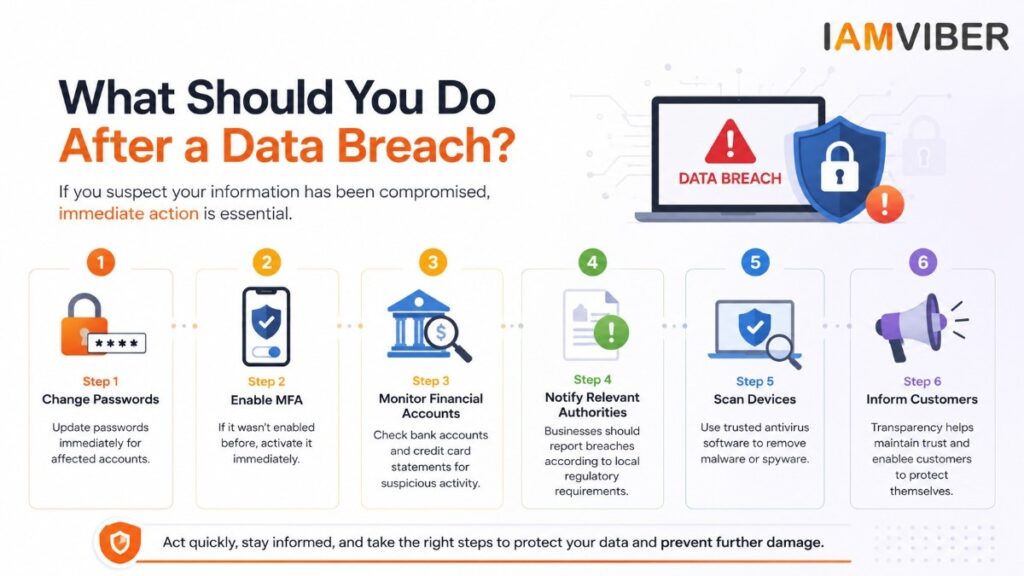
Step 1: Change Passwords
Update passwords immediately for affected accounts.
Step 2: Enable MFA
If it wasn’t enabled before, activate it immediately.
Step 3: Monitor Financial Accounts
Check bank accounts and credit card statements for suspicious activity.
Step 4: Notify Relevant Authorities
Businesses should report breaches according to local regulatory requirements.
Step 5: Scan Devices
Use trusted antivirus software to remove malware or spyware.
Step 6: Inform Customers
Transparency helps maintain trust and enables customers to protect themselves.
Why Data Privacy Matters More Than Ever
The digital economy depends on trust. Consumers expect companies to protect their personal information. Strong Data Privacy practices help organisations:
- Build customer confidence
- Meet legal compliance requirements
- Avoid financial penalties
- Protect brand reputation
- Improve long-term business resilience
Privacy should be integrated into every stage of product development rather than added later.
Future Trends in Data Breaches
Cyber threats continue evolving rapidly. Some emerging trends include:
- AI-powered phishing attacks
- Deepfake-based identity fraud
- Ransomware-as-a-Service
- Supply chain attacks
- Cloud infrastructure exploitation
- Internet of Things (IoT) vulnerabilities
- AI-assisted malware development
Businesses investing in proactive AI Cybersecurity technologies will be better positioned to defend against these evolving threats.
Conclusion
Understanding What is a Data Breach is no longer optional in today’s connected world. Cybercriminals constantly develop new techniques to steal sensitive information, making strong Cybersecurity practices essential for both individuals and organisations.
From recognising early warning signs to implementing effective Data Breach Prevention strategies, every proactive step reduces the likelihood of becoming a victim. Protecting Data Privacy through encryption, employee training, multi-factor authentication, and regular security audits creates a stronger defence against modern cyber threats.
As artificial intelligence reshapes both cyberattacks and security solutions, organisations must adopt advanced AI Cybersecurity tools to stay ahead of increasingly sophisticated attackers. The future belongs to businesses that treat cybersecurity as a continuous investment rather than a one-time project.
By understanding the causes, consequences, and prevention methods, you can make smarter decisions that protect your personal information, safeguard business assets, and build lasting digital trust.
Frequently Asked Questions (FAQs)
1. What is a Data Breach?
A data breach occurs when confidential, sensitive, or protected information is accessed, stolen, copied, or exposed by an unauthorized individual. Data breaches can affect personal accounts, businesses, government agencies, and healthcare organizations, often leading to financial losses and identity theft.
2. What are the most common causes of a data breach?
The most common causes of a data breach include phishing attacks, weak passwords, malware, ransomware, insider threats, software vulnerabilities, cloud misconfigurations, and stolen devices. Regular software updates and strong cybersecurity practices can significantly reduce these risks.
3. How can I tell if my personal data has been breached?
Some warning signs include unexpected password reset emails, unfamiliar login locations, unauthorized financial transactions, missing files, suspicious account activity, or notifications from companies informing you that your information has been compromised.
4. What information is usually stolen during a data breach?
Minor outages may last a few minutes, while larger disruptions can continue for several hours depending on the cause.
5. How can businesses prevent data breaches?
Businesses can reduce the risk of data breaches by implementing strong passwords, multi-factor authentication (MFA), employee cybersecurity training, regular security audits, software updates, data encryption, endpoint protection, and AI-powered threat detection systems.
6. What should I do immediately after a data breach?
If you suspect a data breach, change your passwords immediately, enable multi-factor authentication, monitor your financial accounts, scan your devices for malware, notify your bank if necessary, and report the incident to the relevant authorities or service provider.
7. What role does AI play in cybersecurity?
AI Cybersecurity solutions help organizations detect unusual network activity, identify malware, prevent phishing attacks, analyze security threats in real time, and respond to cyber incidents faster than traditional security systems, reducing the impact of potential data breaches.
8. Why is Data Privacy important in preventing data breaches?
Data Privacy ensures that personal and sensitive information is collected, stored, and processed securely. Strong privacy policies, encryption, access controls, and regulatory compliance help organizations protect customer data and minimize the risk of costly data breaches.
Topics to follow on IAMVIEBR : Current Affairs & Insights Tech Innovation GenZ entrepreneurship Collaborative Fashion GEO AI Agentic SME