AI Chip : Google & Samsung Collaboration
The race to develop more powerful artificial intelligence hardware is accelerating, and two of the world’s biggest technology companies may be preparing to deepen their collaboration. Recent reports suggest that Google and Samsung Electronics are working together on elements of a next-generation AI chip project that could play a significant role in the future of AI infrastructure.
While neither company has officially confirmed all of the reported details, industry observers are paying close attention because the partnership highlights several major trends shaping the semiconductor industry: the growing demand for AI computing power, the increasing importance of advanced manufacturing technologies, and the strategic need for companies to diversify their chip supply chains.
The Growing Importance of AI Chips
Artificial intelligence has become one of the most important drivers of innovation in the technology sector. From large language models and generative AI systems to advanced search capabilities and cloud computing services, AI applications require enormous amounts of computational power.
Traditional central processing units (CPUs) are often not sufficient for handling the massive workloads associated with training and running advanced AI models. As a result, technology companies have increasingly invested in specialized AI accelerators, graphics processing units (GPUs), and custom-designed chips.
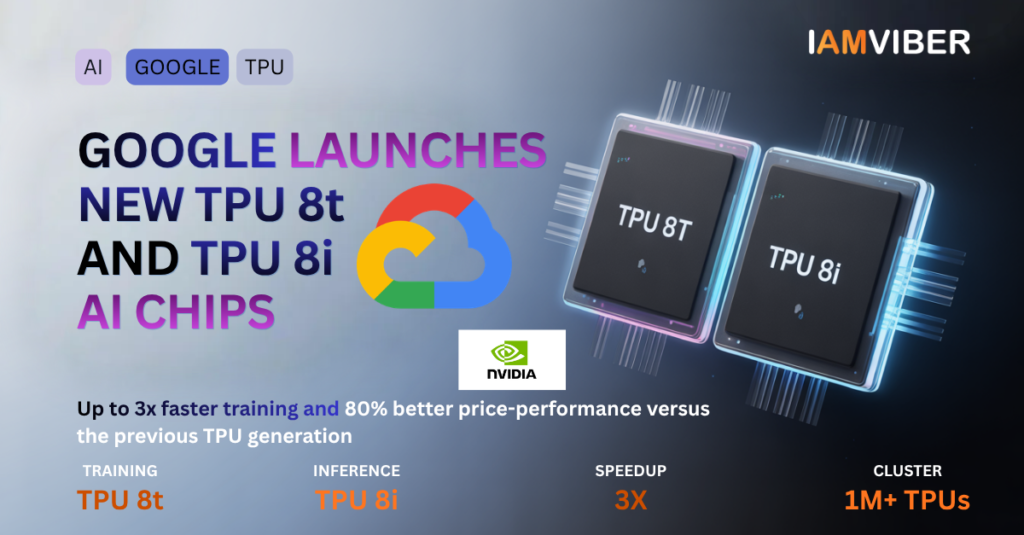
Google has been one of the pioneers in this area through its Tensor Processing Units (TPUs). These custom AI chips are designed specifically to accelerate machine learning workloads and have become a critical component of Google’s cloud and AI ecosystem.
As competition intensifies among major technology companies, the development of next-generation AI hardware has become a strategic priority. This context helps explain why reports of a Google-Samsung collaboration have generated significant interest across the semiconductor industry.
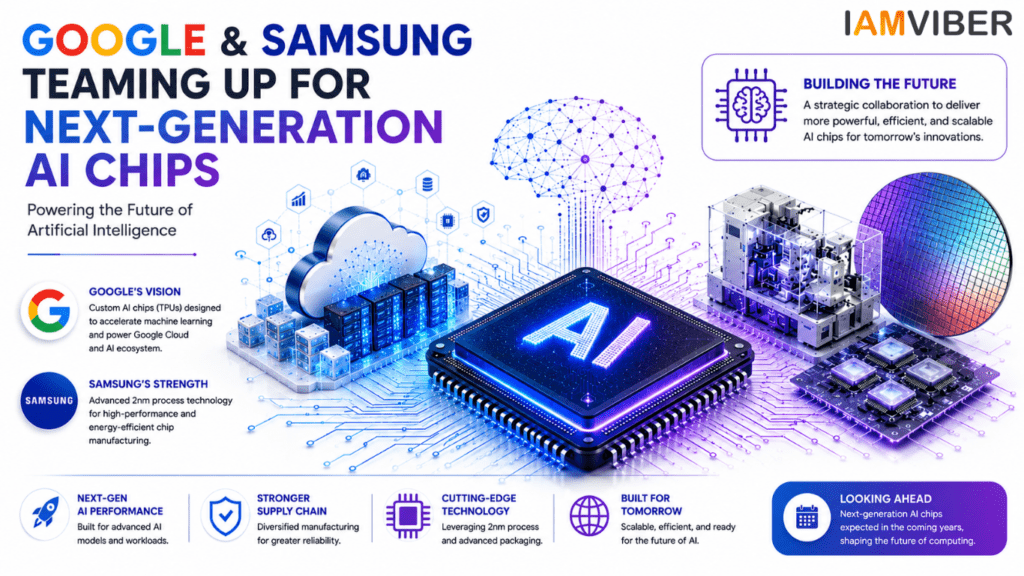
Google & Samsung are emerging as key players in the next phase of AI hardware innovation. While Google continues to expand its AI infrastructure through advanced Tensor Processing Units (TPUs), Samsung brings extensive expertise in semiconductor manufacturing and chip fabrication. A potential collaboration between Google & Samsung could combine Google’s AI software and hardware design capabilities with Samsung’s cutting-edge manufacturing technology, helping accelerate the development of more powerful and efficient AI chips for future applications.
What the Reports Suggest
According to industry reports, Google is developing a future AI processor reportedly known by the codename “Icefish.” The chip is expected to represent a significant advancement in Google’s TPU roadmap and could be used to support future generations of AI models and cloud services.
The reported arrangement suggests a division of responsibilities among multiple semiconductor partners. Taiwan Semiconductor Manufacturing Company (TSMC), the world’s leading contract chip manufacturer, is expected to produce the primary compute portion of the chip. Samsung, meanwhile, may be responsible for manufacturing a crucial component involved in memory connectivity.
Although this arrangement remains subject to change, it reflects a growing trend toward highly specialized semiconductor supply chains where different companies contribute expertise in specific areas of chip production.
The reports also indicate that MediaTek may be involved in aspects of the chip design process. Such collaborations are becoming increasingly common as the complexity of AI processors continues to increase.
chips have become the backbone of modern artificial intelligence infrastructure, enabling faster data processing, improved model training, and more efficient deployment of advanced AI applications. As demand for generative AI, machine learning, and cloud-based AI services continues to grow, technology companies are investing heavily in next-generation AI chip development. These specialized processors are designed to handle complex AI workloads more efficiently than traditional computing hardware, making them a critical component of the future AI ecosystem.
Why Samsung Matters
Samsung is one of the few companies in the world capable of manufacturing chips using the most advanced semiconductor process technologies.
The company has invested heavily in its foundry business, which manufactures chips for external customers. While Samsung remains a major producer of memory chips and consumer electronics, it has also been working to strengthen its position against TSMC in the contract manufacturing market.
One of the most significant aspects of the reported partnership is Samsung’s advanced 2-nanometer manufacturing technology. Semiconductor process nodes continue to shrink, allowing more transistors to be packed into a smaller area. This generally leads to improvements in performance, energy efficiency, or both.
For AI workloads, these advantages can be particularly important. Large AI models require enormous computing resources, and even small improvements in chip efficiency can translate into substantial reductions in energy consumption and operating costs.
If Samsung ultimately secures a role in producing components for Google’s future AI chips, it would represent a major validation of the company’s advanced manufacturing capabilities.
Strategic Benefits for Google
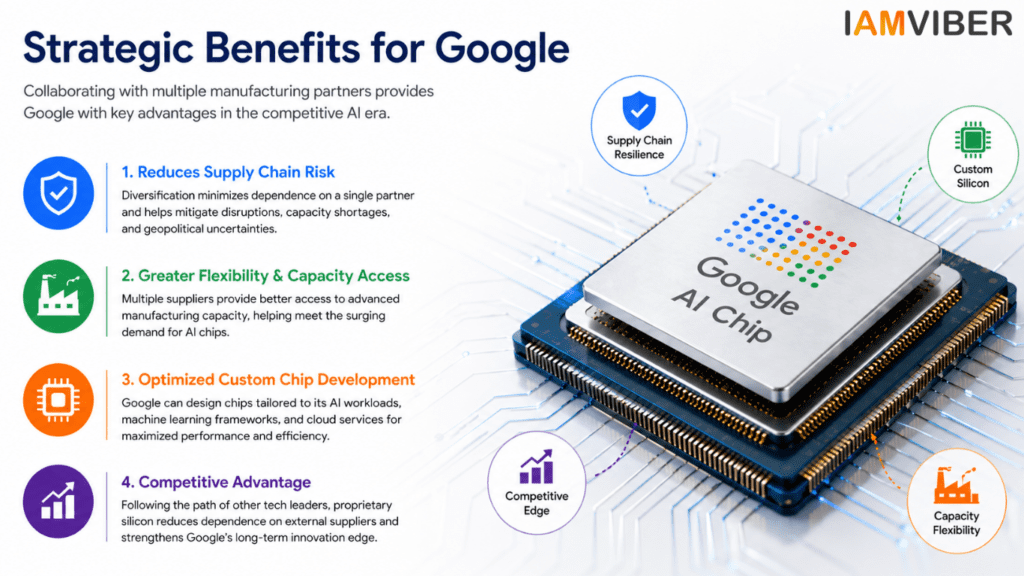
For Google, collaborating with multiple manufacturing partners could provide several important advantages.
First, diversification reduces supply chain risk. The semiconductor industry has experienced significant disruptions in recent years, including capacity shortages and geopolitical concerns. Relying too heavily on a single manufacturing partner can create vulnerabilities.
Second, working with multiple suppliers may provide greater flexibility in securing production capacity. Demand for AI chips has surged dramatically as businesses and governments invest heavily in artificial intelligence technologies. Access to sufficient manufacturing capacity is becoming a competitive advantage in its own right.
Third, custom chip development allows Google to optimizehardware specifically for its AI workloads. Rather than depending entirely on third-party processors, Google can tailor chip architectures to support its own machine learning frameworks and cloud services.
This strategy mirrors efforts by other major technology companies that are increasingly designing proprietary silicon to gain performance advantages and reduce dependence on external suppliers.
The Broader AI Hardware Competition
The reported collaboration must also be viewed within the context of the broader AI hardware race.
NVIDIA currently dominates the market for AI accelerators, particularly in training large-scale AI models. Its GPUs have become the standard platform for many AI developers and cloud providers.
However, major technology companies are investing billions of dollars to develop alternatives. Google, Microsoft, Amazon, Meta, and others have all expanded their efforts to create custom AI hardware tailored to their specific needs.
Custom chips can offer several benefits, including lower costs, better performance for specialized tasks, and tighter integration with proprietary software ecosystems.
As AI workloads continue to grow, demand for specialized silicon is expected to remain strong. This has transformed advanced semiconductor manufacturing into one of the most strategically important industries in the world.
Although the reported Icefish project is still several years away from large-scale production, the potential collaboration between Google and Samsung highlights the direction in which the AI industry is moving.
Future AI systems will require increasingly powerful and efficient hardware. Meeting those demands will depend not only on breakthroughs in software and algorithms but also on continued innovation in semiconductor design and manufacturing.
For Google, the development of advanced AI chips remains central to its long-term AI strategy. For Samsung, participation in such a project could reinforce its ambitions to become a leading force in next-generation semiconductor manufacturing.
While many details remain unconfirmed, the reported partnership underscores a fundamental reality of the modern technology landscape: the future of artificial intelligence will be shaped as much by advances in hardware as by advances in software.
As the global competition for AI leadership intensifies, collaborations between major technology companies and semiconductor manufacturers are likely to become increasingly important. Whether the Icefish project ultimately proceeds as reported or evolves in a different direction, it represents another example of how AI is reshaping the priorities of the world’s leading technology firms and driving a new era of semiconductor innovation.
Topics to follow: Current Affairs & Insights Tech Innovation GenZ entrepreneurship Collaborative Fashion GEO AI Agentic SME