For the last two years, the artificial intelligence conversation has been dominated by companies like OpenAI, Google, and Anthropic. ChatGPT, Gemini, and Claude have rapidly evolved into powerful AI assistants capable of reasoning, writing, coding, and handling complex tasks.
Meanwhile, Apple seemed strangely quiet.Critics argued that Apple had fallen behind in the AI race. Competitors were releasing increasingly capable models while Siri remained largely unchanged. Many questioned whether Apple had missed the biggest technology shift since the smartphone.
Then came WWDC 2026.
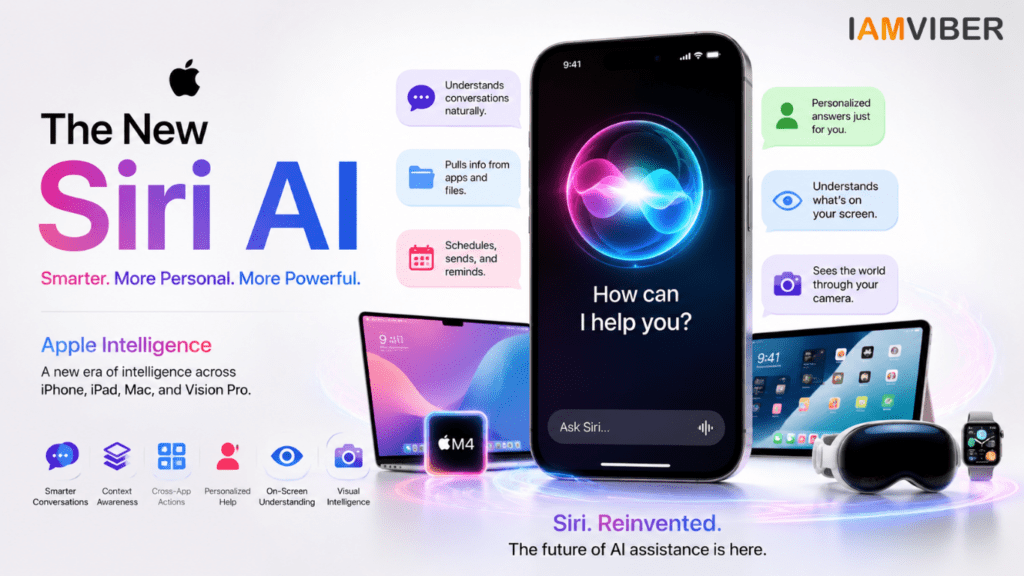
Apple unveiled a dramatically redesigned Siri AI, introducing its most significant voice assistant upgrade since Siri first launched in 2011. The company positioned Siri at the center of its next-generation Apple Intelligence strategy, integrating AI deeply across iPhone, iPad, Mac, Apple Watch, and Vision Pro.
The announcement has sparked a fascinating debate across the tech industry:
Could Apple’s new Siri be the dark horse in the AI race?
The answer might be yes.
Why Apple Was Considered Behind
Before understanding why Siri could become a serious AI contender, it is important to understand why many believed Apple was losing.
When OpenAI launched ChatGPT in late 2022, it fundamentally changed expectations for digital assistants. Users suddenly experienced conversational AI that could write essays, summarize documents, generate code, and answer complex questions.
Google responded with Gemini. Anthropic pushed forward with Claude. Microsoft embedded AI throughout its products. Meanwhile, Siri often struggled with tasks that modern AI systems handled effortlessly.
Apple announced Apple Intelligence in 2024, but several advanced Siri capabilities experienced delays, creating skepticism among users and investors. The company’s cautious rollout strategy contrasted sharply with competitors’ rapid release cycles.
As a result, many observers viewed Apple as an AI follower rather than a leader. That perception may now be changing.
The Siri Reinvention
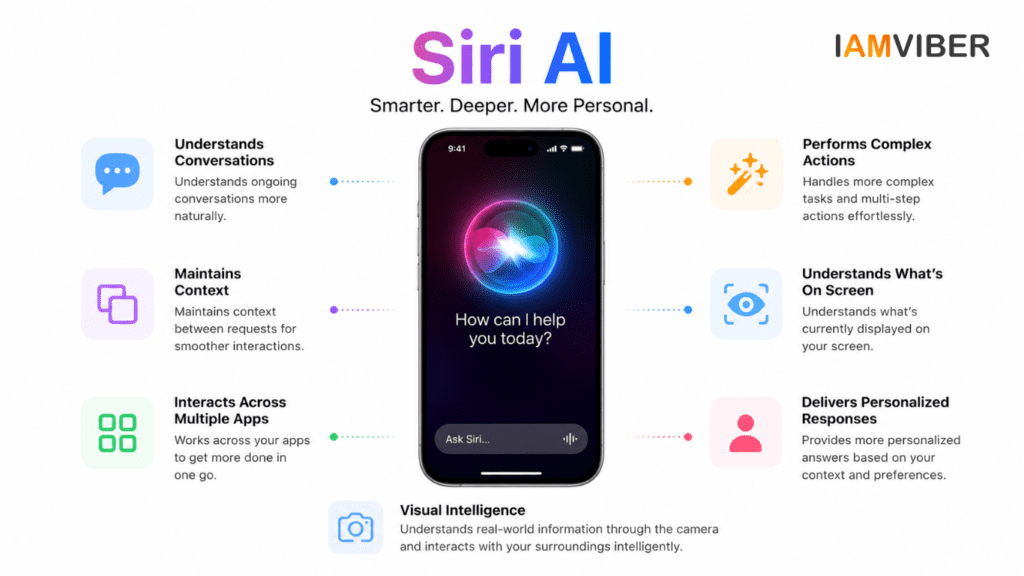
At WWDC 2026, Apple introduced what it calls “Siri AI,” a fundamentally redesigned assistant powered by next-generation Apple Intelligence technologies. The new Siri focuses on conversation, context awareness, personalization, and deeper integration across Apple devices. Unlike previous versions, Siri can:
- Understand ongoing conversations more naturally
- Maintain context between requests
- Interact across multiple apps
- Perform more complex actions
- Understand what's currently displayed on screen
- Deliver more personalized responses based on user context
- Apple also introduced Visual Intelligence, allowing AI features to understand information captured through the camera and interact with real-world content more intelligently.
- These upgrades represent much more than a routine software update.
- They represent Apple's attempt to transform Siri from a simple voice command system into a genuine AI assistant.
Why Apple Might Surprise Everyone
1. Apple Has the Largest Distribution Advantage
Most AI companies must convince users to download an app. Apple already owns the platform.
The company has more than 2.5 billion active devices worldwide, giving Siri a distribution advantage unmatched by nearly every AI competitor. If Apple successfully rolls out a useful AI assistant across its ecosystem, adoption could happen at a scale that startups can only dream about.
OpenAI may have millions of users. Apple has billions of devices. That difference matters.
2. AI Works Best When It Controls the Entire Ecosystem
One of Apple’s greatest strengths has always been ecosystem integration. The company controls:
- Hardware
- Operating systems
- Core applications
- Security architecture
- Device-to-device communication
- Because of this control, Siri can potentially access information and perform actions that standalone AI apps cannot easily replicate.
Imagine asking Siri:
- Schedule a meeting
- Find related emails
- Pull supporting files
- Send invitations
- Update reminders
- All without switching apps. This type of seamless integration could become Apple's biggest AI advantage. Competitors may have stronger models today, but Apple may provide a smoother user experience.
3. Apple's Privacy Strategy Could Become a Competitive Weapon
Privacy has long been a cornerstone of Apple’s brand. While many AI systems rely heavily on cloud processing, Apple continues emphasizing privacy-focused AI experiences and on-device intelligence wherever possible. This approach may resonate with users who are increasingly concerned about:
- Data collection
- Personal information exposure
- AI surveillance
- Security risks
- As AI becomes more integrated into daily life, trust could become just as important as capability. Apple understands this.
4. Siri Is Being Designed for Utility, Not Just Conversation
Many AI assistants are becoming increasingly conversational. Apple appears to be taking a different route.
Reports suggest the new Siri focuses heavily on efficiency and practical usefulness rather than trying to behave like a virtual friend or companion. That distinction may sound minor, but it could prove important.
Most users don’t necessarily need another chatbot. They need an assistant that gets things done. If Siri consistently helps users complete tasks faster, adoption could accelerate quickly.
Challenges Apple Still Faces
Despite the excitement, Apple’s AI journey is far from guaranteed. Several obstacles remain.
Device Limitations
Not every Apple user will receive the full Siri experience. Analysts estimate that hundreds of millions of older iPhones lack the hardware requirements needed for advanced Apple Intelligence features.
This creates a significant adoption challenge. A revolutionary AI assistant cannot transform the ecosystem if much of the ecosystem cannot run it.
Apple Is Still Catching Up
While Siri has improved dramatically, competitors have spent years refining their models. OpenAI continues advancing ChatGPT. Google is aggressively improving Gemini. Anthropic is rapidly expanding Claude’s capabilities.
Apple must prove that Siri can compete not only in demonstrations but also in everyday usage. The AI race is moving incredibly fast.
Expectations Are Higher Than Ever
Apple delayed several AI initiatives in the past, leading to criticism and skepticism. Now the company faces enormous expectations. Users want:
- Reliability
- Accuracy
- Speed
- Natural conversations
- Complex task execution
- Anything less could reignite concerns that Apple remains behind.
What Makes Siri Different from ChatGPT, Gemini, and Claude?
The key difference is philosophy. ChatGPT, Gemini, and Claude primarily function as AI platforms.
Siri aims to become an operating-system-level assistant. Instead of simply answering questions, Siri is being designed to interact with apps, understand device context, and perform actions throughout Apple’s ecosystem. In other words:
ChatGPT wants to be your AI companion.
That distinction could reshape how consumers think about AI assistants over the next few years.
Why the "Dark Horse" Label Fits
A dark horse is a competitor that few people expect to win but possesses hidden strengths that could dramatically change the outcome. Apple fits that description perfectly.
For much of the AI boom, the spotlight focused on OpenAI, Google, Microsoft, and Anthropic. Apple was viewed as late. Slow. Behind. Yet today, the company possesses:
- A massive device ecosystem
- Deep hardware-software integration
- Strong brand trust
- Growing AI capabilities
- A privacy-focused strategy
- A redesigned Siri built specifically for everyday users
- Those assets make Apple uniquely positioned to challenge AI leaders. The company may not have launched first. But history shows Apple rarely succeeds by being first.
- Instead, Apple often succeeds by making emerging technologies more useful, more accessible, and more mainstream.
Final Thoughts
The AI race is still in its early stages, and no company has secured a permanent lead. OpenAI, Google, and Anthropic continue pushing the boundaries of what AI models can do. However, Apple’s revamped Siri introduces a different vision—one centered on practical assistance, ecosystem integration, and privacy.
Whether Siri ultimately becomes the dominant AI assistant remains uncertain. What is clear is that Apple is no longer sitting on the sidelines.
With billions of devices, deep platform control, and a significantly smarter Siri, Apple may have quietly positioned itself as one of the most dangerous competitors in the AI landscape.
And that is exactly why Apple’s new Siri might be the biggest dark horse in the AI race.
Topics to follow : Current Affairs & Insights Tech Innovation GenZ entrepreneurship Collaborative Fashion GEO AI Agentic SME