
From Corporate Life to Building a Food Brand The Entrepreneurial Journey of Madan Kumar
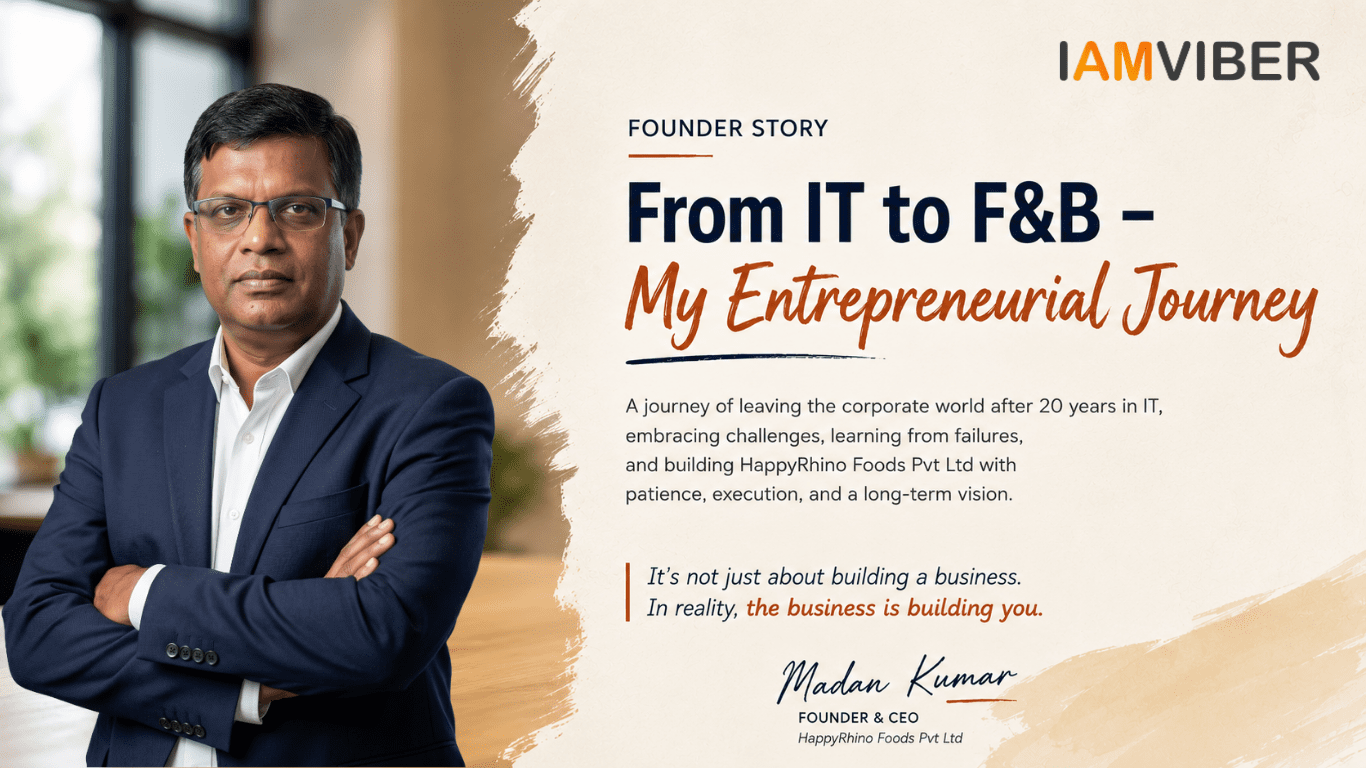
In today’s fast-changing business world, entrepreneurship is no longer limited to tech startups or venture-funded companies. More professionals are stepping away from stable corporate careers to build something of their own — something meaningful, impactful, and deeply personal. One such inspiring story is that of Madan Kumar, the Founder & CEO of HappyRhino Foods Pvt Ltd.
After spending nearly two decades in the IT industry, Madan Kumar made a bold transition into the food and beverage sector. His entrepreneurial journey is not just about starting a business; it is about personal transformation, resilience, patience, and learning through real-world experiences.
This story offers valuable lessons for aspiring entrepreneurs, startup founders, and anyone dreaming of building something independently.
Leaving Corporate Comfort Behind
For many professionals, a long corporate career provides stability, routine, and financial security. But for Madan Kumar, after almost 20 years in IT, there was a growing desire to create something beyond the structured corporate environment. He wanted to apply the lessons he had learned throughout his career into building his own venture.
Entrepreneurship often begins with a simple thought: “What if I build something of my own?”
That thought eventually became the foundation of HappyRhino Foods Pvt Ltd — a company built on practical learning, market understanding, and long-term vision. The shift from corporate life to entrepreneurship is never easy. In a job, there are managers, teams, processes, and systems guiding daily work. But in a startup, founders must make decisions independently. There is no roadmap, no guaranteed outcome, and no one constantly providing direction. This independence can feel exciting and overwhelming at the same time.
Entrepreneurs Are Built, Not Born
One of the strongest beliefs shared by Madan Kumar is that entrepreneurs are not born naturally — they are built through experience.
This perspective challenges the common myth that successful founders possess some magical talent from birth. In reality, entrepreneurship is shaped by failures, challenges, learning, adaptability, and consistency.
Every entrepreneur develops through:
- Real-world experiences
- Problem-solving under pressure
- Understanding people and markets
- Learning from mistakes
- Continuous self-improvement
This is especially relevant for young founders in India today. Many aspiring entrepreneurs spend too much time consuming theoretical knowledge online without testing ideas in the actual market. But true entrepreneurial growth comes from implementation, not just information.
The Biggest Startup Mistake: Product Market Fit
According to Madan Kumar, one of the biggest mistakes first-time founders make is getting their Product Market Fit (PMF) wrong.
For startups, Product Market Fit means building a product or service that genuinely solves a problem for the right audience. Many founders become emotionally attached to their idea without validating whether the market actually needs it.
This often leads to:
- Building for the wrong audience
- Poor customer demand
- Weak brand positioning
- Unsustainable growth
Even Madan Kumar admits that during his early entrepreneurial journey, he initially misunderstood the market and had to spend significant time course-correcting. However, this challenge eventually became a valuable learning experience. It helped him understand real customer behavior, market expectations, and what actually works beyond theory. For startups today, this lesson is critical: Before scaling, perfect your Product Market Fit.
Why Execution Matters More Than Ideas
In the startup ecosystem, ideas are everywhere. Every day, thousands of people discuss innovative concepts, billion-dollar opportunities, and disruptive business models. But according to Madan Kumar, execution matters far more than the idea itself. An idea without execution remains just a thought. Successful execution requires:
- Discipline
- Consistency
- Teamwork
- Market understanding
- Operational efficiency
- Customer focus
Many people dream about starting a business, but only a few can successfully execute under uncertainty and pressure. The ability to consistently take action is what separates entrepreneurs from dreamers.
Building the Right Team Early
Another important insight from Madan Kumar’s entrepreneurial journey is the importance of building a strong core team from the beginning. While founders often handle multiple responsibilities during the early stages, entrepreneurship should never become a completely solo journey.
A startup’s early team plays a major role in:
- Setting company culture
- Handling operations
- Supporting decision-making
- Solving unexpected problems
- Maintaining execution speed
As businesses grow, specialized leadership roles in sales, marketing, HR, and operations become necessary. But in the beginning, adaptability and commitment matter more than hierarchy. Strong businesses are rarely built alone.
Risk-Taking and Confidence
Entrepreneurship always involves risk. Leaving a stable career to start a business requires confidence, emotional resilience, and long-term thinking. For Madan Kumar, the confidence to take risks came from life experiences. People who have faced challenges, uncertainty, and real-world struggles often develop stronger decision-making abilities. Over time, experiences build emotional strength and help entrepreneurs remain calm during difficult phases. He also highlights an important reality: Corporate life may work well for some individuals, but not everyone thrives in highly structured and rigid environments. Entrepreneurship offers freedom, creativity, and ownership — but it also demands accountability and patience.
The Loneliness of Entrepreneurship
One of the most honest parts of entrepreneurship is loneliness. Madan Kumar describes the loneliest phase as the journey toward profitability. Behind every growing business are countless unseen struggles:
- Financial pressure
- Operational challenges
- Team management
- Customer acquisition
- Market uncertainty
- Personal sacrifices
Many of these decisions cannot easily be shared with others. Founders often carry emotional and mental pressure silently while continuing to lead their business confidently. This is why entrepreneurship requires mental resilience just as much as business intelligence.
Profitability Over Hype
In today’s startup culture, funding announcements often receive more attention than sustainable business growth. But Madan Kumar strongly believes that founders should focus on building a sustainable business first. Funding should primarily help scale a proven business model — not compensate for the absence of one. This approach reflects a growing shift toward bootstrapped and profitability-driven businesses, especially in India’s evolving startup ecosystem. In fact, one startup myth he strongly disagrees with is the belief that every successful business requires investor funding. Sometimes, bootstrapping is the smarter and healthier path.
Founder Burnout Is Real
Entrepreneurship can be emotionally exhausting. Long working hours, uncertainty, constant decision-making, and business pressure often lead to founder burnout. Madan Kumar openly acknowledges that burnout is very real. To stay mentally balanced, he dedicates at least one hour daily to meditation and self-connection.
This highlights an important lesson for modern entrepreneurs: Mental clarity is a business asset. Successful founders today increasingly focus on:
- Mental wellness
- Emotional balance
- Physical health
- Self-awareness
- Mindfulness practices
A healthy founder builds a healthier business.
The Future of AI in Entrepreneurship
Like many modern business leaders, Madan Kumar believes Artificial Intelligence will significantly shape entrepreneurship over the coming years.
AI tools are already helping businesses with:
- Market research
- Consumer behavior analysis
- Business expansion planning
- Automation
- Customer support
- Data-driven decision making
What previously required expensive and time-consuming ground research can now be accelerated through AI-powered tools and insights. However, technology alone is never enough. Founders still need human judgment, creativity, and market understanding to build successful brands.
The Importance of Patience
When asked about the most underrated skill for entrepreneurs, Madan Kumar gives a simple yet powerful answer: Patience. In the era of instant gratification and viral success stories, many young entrepreneurs expect fast results. But real business growth takes time. The road to profitability is often long, uncertain, and difficult.
His advice to young entrepreneurs is deeply practical: Focus on understanding your market, stay patient, and continue learning through action. Because in the end, entrepreneurship is not only about building a business. Sometimes, the business is actually building you.
Final Thoughts
The journey of Madan Kumar is a reminder that entrepreneurship is not about overnight success, funding headlines, or social media hype. It is about persistence, execution, learning, patience, and self-growth.
From spending 20 years in IT to building a food and beverage venture, his story reflects the mindset required to succeed in today’s entrepreneurial world.
For aspiring founders, the biggest takeaway is simple: Start learning from the market, focus on execution, build sustainably, and trust the process. Because entrepreneurship is not a shortcut to success — it is a journey that transforms the person building it.