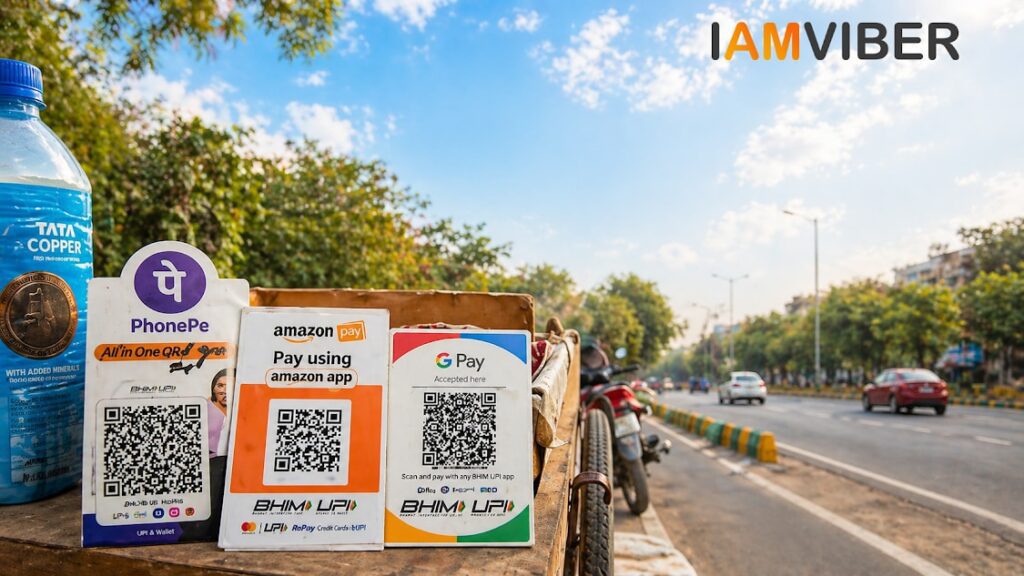
The Battle for India’s Digital Payments Dominance
India’s digital payments ecosystem has quietly become one of the most powerful in the world. What looks like a simple “scan and pay” experience is actually supported by a massive infrastructure handling billions of transactions every month.
At the center of this system is Unified Payments Interface (UPI). And while everything feels smooth for users, behind the scenes, a serious power struggle is going on.
Global giants like Amazon and Meta are trying to challenge the dominance of Google Pay and PhonePe—two apps that currently control most of India’s UPI ecosystem.
UPI — The Backbone of India’s Cashless Economy
UPI has completely changed how India pays. It is fast, free for users, and extremely easy to use. Built by the National Payments Corporation of India, it was designed as an open system where multiple apps could compete equally.
Today, UPI is part of everyday life—from splitting bills to paying at local shops.
Why UPI Works So Well
- It processes billions of transactions every month
- Works 24/7 with instant settlement
- Connects banks, users, and merchants in one system
- Drives India’s shift toward a cashless economy
A Market Dominated by Two Players
Even though UPI is an open platform, the reality is very different. Google Pay and PhonePe dominate the market.
Over time, they’ve built strong user habits and huge merchant networks. That makes it very hard for new players to compete.
Why This Dominance Exists
- People use what everyone around them is using
- Switching apps feels unnecessary once trust is built
- Merchants prefer apps with more users
Current Market Reality
- Majority of UPI transactions go through these two apps
- New apps struggle to gain visibility
- The ecosystem is slowly turning into a duopoly
Why Amazon and Meta Are Challenging the System
India is too big a market for companies like Amazon and Meta to ignore.
They already have strong platforms:
- Amazon → shopping ecosystem
- Meta → WhatsApp user base
But their payment services haven’t scaled as expected.
The Real Problem
It’s not about features. It’s about user behavior. People don’t easily change their primary payment app especially when money is involved.
Their Key Concerns
- Breaking existing user habits is very difficult
- Limited merchant acceptance compared to leaders
- Need for better regulatory balance
The 30% Market Share Cap — A Delayed Game Changer
To prevent monopoly-like situations, India introduced a rule:
No single UPI app should control more than 30% of the market.
Sounds fair, right? But here’s the issue—it has been repeatedly delayed.
Why This Matters
- Big players keep growing without restrictions
- Smaller players don’t get enough room to scale
- Market imbalance continues
Impact of the Delay
- Regulatory uncertainty increases
- Competition weakens
- Dominant apps become even stronger
Why This Battle Matters Beyond Companies
This is not just a fight between companies—it directly affects India’s digital future.
If too much power stays with a few players, it can slow innovation and increase risks.
Bigger Picture Impact
- More competition = better innovation
- Less concentration = lower system risk
- More options = better user experience
For Users and Businesses
- More rewards and features
- Better services
- Healthier ecosystem overall
Challenges Amazon and Meta Still Face
Even with strong backing, Amazon Pay and WhatsApp Pay face real challenges.
The Core Issue
People trust what they already use. And in payments, trust matters more than anything.
Key Challenges
- Strong loyalty toward existing apps
- No major differentiation in features
- High dependency on trust
- Changing habits is extremely difficult
What Happens Next?
The future of this battle depends on three things:
- Regulation
- Innovation
- User behavior
Possible Scenarios
- Stronger regulation: Market share cap enforced
- Status quo: Leaders continue to dominate
- New disruption: Innovation changes the game
What to Watch
- Government policies
- New features or incentives
- User adoption trends
Final Thoughts — The Human Side of the Story
For users, UPI feels effortless—just scan and pay.
But behind that simplicity is a complex battle between billion-dollar companies, policies, and technology.
The Real Question
Who wins?
The Real Answer
It shouldn’t just be companies.
Ideally
The system should stay
- Open
- Competitive
- Reliable
Because in the end
The real winner should always be the user—not the platforms.