The semiconductor industry is watching a potentially important development involving SK hynix and Intel. The SK Hynix Intel deal is being discussed as a possible route for producing memory chips in the United States, with Intel’s long-planned Ohio manufacturing campus among the options reportedly being considered. Discussions remain exploratory, but the development matters because artificial intelligence is creating enormous demand for advanced memory, particularly high-bandwidth memory (HBM).
The SK Hynix Intel deal also highlights how chip companies are trying to build more resilient supply chains closer to major customers.
What Is the SK Hynix Intel Deal About?
The SK Hynix Intel deal could reshape how AI memory capacity is planned in the U.S.
Reports published on September 16, 2026, said SK hynix is exploring U.S. memory production with Intel. One reported scenario involves leasing part of Intel’s Ohio facility, while another involves a joint venture with major cloud companies.
SK hynix has said that no specific decision has been made and that it is reviewing different options for strengthening its memory business. That makes the SK Hynix Intel deal a proposal under consideration rather than a completed transaction.
Why Is AI Driving Demand for Memory?
The SK Hynix Intel deal is closely connected to the AI memory boom.
Modern AI systems require far more than powerful processors. They also need enormous amounts of fast memory to move data between computing components. HBM has become particularly important because it can provide high bandwidth for AI accelerators and data-center workloads.
As cloud companies build larger AI infrastructure, demand for advanced memory has increased. This is one reason the SK Hynix Intel deal is attracting attention beyond the semiconductor manufacturing sector.
SK hynix is already heavily involved in the HBM market. Its U.S. expansion plans include an advanced packaging facility in Indiana, which the company has described as an AI memory production hub. The company says the facility is intended to support next-generation HBM and advanced packaging, with U.S. supply targeted from 2029.
Why Is Intel Stock Trending?
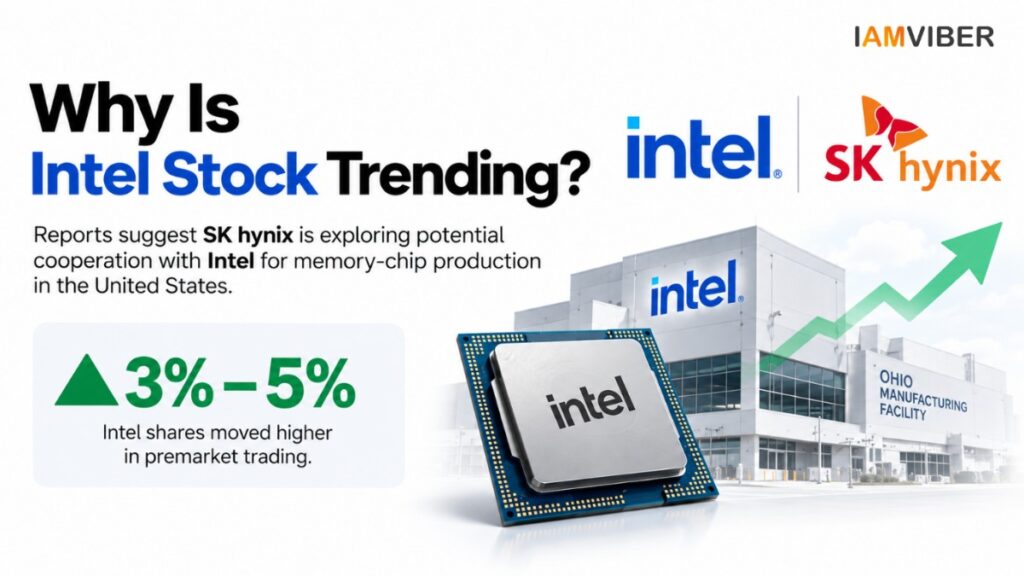
The recent Intel stock movement is closely linked to reports that SK hynix is exploring potential cooperation with Intel for memory-chip production in the United States.
Following the reports, INTC stock attracted increased market attention, with Intel shares reportedly moving around 3%–5% higher in premarket trading after the reports emerged.
The market reaction reflects investor interest in what a potential partnership could mean for Intel’s manufacturing assets and its position in the growing AI semiconductor market.
The Intel stock reaction is particularly notable because the reported discussions could potentially give Intel’s Ohio manufacturing infrastructure another role in the semiconductor supply chain. However, the discussions remain exploratory, meaning the reported percentage move should not be interpreted as confirmation of a completed deal or a guaranteed long-term impact on the company.
How Could Intel’s Ohio Facility Fit Into the Plan?
The SK Hynix Intel deal could give the Ohio project a new potential role.
Intel’s Ohio project has been positioned as a major semiconductor manufacturing investment, but its construction and production timelines have faced delays. A potential arrangement with SK hynix could create another possible use for part of that infrastructure.
If the SK Hynix Intel deal moves forward through an Ohio arrangement, SK hynix could potentially gain access to an established U.S. semiconductor site instead of building an entirely new location from scratch.
For Intel, such an arrangement could create another commercial relationship around its Ohio investment, while SK hynix could gain a pathway toward local memory manufacturing. Semiconductor fabs require specialized equipment, suppliers, engineering talent and controlled manufacturing environments, so expansion would involve much more than occupying factory space.
What Could the Deal Mean for Intel Stock?
For Intel stock, a potential agreement with SK hynix could create attention around Intel’s manufacturing strategy and future use of its Ohio facility.
Investors may look at several numbers if a formal agreement is announced, including the size of the investment, production capacity, facility utilization and potential revenue contribution.
At present, however, no confirmed financial figures for a potential SK Hynix Intel deal have been announced.
The INTC stock movement therefore reflects market reaction to the news rather than a confirmed change in Intel’s financial results.
Any meaningful long-term effect on Intel stock would depend on the final structure of the partnership, investment commitments and the type of memory production ultimately planned.
Why Is U.S. Semiconductor Manufacturing Important?
The SK Hynix Intel deal also reflects the changing geography of semiconductor manufacturing.
The semiconductor supply chain is distributed across the United States, South Korea, Taiwan, Japan and other regions, covering design, wafer manufacturing, memory, packaging and equipment.
For American technology companies, local semiconductor capacity can help reduce dependence on overseas supply chains. For memory manufacturers, U.S. production can bring them closer to major cloud and AI customers.
U.S. manufacturing can also be more expensive because of construction, labor, infrastructure and supply-chain requirements, making economics an important consideration.
This is where U.S. semiconductor manufacturing becomes an important part of the wider story. Companies are increasingly balancing production efficiency with supply security and proximity to customers.
What Role Could HBM Memory Play?
For AI infrastructure, the SK Hynix Intel deal is especially relevant because of HBM demand.
HBM is one of the most important memory technologies for modern AI computing. Unlike conventional memory products, HBM uses vertically stacked memory dies and advanced packaging techniques to provide very high data-transfer performance.
AI accelerators depend on fast memory because they process huge volumes of data, making memory bandwidth increasingly important as AI models and data centers grow.
This is why the SK Hynix Intel deal could matter for the AI hardware ecosystem. If the companies eventually establish U.S.-based production for advanced memory, it could add another source of supply for AI infrastructure.
The exact type of memory that could eventually be produced in the United States under any future arrangement has not been finalized.
Could Cloud Companies Become Part of the Partnership?
Another possibility in the SK Hynix Intel deal is the involvement of large cloud companies.
Cloud providers are among the biggest buyers of AI infrastructure. They need processors, networking equipment, storage and memory at massive scale. Securing reliable access to advanced memory can therefore become an important part of their infrastructure strategy.
A joint venture involving chipmakers and cloud companies could theoretically give customers more visibility into future supply while giving manufacturers stronger demand commitments.
Such a structure would still require agreement on investment, production targets, technology access and capacity allocation.
This could make SK Hynix memory chips an increasingly important part of the AI infrastructure conversation, especially as cloud companies expand their AI data-center footprints.
What Are the Biggest Challenges?
The main challenges are cost and technology. Competitive memory manufacturing requires major capital investment, specialized processes, equipment and intellectual property.
Even with U.S. manufacturing, many semiconductor materials and equipment components would still come from international suppliers.
Regulatory review is another consideration. Advanced memory technologies can have strategic importance, so cross-border technology transfers and investments may receive additional scrutiny.
These factors mean the SK Hynix Intel deal could take time to develop even if both companies see commercial value in cooperation.
SK hynix’s Existing U.S. Expansion
The potential partnership should also be viewed alongside SK hynix’s existing U.S. investment.
In August 2026, SK hynix announced the groundbreaking of its Indiana AI memory facility. The company described the project as its first AI memory production hub in the United States and said it would focus on next-generation HBM and advanced packaging.
The SK Hynix Intel deal would add another layer to SK hynix’s U.S. strategy.
This existing investment makes the SK Hynix Intel deal particularly interesting because a future U.S. manufacturing arrangement could potentially complement, rather than replace, SK hynix’s Indiana operations.
The company is therefore building a broader U.S. footprint around AI memory, with manufacturing and advanced packaging becoming important parts of that strategy.
What It Means for the Global AI Chip Supply Chain
The semiconductor industry is placing greater emphasis on supply security as AI infrastructure expands. Memory is a critical part of that infrastructure, encouraging companies to secure capacity ahead of demand.
The SK Hynix Intel deal fits into this wider shift. Instead of relying entirely on manufacturing concentrated in Asia, memory companies can explore additional production locations closer to customers.
For the United States, domestic memory capacity could strengthen the semiconductor ecosystem. For SK hynix, it could bring production closer to AI customers, while Intel could gain another use for its manufacturing infrastructure.
The development also connects with the growing importance of HBM memory. HBM is increasingly associated with AI accelerators, making reliable production capacity strategically important for the broader AI hardware market.
What Investors Are Watching in INTC Stock
The latest development gives INTC stock another semiconductor-related catalyst to watch. Beyond the reported 3%–5% premarket move, investors are likely to focus on whether Intel and SK hynix announce an actual agreement and whether the Ohio facility becomes part of the plan.
Other factors that could influence Intel stock include Intel’s manufacturing investments, AI infrastructure demand and the company’s broader semiconductor strategy.
For now, the Intel stock story is tied to expectations around the potential partnership.
Until specific terms are announced, numbers such as investment size, production volumes and expected revenue impact remain unknown. This makes the reported SK Hynix Intel deal an important development to monitor rather than a finalized business transaction.
What Happens Next?
The biggest question is whether discussions turn into a formal agreement.
At present, SK hynix has emphasized that nothing specific has been finalized. Several structures remain possible, including leasing manufacturing space, creating a joint venture or pursuing another U.S. production strategy.
The SK Hynix Intel deal should therefore be viewed as an evolving semiconductor industry development rather than a completed partnership.
If an agreement happens, its location, memory technology, investment size and production timeline will determine its impact.
For technology companies, one of the biggest things to watch will be whether any eventual facility focuses on conventional DRAM, NAND or advanced HBM-related production.
Final Takeaway
For the AI hardware industry, the SK Hynix Intel deal is worth watching as discussions develop.
The SK Hynix Intel deal is notable because it connects three major trends: the rapid expansion of AI infrastructure, rising demand for advanced memory and the push to diversify semiconductor manufacturing.
SK hynix already has a growing U.S. presence through its Indiana AI memory project, while Intel has a major manufacturing site planned in Ohio. Bringing those capabilities together could create a new model for producing memory closer to U.S. AI customers.
But the proposal is still developing, and no final agreement has been announced. For now, the most important story is the changing geography of AI memory production.
As AI data centers continue to expand, companies that can secure advanced memory capacity, packaging capabilities and reliable manufacturing networks will remain central to the next phase of the semiconductor industry.
Topics to follow on IAMVIEBR : AI & Tech, Startup, AI Creative, Agentic AI, Current Affairs & Insights, Collaboration