Artificial Intelligence is evolving beyond simple chatbots. Today’s AI systems are becoming capable of interacting with applications, databases, APIs, documents, and even operating systems. However, connecting every AI model to every external tool individually creates complexity.
This is where Model Context Protocol comes into the picture.
Model Context Protocol is quickly becoming one of the most important standards in the AI ecosystem because it enables AI assistants to communicate with external tools through a standardized interface. Instead of building custom integrations for every AI application, developers can build once and connect everywhere.
If you’re hearing about Model Context Protocol for the first time, don’t worry. This guide explains everything in simple language.
What is Model Context Protocol?
Model Context Protocol is an open standard that allows AI models to securely communicate with external applications, tools, databases, APIs, and file systems.
Think of it like USB-C for AI.
Just as USB-C allows different devices to communicate using one universal connector, Model Context Protocol provides one universal communication layer between AI models and external systems.
Without this protocol, every AI application needs separate integrations.
With MCP, one standardized connection can work across multiple AI applications.
Why Was Model Context Protocol Created?
Modern AI assistants need access to real-world information. For example, an AI assistant may need to:
- Read Google Drive files
- Search databases
- Access CRM software
- Query GitHub repositories
- Control business applications
- Connect to APIs
Before Model Context Protocol, developers had to create custom integrations for every application.
That resulted in:
- Duplicate work
- High maintenance costs
- Security challenges
- Poor scalability
Model Context Protocol solves these problems with a universal framework.
How Model Context Protocol Works
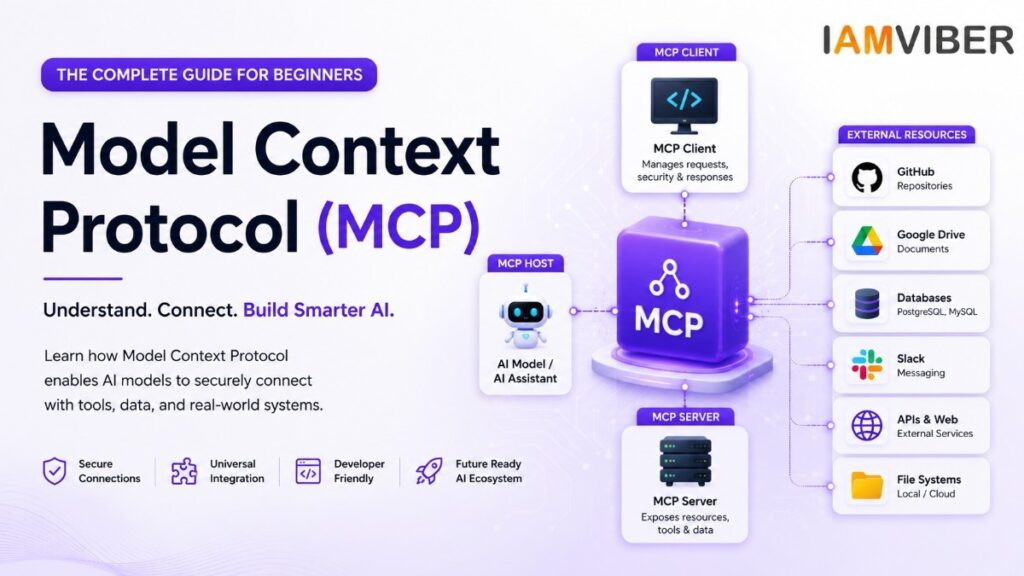
The architecture of MCP is surprisingly simple. There are three primary components:
1. MCP Host
The host is the AI application. Examples include:
- AI assistants
- Desktop AI apps
- IDE extensions
- AI coding tools
The host sends requests.
2. MCP Client
The client acts as the bridge between the AI model and external resources. It manages:
- Authentication
- Requests
- Responses
- Security
- Communication
3. MCP Server
The server exposes resources and tools. Examples include:
- Databases
- File systems
- APIs
- GitHub
- Slack
- Notion
- Google Drive
The server returns information back to the AI. Together, these components make MCP flexible and scalable.
Why Developers Love Model Context Protocol
There are several reasons why developers are rapidly adopting MCP:
Standardization
Instead of building hundreds of custom integrations, developers build one integration that follows the protocol.
Better Security
Permissions remain controlled. The AI only accesses resources it is authorized to use.
Faster Development
Developers spend less time writing connectors. More time can be spent improving AI experiences.
Easier Maintenance
Updates happen in one standardized place rather than dozens of custom APIs.
Cross-Platform Compatibility
Multiple AI applications can communicate with the same MCP server.
Real-World Use Cases of Model Context Protocol
Today, MCP is being adopted across many industries.
Software Development
AI coding assistants can:
- Read repositories
- Analyze code
- Generate pull requests
- Debug projects
Customer Support
AI agents can access:
- CRM platforms
- Knowledge bases
- Support tickets
This enables personalized customer service.
Enterprise Automation
Businesses connect AI with:
- Internal databases
- HR software
- ERP systems
- Analytics dashboards
Content Creation
AI writers can retrieve:
- Brand guidelines
- Documents
- Research
- Marketing assets
Model Context Protocol vs Traditional API Integrations
| Traditional APIs | Model Context Protocol |
|---|---|
| Custom integration for every tool | One standardized protocol |
| High maintenance | Easier maintenance |
| Complex scaling | Simple scaling |
| Different authentication methods | Unified communication |
| Repeated development work | Reusable architecture |
This comparison explains why Model Context Protocol is becoming the preferred approach for AI integrations.
How MCP AI Is Changing AI Development
The rise of MCP AI is changing how developers think about AI architecture.
Instead of creating isolated AI applications, developers are building AI systems that can communicate with virtually any compatible service.
This makes AI assistants significantly more capable. For example, one AI assistant could:
- Read GitHub issues
- Update Jira tickets
- Query PostgreSQL
- Search documentation
- Send Slack messages
—all without building custom integrations for every service.
Understanding the AI Agent Protocol Concept
Modern AI agents need memory, reasoning, and tools.
An AI Agent Protocol defines how these agents interact with external environments.
MCP has become one of the leading standards because it focuses on tool interoperability rather than model architecture.
This makes it especially useful for enterprise AI applications.
Why Anthropic MCP Matters
When people search for Anthropic MCP, they are usually referring to the open protocol introduced to simplify AI-tool communication.
Its biggest contribution is encouraging an open ecosystem rather than locking developers into a single vendor.
As more AI platforms adopt compatible servers and clients, developers gain greater flexibility and portability for their AI applications.
Model Context Protocol Tutorial: Getting Started
If you’re looking for a simple Model Context Protocol Tutorial, follow these basic steps:
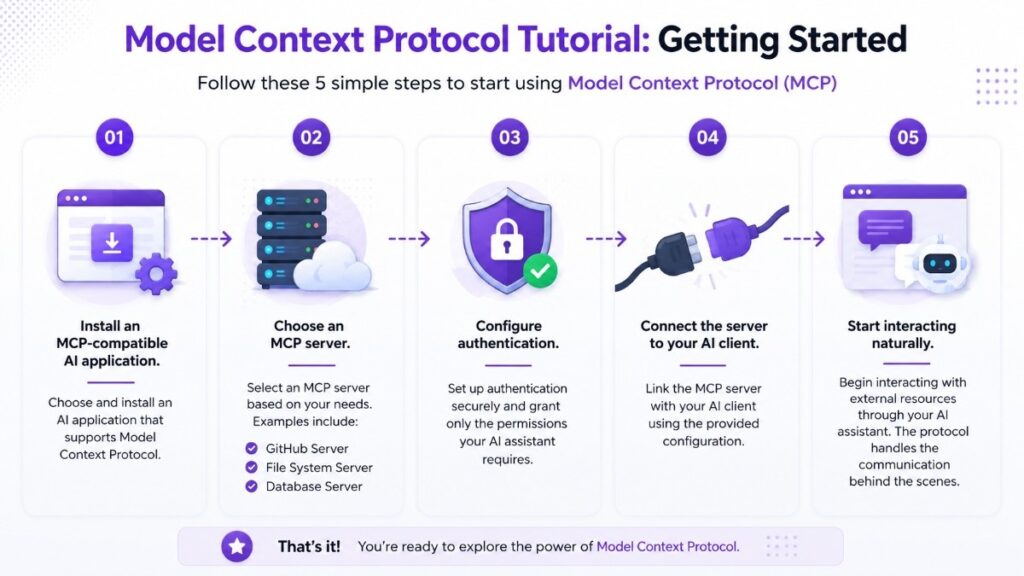
Step 1
Install an MCP-compatible AI application.
Step 2
Choose an MCP server. Examples include:
- GitHub Server
- File System Server
- Database Server
Step 3
Configure authentication. Grant only the permissions your AI assistant requires.
Step 4
Connect the server to your AI client.
Step 5
Start interacting with external resources naturally through the AI assistant. The protocol handles the communication behind the scenes.
Benefits of Using Model Context Protocol
Organizations adopting Model Context Protocol experience several advantages:
- Faster AI deployment
- Lower integration costs
- Better scalability
- Improved developer productivity
- Stronger security controls
- Easier upgrades
- Vendor flexibility
- Reusable infrastructure
These benefits make MCP attractive for startups as well as large enterprises.
Challenges of Model Context Protocol
Although MCP offers many benefits, there are still challenges. Some organizations need to:
- Configure secure authentication
- Manage permissions carefully
- Monitor connected tools
- Maintain server availability
- Maintain server availability
Fortunately, as adoption grows, documentation and tooling continue to improve.
Future of Model Context Protocol
Experts believe MCP will become a foundational layer for AI applications.
As AI agents continue replacing traditional software workflows, standardized communication between AI and external systems will become essential.
Future developments may include:
- Enterprise-grade security
- Multi-agent collaboration
- Cross-platform AI ecosystems
- Better developer tools
- Cloud-native MCP infrastructure
- Wider adoption across SaaS platforms
The protocol is expected to play a major role in the next generation of intelligent applications.
Conclusion
The future of AI isn’t just about smarter models—it’s about smarter connectivity. MCP provides a standardized, secure, and scalable way for AI systems to interact with the tools, data, and services people use every day.
Whether you’re a developer, business owner, or AI enthusiast, understanding MCP today will help you prepare for the next wave of AI innovation. As more platforms adopt this standard, it is likely to become a core building block of modern AI ecosystems.
Frequently Asked Questions
1. What is Model Context Protocol?
Model Context Protocol is an open standard that enables AI models to securely connect with external tools, applications, APIs, databases, and file systems through a unified interface.
2. Who created Model Context Protocol?
Model Context Protocol was introduced by Anthropic as an open standard and is now being adopted by a growing ecosystem of AI tools and developers.
3. Why is Model Context Protocol important?
It reduces integration complexity, improves security, speeds up development, and enables interoperability between AI applications and external services.
4. Is Model Context Protocol free to use?
Yes. The protocol itself is open, though individual MCP servers or connected services may have their own licensing or usage costs.
5. Can MCP work with AI agents?
Yes. It is widely used to give AI agents secure access to tools, documents, APIs, and business systems.
6. What is the difference between MCP and APIs?
APIs define how one application communicates with another specific service, while Model Context Protocol provides a standardized framework that allows AI models to interact with many different tools in a consistent way.
7. Which industries benefit from MCP?
Software development, enterprise automation, healthcare, finance, customer support, education, and content creation are among the industries benefiting from MCP.
8. Is Model Context Protocol the future of AI integration?
Many AI experts believe it will become one of the foundational standards for connecting AI models with external tools and services as AI agents become more capable.
Topics to follow on IAMVIEBR : Current Affairs & Insights Tech Innovation GenZ entrepreneurship Collaborative Fashion GEO SME