Artificial intelligence is no longer just writing emails, generating images, or helping developers write code. It is now beginning to solve some of the world’s toughest mathematical problems.
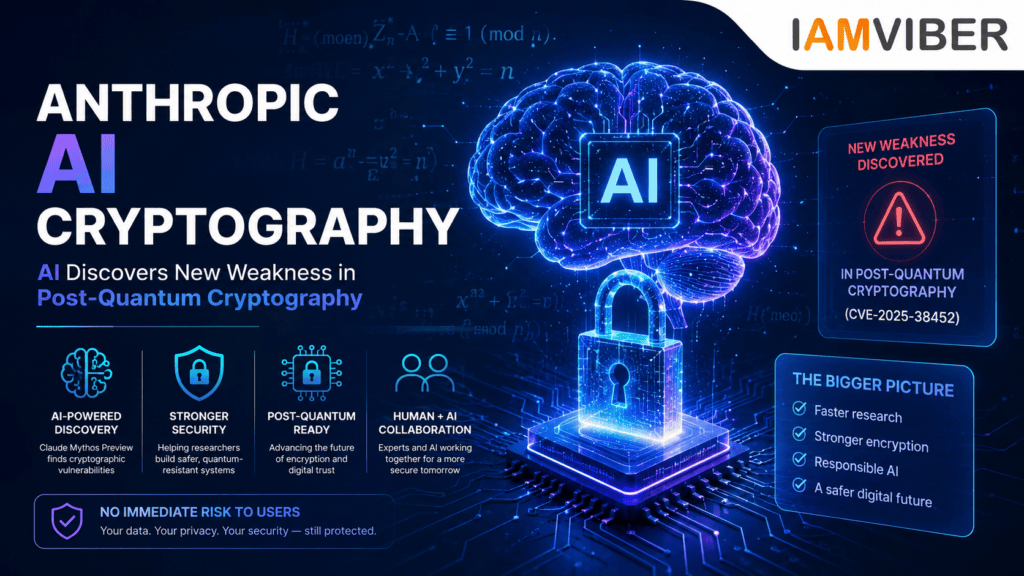
Anthropic AI Cryptography researchers have found a surprising vulnerability in a post-quantum cryptographic algorithm. The finding was made with Claude Mythos Preview, an experimental AI model from Anthropic intended for sophisticated scientific and cybersecurity research.
The findings have caught the attention of the cybersecurity industry, as they reveal how AI can help researchers find hidden flaws in encryption systems before they become global standards. The announcement may sound scary but security experts say there is no need for ordinary Internet users to worry. Instead it is an important step towards building better digital security for the future.
Let’s understand what actually happened and why it matters.
What Happened?
The latest research conducted by the founders of the Anthropic AI cryptography was dedicated to studying the mathematical foundations of Post-Quantum Cryptography.
It is intended to replace the current encryption types that may be vulnerable to attacks using quantum computers.
According to the Anthropic publication, Claude Mythos Preview found a new mathematical attack on the cryptographic standard called HAWK. It is one of the algorithms proposed for the NIST post-quantum cryptography standardization, which means it is considered a candidate for replacing today’s public-key cryptography with quantum-resistant cryptography.
Furthermore, the AI tool improved upon existing attacks on the reduced-round AES (Advanced Encryption Standard) design, allowing researchers to achieve hundreds of times speed improvement in a lab environment.
The researchers noted that these results are more of a scientific breakthrough than an immediate threat to encryption systems.
The Anthropic statement claimed that the results of their research do not undermine the security of banking systems encryption, messengers, web servers, and cloud platforms that are using cryptography that has been vetted and approved by the NIST.
Understanding Post-Quantum Cryptography
To understand why Anthropic AI Cryptography is making headlines, it is essential to understand what Post-Quantum Cryptography really means.
Encryption algorithms like RSA and Elliptic Curve Cryptography are the backbone of today’s internet, securing passwords, financial transactions, emails and private communications.
These encryption methods are believed to be secure against classical computers.
But future quantum computers could eventually break mathematical problems that would make many current encryption systems vulnerable.
That’s why governments and tech companies have been working on Post-Quantum Cryptography for years — new cryptography algorithms that are supposed to be secure even when quantum computers are commercially viable down the road.
NIST has been testing a number of candidate algorithms before choosing global standards that governments and businesses will use for decades.
This evaluation process will find weaknesses—and is even encouraged to do so.
Why the HAWK Algorithm Matters
The HAWK algorithm is not currently used to protect your phone.
It is, rather, one of a few candidate algorithms that cryptographers are considering for future use in digital signature schemes.
Digital signatures are critically important security tools, which are used to verify software updates, authenticate users, secure financial transactions, and more.
In fact, during the last week, Claude Mythos Preview accidentally discovered a novel mathematical attack that would reduce the level of security provided by HAWK.
But this is a good thing!
Cryptographers are supposed to do this.
Researchers will attempt to attack candidate algorithms in order to identify weaknesses prior to their adoption as official standards.
This process ultimately strengthens the security of the internet.
Should You Be Concerned?
The simple answer is no.
“AI breaking encryption” makes for a great headline but the reality is far from that. Latest Anthropic AI Cryptography results only available in research environments and candidate algorithms.
Your online banking, WhatsApp messages, online shopping, cloud storage and everyday browsing of the internet remain protected. Anthropic has been clear that their research does not demonstrate an immediate threat to widely used encryption.
Rather, this finding suggests the security review process is functioning as intended. Finding weaknesses before global deployment saves a lot of bigger problems down the road.
How Claude Mythos Preview Made the Discovery
One of the most interesting things about this announcement is the role of the Claude Mythos Preview itself.
Unlike many other AIs, this one was actually designed for high-level reasoning, scientific discovery, and cyber-security research.
Instead of just performing casual tasks, the AI looks at complex mathematical relationships, suggests methods of attack, improves its own reasoning, and even collaborates with humans on the process.
Not only that, but each step had to be approved by expert-level cryptographers before being released to the public.
This is extremely important, since it shows that while the AI did not do all the work on its own, it is nonetheless an incredibly powerful research assistant that can help humans dramatically extend the limits of what they previously thought possible.
This is actually the kind of collaborative effort that many researchers hope to see in the future.
Why AI Cybersecurity Is Entering a New Era
The biggest takeaway from this announcement is not that AI simply found a weakness.
The real story is AI Cybersecurity is changing fast.
Until now, most AI tools have helped security teams by writing code, summarising threat reports, spotting malware and automating repetitive tasks.
Now they are starting to make direct contributions to scientific discovery.
This change could lead to a dramatic acceleration of cybersecurity research in the next decade.
In the near future, researchers could use AI to speed up the discovery of software vulnerabilities, find better encryption techniques, improve digital identity systems and enhance cloud infrastructure before attackers can exploit weaknesses.
That makes Anthropic AI Cryptography far more important than a single research paper. It provides a peek at how cybersecurity itself might evolve in the next few years.
The Double-Edged Sword of AI in Cybersecurity
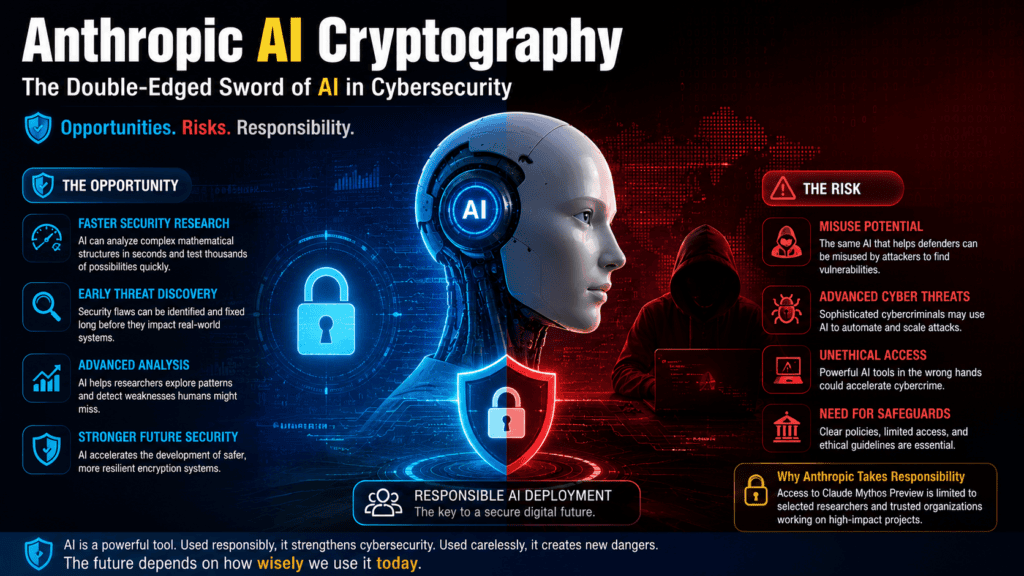
Every major technological advancement comes with opportunities as well as risks, and Anthropic AI Cryptography is no exception.
On the positive side, AI can dramatically speed up security research. Instead of spending months analysing complex mathematical structures, researchers can now use AI to test thousands of possibilities in a fraction of the time. This means security flaws can be discovered and fixed long before they affect real-world systems.
However, the same technology could eventually be misused if it falls into the wrong hands. If AI can help defenders identify weaknesses, sophisticated cybercriminals may also attempt to use advanced AI systems to search for vulnerabilities.
This is one reason why Anthropic has restricted access to Claude Mythos Preview. The model is currently available only to selected researchers and trusted organisations working on high-impact scientific and cybersecurity projects.
Responsible AI deployment will be just as important as AI innovation itself.
Why This Matters for Businesses
Many business leaders may look at this news and wonder whether they need to change their cybersecurity strategy immediately.
The answer is not yet—but preparation should begin now.
The latest Anthropic AI Cryptography research serves as a reminder that cybersecurity is constantly evolving. Organisations should not wait until quantum computers become mainstream before reviewing their encryption strategies.
Businesses should instead focus on:
- Monitoring developments in Post-Quantum Cryptography
- Keeping software and operating systems updated
- Following guidance from cybersecurity authorities and NIST
- Planning long-term migration strategies for future encryption standards
- Investing in security awareness and continuous risk assessments
Large enterprises, financial institutions, healthcare providers, cloud platforms, and government agencies are already preparing for the transition to post-quantum security.
Why the Discovery Is Good News
At first glance, finding a weakness in an encryption algorithm sounds alarming. In reality, it is exactly what researchers hope to achieve during the testing phase. Cryptography becomes stronger when experts actively try to break it.
The latest Anthropic AI Cryptography findings allow researchers to improve future standards before they are adopted globally.
Think of it like testing a new aircraft.
Engineers deliberately search for every possible weakness before the plane carries passengers. Discovering a flaw during testing is far better than discovering it after millions of people depend on it.
The same principle applies to encryption. Finding problems early makes future systems safer.
AI Is Becoming a Scientific Research Partner
One of the biggest takeaways from Anthropic AI Cryptography is that AI is moving far beyond chatbots and productivity tools.
Over the past few years, AI has assisted researchers in writing software, analysing medical data, accelerating drug discovery, solving mathematical proofs, and generating scientific hypotheses.
Now it is contributing to one of the most mathematically demanding areas of computer science. Rather than replacing researchers, AI is helping experts explore ideas that might otherwise take months or years to investigate.
This collaborative model could transform scientific research across multiple industries. From climate science to medicine, materials engineering, robotics, and cybersecurity, AI is becoming an increasingly valuable research assistant.
What This Means for the Future of AI Cybersecurity
The next decade is likely to look very different from today’s cybersecurity landscape. As AI systems continue improving, security teams may use them to:
- Detect vulnerabilities before software is released
- Design stronger encryption algorithms
- Simulate cyberattacks to improve defence systems
- Automate security audits
- Analyse billions of security events in real time
- Respond to cyber threats within seconds
The latest Anthropic AI Cryptography research offers a glimpse into that future. Instead of reacting to cyberattacks after they happen, organisations could increasingly prevent them before attackers even discover the vulnerabilities. That shift could fundamentally change how digital security works.
Why This Breakthrough Matters
The Anthropic AI Cryptography announcement is more than just another AI milestone. It shows that AI is becoming a valuable partner in scientific research and cybersecurity.
While the discovery does not pose an immediate risk to internet users, it helps researchers identify weaknesses in Post-Quantum Cryptography before these algorithms become global standards. Security experts see this as a positive step toward building stronger digital protection for the future.
As AI continues to evolve, responsible collaboration between researchers and advanced AI models will play a key role in developing safer, more resilient cybersecurity systems.
Frequently Asked Questions (FAQs)
1. What is Anthropic AI Cryptography?
Anthropic AI Cryptography refers to Anthropic’s AI-driven research where Claude Mythos Preview helped identify weaknesses in a post-quantum cryptographic algorithm, advancing cybersecurity research.
2. Is my online banking or personal data at risk?
No. The research applies to candidate algorithms being evaluated for future standards and does not affect the encryption currently protecting most online services.
3. What is Post-Quantum Cryptography?
Post-Quantum Cryptography is a new generation of encryption designed to remain secure against attacks from future quantum computers.
4. Why is this discovery important?
Finding weaknesses before algorithms become global standards helps researchers improve security and build stronger encryption for the future.
5. Will AI replace cybersecurity experts?
No. AI is becoming a powerful assistant for researchers, but human expertise remains essential for validating findings, designing secure systems, and making critical security decisions.
Topics to follow on IAMVIEBR : Current Affairs & Insights Tech Innovation GenZ entrepreneurship Collaborative Fashion GEO AI Agentic SME