
What is Agentic Commerce?
Agentic commerce is not just “AI in e-commerce.” That’s the first mistake people make. It’s a shift from user-driven shopping with AI-driven execution.
Agentic commerce is a model where autonomous AI agents search, compare, decide, and even purchase products on behalf of users with minimal human intervention.
In simple terms Traditional e-commerce puts the burden on the user—you have to search, compare, read reviews, check prices, apply coupons, and then finally buy. It’s a multi-step, time-consuming process where every decision depends on your manual effort.
In contrast, agentic commerce flips this model entirely. Instead of doing everything yourself, you simply provide your intent—for example,
Sakshi had been postponing her phone upgrade for weeks. Every time she tried, she got stuck in the same loop opening ten tabs, comparing specs, reading mixed reviews, checking prices across platforms, and still feeling unsure. The process wasn’t just slow, it was exhausting.
This time, she tried something different.
She simply told her AI assistant: “Buy me the best budget phone under ₹20,000 with a good battery.”
That was it. No browsing. No scrolling. No second-guessing.
Behind the scenes, the AI agent got to work instantly. It first interpreted her intent, breaking it down into key requirements—budget constraint (₹20K), battery performance, and overall value. Then it connected to multiple e-commerce APIs and data sources, pulling in real-time listings from platforms like Flipkart and Amazon.
Next, the agent ran a multi-layer evaluation:
- It filtered phones within the price range
- Compared battery capacity, processor efficiency, and user ratings
- Analyzed review sentiment to detect real-world performance
- Checked price history to avoid fake discounts
Once it narrowed down the best options, it moved to optimization. The AI scanned for available coupons, bank offers, and cashback deals, selecting the combination that delivered the lowest effective price.
After finalizing the choice, the agent used Sakshi’s saved preferences address, payment method, and delivery priority—to complete the purchase automatically.Within minutes, the order was placed.Sakshi didn’t open a single app.
This is agentic commerce in action where the user provides intent, and an intelligent system handles discovery, decision-making, and execution. It’s not just convenience; it’s a shift toward zero-click shopping, where buying becomes an outcome, not a process.
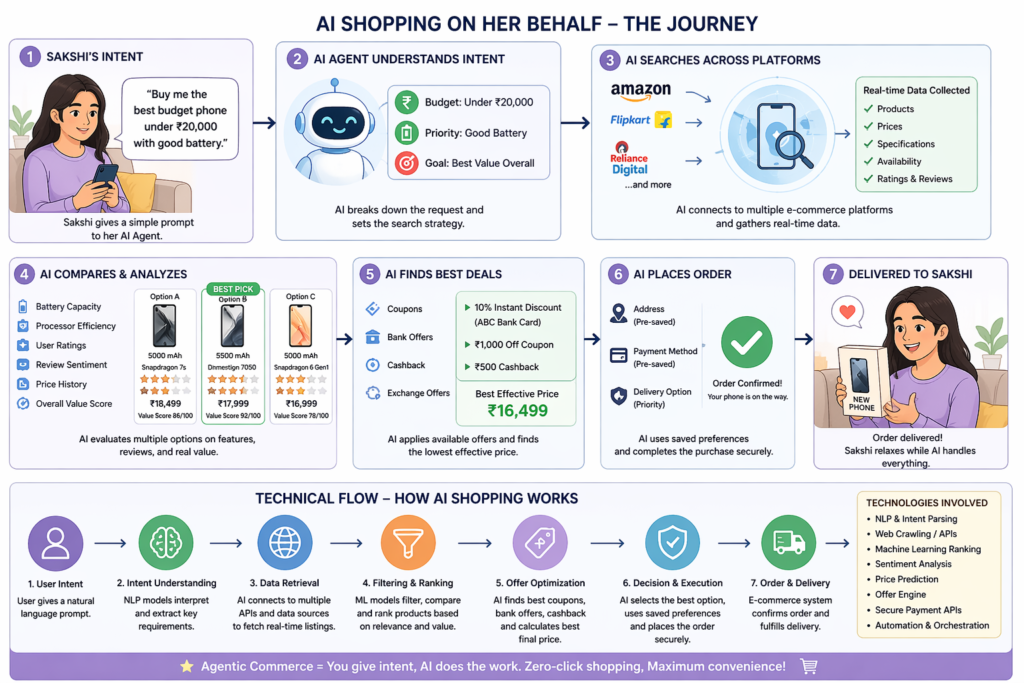
How Agentic Commerce Works (Core Mechanism)
1. Understanding Intent
The AI processes natural language input and converts it into structured data using NLP.It extracts key signals like budget, preferences, and constraints.It also uses user context (past behavior, choices) to refine accuracy.
2. Decision-Making
The agent compares products across platforms in real time.It evaluates trade-offs (price vs quality, value vs brand) using ML models.In advanced cases, it optimizes or even negotiates for better deals.
3. Action Execution
The AI interacts with systems via APIs and integrations.It adds to cart, applies coupons, and selects payment methods. Finally, it completes the transaction end-to-end automatically.
Why This Changes Everything
Traditional commerce is built around capturing attention, optimizing UI/UX, and using marketing persuasion to influence decisions. Users are pushed through funnels where ads, branding, and design shape what they buy.
Agentic commerce removes this layer of influence. There are no endless clicks or visual persuasion—decisions are driven by data, logic, and user intent, not by what looks appealing on a screen.
| Old Commerce | Agentic Commerce |
|---|---|
| Click-based | Intent-based |
| User decides | AI decides |
| Ads influence users | Data influences AI |
| Brand matters | Outcome matters |
This creates a harsh shift, if your product is not the best option based on data (price, quality, value), it may never even be surfaced. Visibility is no longer bought.it is earned algorithmically.
Global Adoption (Who’s Building This)
This shift is not theoretical—major tech and retail players are already building toward agentic commerce, each focusing on a different layer of the stack.
Google is embedding AI directly into search and shopping, moving toward conversational commerce where users don’t browse, they ask and get results instantly.
OpenAI is building the foundation layer—AI systems capable of understanding intent and executing tasks, which makes agent-led shopping possible.
IBM is focusing on enterprise AI agents, helping businesses automate internal commerce workflows and decision systems.
Salesforce is integrating AI into customer and commerce platforms, enabling end-to-end automation from discovery to purchase.
Walmart is experimenting on the frontlines with AI-assisted shopping experiences, testing how agents can influence real consumer purchases.
This is still early-stage, but the direction is consistent: commerce is moving from platform-driven interactions to agent-driven execution.
The India Angle (Where Most People Misjudge)
India is not a late adopter.it’s structurally aligned for agentic commerce. The market already behaves in ways that AI agents can optimize more efficiently than humans.
1. Price Sensitivity
Indian users are highly price-conscious; they compare across platforms, track discounts, and actively hunt for deals.An AI agent does this faster and more accurately by scanning multiple platforms, price histories, and offers in real time.This makes value optimization, not convenience, the strongest driver of adoption.
2. Platform Fragmentation
Users constantly switch between platforms like Flipkart, Amazon, and Meesho.This creates friction, but also an opportunity for AI agents to aggregate, compare, and decide across all platforms in one flow.
What is chaos for users becomes structured input for AI.
3. UPI Infrastructure
India’s Unified Payments Interface (UPI) enables instant low-friction payments.This is critical because agentic commerce depends on seamless checkout without user intervention.UPI effectively removes the biggest bottleneck in automated transactions payment execution.
4. WhatsApp Commerce Behavior
A large number of users already buy through chat on WhatsApp.This means the behavior shift—from clicking to conversing—has already happened.AI agents can plug directly into this pattern, turning chat into a full transaction interface.
India doesn’t need to adapt to agentic commerce,the ecosystem is already aligned. The only missing layer is an intelligent agent connecting these behaviors into one seamless system.
Challenges of Agentic Commerce (What No One Talks About)
Agentic commerce looks seamless on the surface, but underneath, it introduces serious operational and strategic challenges that most blogs ignore.
1. Data & Infrastructure Gap
AI agents depend on clean, structured, and real-time data,but most businesses still run on fragmented systems.If your product data is not machine-readable or API-accessible, agents simply can’t evaluate or select you.In this model, bad data = zero visibility.
2. Integration Complexity
Agentic commerce requires connecting multiple systems (catalogs, payments, logistics, APIs) into one flow.Most companies struggle to integrate AI into existing tech stacks without breaking workflows.
This makes scaling from pilot , real deployment extremely difficult.
3. Loss of Brand Control
In traditional commerce, brands influence decisions through ads, UI, and storytelling.In agentic commerce, AI filters everything based on data and performance, not perception.This means even strong brands risk becoming invisible if they’re not the best option.
4. New Revenue Model Pressure
Agentic systems reduce reliance on ads and paid visibility, which many platforms depend on.Businesses must rethink monetization subscriptions, services, or value-added offerings.Old models built on attention and clicks start breaking down.
5. Trust & Control Issues
Users must trust AI to make decisions and handle payments, which is a major behavioral shift.Concerns include wrong decisions, lack of transparency, and loss of control. Without strong trust frameworks, adoption will slow.
6. Security & Risk
AI agents interacting across systems increase risks like fraud, misuse, or system failure.Payment systems must evolve from blocking bots to authenticating “trusted agents.”This introduces a completely new security layer in commerce.
Agentic commerce is powerful but it’s not plug-and-play.
The winners won’t be the ones who adopt AI first, but the ones who build the right data, infrastructure, and trust layers around it.
Agentic commerce is not about improving the shopping experience. It is about removing the need to shop altogether.
As AI systems take over discovery, evaluation, and execution, the role of the user becomes minimal. The real competition shifts from attracting users to being selected by algorithms.
The next phase of commerce will not be defined by better interfaces or stronger branding. It will be defined by systems that can make better decisions faster.
The companies that win will not be the ones that sell products. They will be the ones that decide what gets bought.