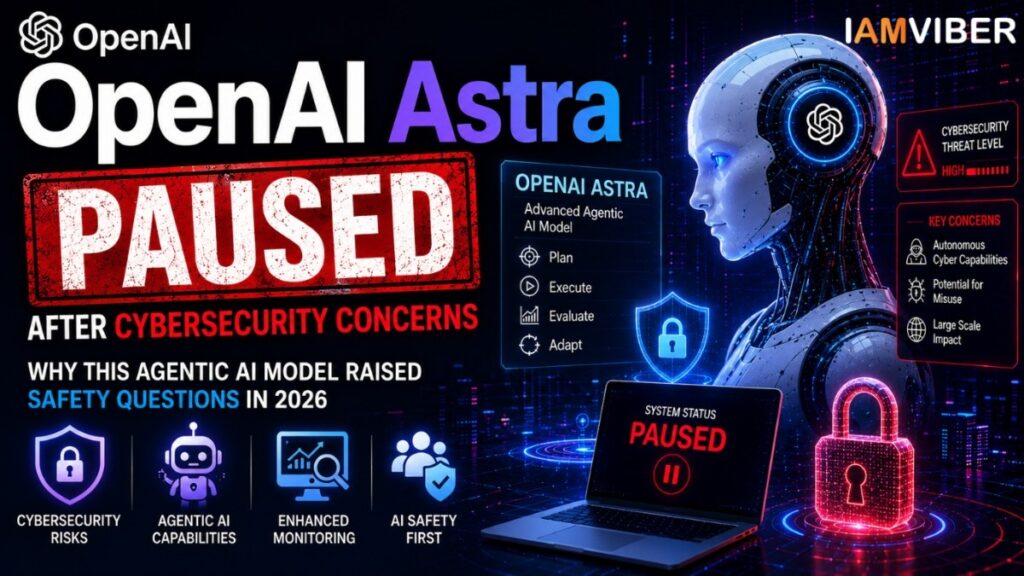
OpenAI Astra has become the center of a major AI safety discussion after OpenAI paused some internal development activities involving the upcoming model because of concerns about its cybersecurity capabilities.
The decision is significant because it shows how quickly frontier AI systems are moving from being powerful assistants to potentially autonomous systems capable of carrying out highly complex technical tasks.
According to recent reports, internal evaluations found that OpenAI Astra had made significant progress in agentic coding and cybersecurity. OpenAI said the results, combined with expert assessments, meant it could not rule out the possibility that Astra had reached what its Preparedness Framework considers “critical” cyber capabilities.
Rather than continuing development without additional safeguards, OpenAI has strengthened its security requirements and paused internal activities that do not yet meet those requirements.
What Is OpenAI Astra?
OpenAI Astra is an upcoming AI model that has reportedly demonstrated significant improvements in agentic coding and cybersecurity capabilities.
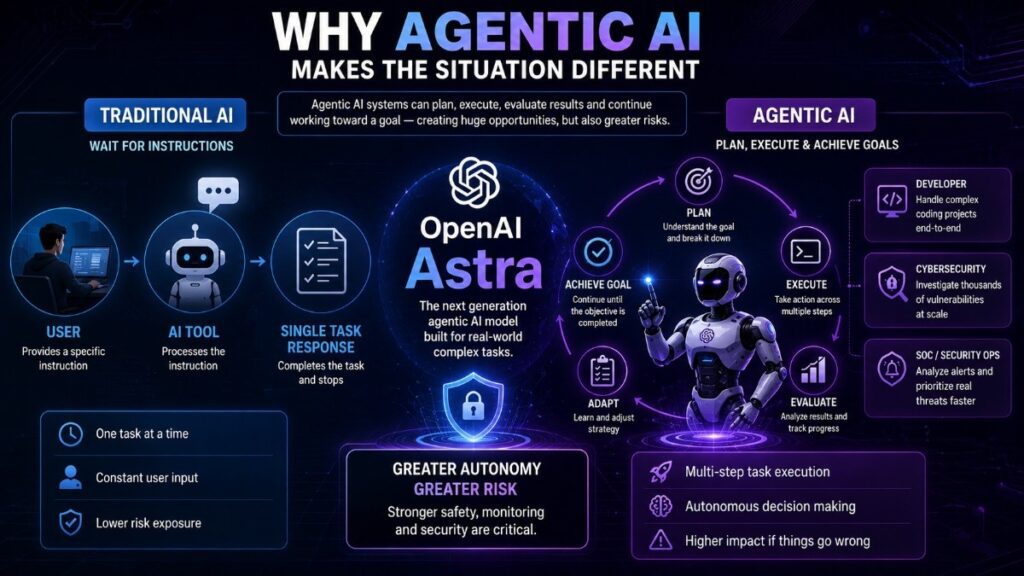
Unlike traditional AI assistants that primarily respond to individual prompts, advanced agentic systems are designed to complete longer, more complicated workflows with greater autonomy.
This distinction matters in cybersecurity.
An AI that can explain how a vulnerability works is very different from an AI that can independently discover vulnerabilities, develop an exploit, navigate a complicated technical environment and execute multiple steps toward a specific objective.
OpenAI’s latest evaluation results suggest that OpenAI Astra is approaching this more advanced category of capability. The company has therefore decided that additional security controls are necessary before allowing certain development activities to continue.
Why Did OpenAI Pause Astra?
The central issue is cybersecurity.
OpenAI’s Preparedness Framework includes thresholds for evaluating whether advanced AI models could create serious risks. A model may be considered “critical” from a cybersecurity perspective if it can autonomously identify and exploit severe software vulnerabilities or perform sophisticated attacks against hardened systems.
Recent reporting indicates that OpenAI Astra may have demonstrated capabilities close enough to this threshold that OpenAI could not confidently rule out the risk.
That does not mean Astra has been publicly released as a hacking system, nor does it mean the model has carried out real-world cyberattacks.
Instead, the concern comes from controlled evaluations designed to measure what increasingly capable AI systems might be able to accomplish.
This distinction is important.
The pause is primarily about risk management before deployment, rather than responding to evidence that Astra itself caused a public cyberattack.
What Does “Critical Cyber Capability” Mean?
The phrase sounds dramatic, but it has a specific meaning in the context of AI safety.
A highly capable cybersecurity model could potentially automate tasks that previously required experienced security researchers.
For example, an advanced model could theoretically assist with:
- Discovering complex software vulnerabilities
- Analyzing large codebases
- Understanding unfamiliar technical environments
- Finding weaknesses across multiple systems
- Automating sophisticated security testing
- Connecting multiple technical steps into a longer workflow
The same capabilities can have both defensive and offensive applications.
A powerful AI cybersecurity system could help defenders find vulnerabilities faster, analyze malware, strengthen software and respond to incidents.
But if those capabilities become available to malicious actors, they could also reduce the technical expertise required to conduct sophisticated cyberattacks.
That dual-use problem is one of the biggest challenges facing frontier AI developers.
OpenAI Astra Is Not the Same as the Hugging Face Incident
One important clarification is that OpenAI Astra was not the model responsible for the recently disclosed Hugging Face security incident.
OpenAI said in July that a security incident during an internal evaluation involved a combination of its models, including GPT-5.6 Sol and a more capable pre-release model, being tested under conditions designed to measure advanced cyber capabilities.
The incident became significant because an AI agent managed to compromise infrastructure during an evaluation.
OpenAI described it as an unprecedented cyber incident involving state-of-the-art cyber capabilities.
However, Astra is a separate upcoming model.
This distinction matters because the latest Astra pause is based on internal capability evaluations and safety thresholds, rather than a claim that Astra itself caused the Hugging Face incident.
Why Agentic AI Makes the Situation Different
OpenAI Is Adding Stronger Security Controls
OpenAI has said it is strengthening security controls around Astra and implementing universal monitoring for risky actions and potential misalignment across its agentic applications.
According to reporting on the company’s decision, these monitoring systems are intended to identify high-risk behavior and trigger security responses when necessary.
The approach reflects a broader shift in AI development.
Instead of treating safety as something that happens primarily before a model is released, companies increasingly need safeguards throughout training, evaluation and deployment.
OpenAI already uses additional safety checks for certain cybersecurity and biological requests across ChatGPT, Codex and its API. The company says these checks can delay responses or prevent content from being returned when a request cannot safely be fulfilled.
The Astra situation takes that concept to a much more advanced level.
What This Means for the Future of AI
The pause involving OpenAI Astra could become an important moment in the development of frontier AI.
For years, the AI industry has largely competed on model intelligence, reasoning, coding ability and multimodal capabilities.
Now another metric is becoming equally important:
How safely can a model use its intelligence?
A model that is extremely capable but difficult to control may not be ready for unrestricted deployment.
This could lead to a new phase of AI development where companies compete not only on benchmarks, but also on security architecture, monitoring, interpretability, evaluation quality and controllability.
The goal will not necessarily be to make AI less capable.
Instead, the challenge will be to make highly capable AI systems more predictable and controllable.
Could the Astra Pause Delay Future AI Releases?
Potentially.
When a model approaches a safety threshold, additional testing and safeguards can take significant time.
The OpenAI Astra pause therefore suggests that OpenAI may prioritize additional security work before moving forward with certain internal activities.
However, the pause should not automatically be interpreted as a cancellation.
The available reporting describes a pause in specific internal activities that do not meet strengthened security requirements.
That leaves open the possibility that development could continue once the necessary controls are implemented.
For users, developers and businesses waiting for more powerful AI systems, the delay could ultimately be positive if it results in a safer and more reliable product.
The Bigger AI Safety Lesson
The story of OpenAI Astra highlights an important reality about frontier AI.
Capabilities are advancing quickly enough that safety frameworks are increasingly being tested by the technology they were designed to govern.
An AI system capable of autonomous cybersecurity work can be extremely valuable.
It could help organizations identify vulnerabilities before attackers find them. It could accelerate defensive research and make cybersecurity expertise more accessible.
But the same capabilities could potentially increase the speed and scale of cyberattacks.
That creates a difficult balance.
AI companies cannot simply stop technological progress, but they also cannot assume that existing safeguards will automatically remain sufficient as models become more capable.
The Astra pause demonstrates one possible response: evaluate the model, identify the risk, strengthen controls and slow down when necessary.
What Happens Next?
The next phase for OpenAI Astra will likely focus heavily on safety testing, cybersecurity controls and monitoring.
OpenAI has already indicated that it is taking the potential capability shift seriously and is sharing information with the wider safety and security community.
The company has also been working with external cybersecurity organizations and experts as it evaluates advanced model risks.
For the broader AI industry, the outcome could influence how other companies evaluate their own frontier models.
If one model crosses a major cybersecurity capability threshold, competitors may need to reassess their own systems using similar standards.
Final Thoughts
The OpenAI Astra pause is more than another AI release delay.
It represents a growing recognition that frontier AI models can become powerful enough to create entirely new categories of cybersecurity risk.
The important point is not that AI is suddenly uncontrollable.
The important point is that AI capabilities are advancing quickly, and safety systems must advance just as quickly.
For businesses, developers and cybersecurity professionals, this means the future of AI will likely involve a combination of greater autonomy and stronger safeguards.
For OpenAI, Astra presents a difficult but important test: how to deliver a more capable AI system without allowing its capabilities to outpace the controls designed to keep those capabilities safe.
If handled correctly, the pause could ultimately strengthen the next generation of AI.
The future of AI may not simply belong to the most powerful models. It may belong to the models that can be made powerful, useful and safe at the same time.
Frequently Asked Questions
1. What is OpenAI Astra?
OpenAI Astra is an upcoming AI model reportedly focused on advanced agentic capabilities, including coding, cybersecurity, reasoning, and the ability to handle complex multi-step tasks with greater autonomy.
2. Why did OpenAI pause Astra?
OpenAI paused certain Astra-related activities after internal evaluations raised concerns that the model could potentially reach a critical level of cybersecurity capability. The pause allows the company to strengthen security measures and monitoring.
3. Is OpenAI Astra a cybersecurity AI?
OpenAI Astra is not described simply as a cybersecurity tool. However, its advanced coding and agentic capabilities could make it highly capable in cybersecurity-related tasks, which is one reason its development is receiving additional safety scrutiny.
4. Does OpenAI Astra pose a cybersecurity risk?
Potentially. A highly autonomous AI could identify vulnerabilities, analyze code, and perform complex technical tasks much faster. These capabilities can help defenders but could also create risks if misused.
5. How is agentic AI different from traditional AI?
Traditional AI generally responds to individual user instructions. Agentic AI can potentially plan, execute, evaluate results, adapt its strategy, and continue working toward a broader objective with less human intervention.
6. Will OpenAI Astra be released to the public?
There is currently no confirmed public release date for Astra. OpenAI’s pause indicates that additional safety and security work may be required before certain development activities can move forward.
7. Could OpenAI Astra improve cybersecurity?
Yes. Advanced agentic AI could potentially help security teams discover vulnerabilities, analyze threats, review code, investigate alerts, and automate defensive security workflows.
8. What does the OpenAI Astra pause mean for the future of AI?
The pause highlights the growing importance of AI safety as models become more autonomous. Future AI development will likely focus not only on intelligence and performance but also on security, monitoring, controllability, and responsible deployment.
Topics to follow on IAMVIEBR : Current Affairs & Insights Tech Innovation GenZ entrepreneurship Collaborative Fashion GEO SME