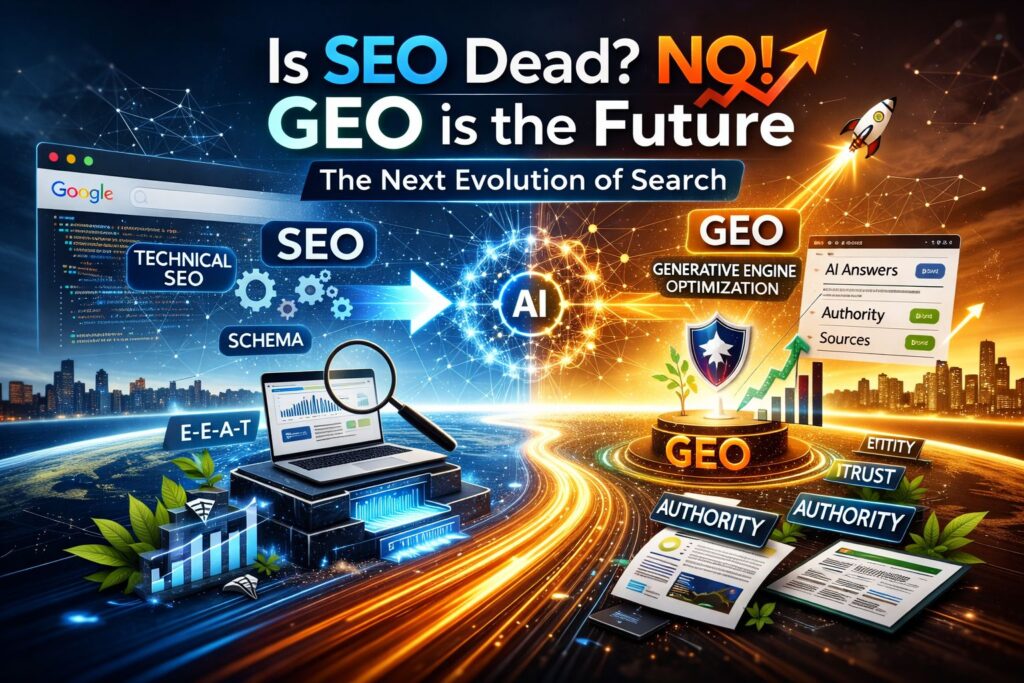
The search world shifted in 2026. Instead of Google’s 10 blue links, AI engines like ChatGPT, Gemini, and Perplexity deliver summarized answers. The big question: Is SEO dead? Straight answer No! It’s evolving into GEO (Generative Engine Optimization). Perfect for web developers and SEO specialists let’s break it down.
SEO Is Alive Fundamentals Haven't Changed
SEO basics remain rock-solid. Only delivery has evolved.
Two Core Pillars:
Backend (Technical SEO): Structure your site for machine
- Clean code (use Next.js frameworks)
- Schema.org JSON-LD (for entity relationships)
- Metadata, site speed, and mobile optimization
Frontend (User-Focused Content): Value for humans.
- Clear, trustworthy, valuable content
- Direct answers, no fluff
What is GEO? The New Rule for AI Search
GEO (Generative Engine Optimization) — Traditional SEO upgraded for AI. Generative engines synthesize summaries from trusted sources.
Why GEO Matters:
- AI pulls content, doesn't just link.
- Focus: Credibility, structure, authority.
Why GEO Matters:
- Direct Answers: Respond straight to queries.
- Entity Relationships: Use schema (e.g., Person, Organization).
- Transparency: Cite sources, add ai.txt/llm.txt.
- Authority: Build high-quality backlinks and E-E-A-T (Experience, Expertise, Authoritativeness, Trustworthiness).
Also called AI SEO or AIOSEO. Same game, new name!
SEO and GEO: Two Sides of the Same Coin
- SEO builds the foundation (technical + content).
- GEO leverages it in AI search.
- Businesses that get this become go-to sources for generative engines.