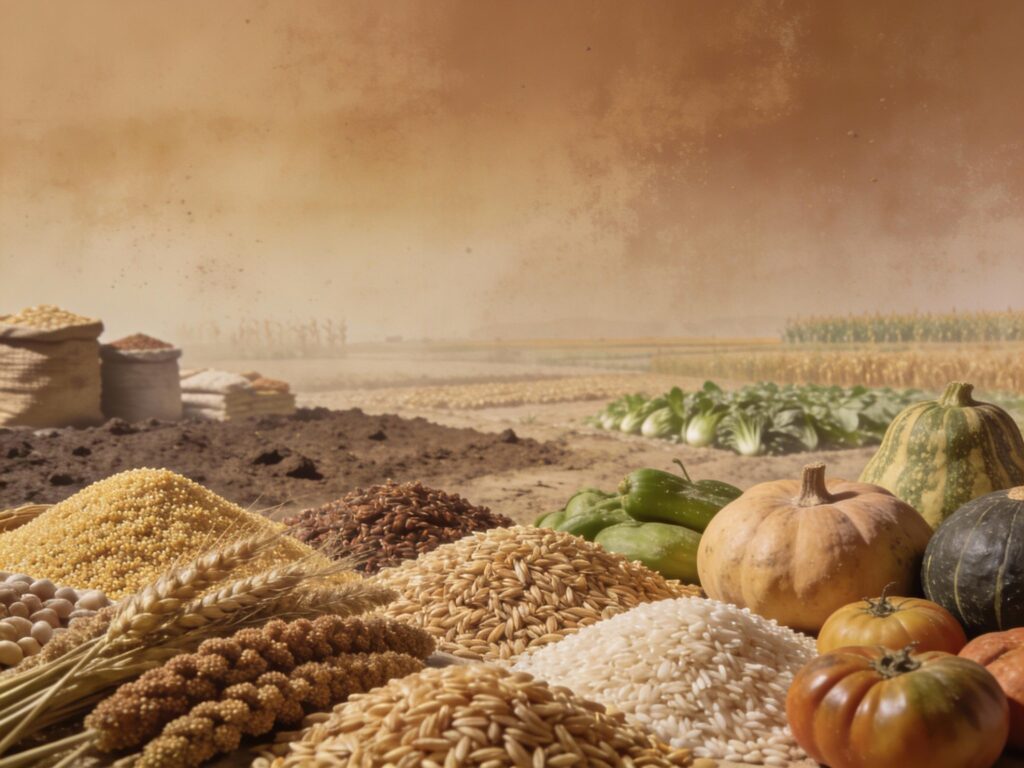
India is home to one of the world’s richest agricultural biodiversities. Historically, regions cultivated crops that evolved over centuries to suit local soil, rainfall, altitude, and dietary needs. These native varieties were not uniform, but they were resilient.
The shift toward standardised agriculture began in the mid-20th century with the push for higher yields and food security. High-yield varieties, chemical fertilisers, and irrigation systems allowed large-scale production, but they also displaced many indigenous crops.
Native grains and pulses often require longer growing periods, produce smaller yields, or look inconsistent in size and colour. These traits make them unsuitable for industrial supply chains that depend on predictability. As a result, farmers gradually abandoned them in favour of varieties that fit procurement systems.
Research has shown that this loss of crop diversity has long-term consequences. Monoculture farming increases vulnerability to pests, climate fluctuations, and soil degradation. Nutritionally, diets become narrower, relying on fewer food groups.
Native crops were not designed for export or mass storage. They were designed for survival. Many required less water, fewer inputs, and adapted naturally to their environment. They also aligned closely with local cooking practices and seasonal eating patterns.
The disappearance of these crops is not accidental—it is structural. Reviving them requires rethinking what we value in food: resilience over yield, suitability over uniformity, nourishment over volume.