Continuous Integration and Continuous Delivery (CI/CD) have evolved far beyond simple
automation scripts that move code from commit to production. Modern pipelines are becoming
intelligent delivery systems capable of learning from data, predicting failures, optimizing testing
strategies, and making informed deployment decisions. AI-powered CI/CD transforms software
delivery from being fast but risky into fast and data-driven.
What Makes a CI/CD Pipeline AI-Powered
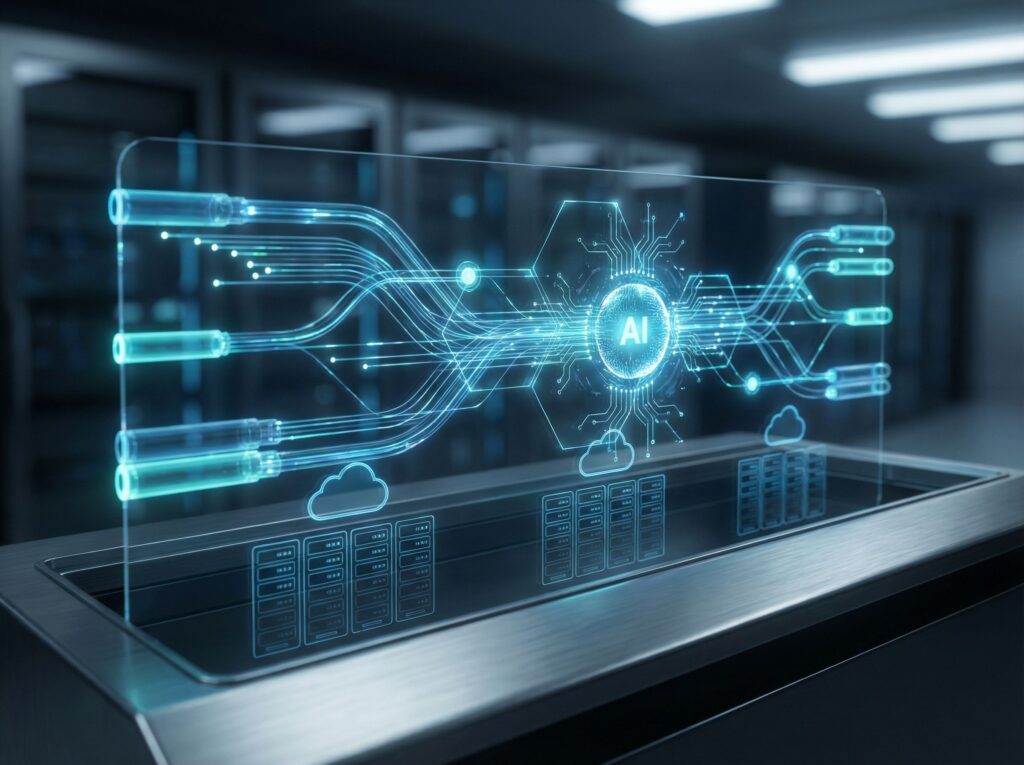
An AI-powered CI/CD pipeline combines traditional build, test, and deploy stages with machine
learning and generative AI. Instead of following the same static workflow for every commit, the
pipeline adapts based on historical build data, test outcomes, incidents, and deployment
signals. It understands what changed in the codebase, where failures usually occur, and how
similar changes behaved in the past, allowing it to continuously improve over time.
These pipelines can assess the risk of a commit before execution, prioritize the most relevant
tests instead of running entire test suites blindly, and make smarter promotion decisions by
analyzing performance metrics, error trends, and user behavior. As a result, the pipeline
becomes adaptive rather than purely automated.
Smarter Testing and Faster Feedback
Testing is one of the areas where AI brings immediate value to CI/CD. Traditional pipelines often
struggle with long-running test suites, flaky tests, and slow feedback cycles. AI-driven testing
systems analyze historical test runs, execution time, failure patterns, and code coverage to
determine which tests matter most for a given change.
By focusing on high-risk areas, AI reduces overall pipeline execution time while increasing
confidence in the results. It can also identify flaky or low-value tests, automatically isolate them,
and recommend fixes. This leads to faster feedback for developers and more stable, reliable
pipelines.
Predictive Failure Detection and Self-Healing Pipelines
AI-powered pipelines are not limited to optimizing successful runs; they also help manage
failures intelligently. By learning from logs, metrics, and previous incidents, AI models can detect
early warning signs that resemble known failure patterns. Risky changes can be flagged before
full execution, triggering additional testing or manual review when necessary.
When failures occur, self-healing mechanisms allow pipelines to recover automatically. Transient
errors can be retried, fallback environments can be used when infrastructure issues arise, and
automated rollbacks can be triggered if production metrics degrade after deployment. This
reduces the need for manual intervention and improves overall delivery resilience.
AI in Code Review and Security
AI is also playing an increasing role in code quality and security within CI/CD pipelines.
Integrated AI-based code review systems analyze pull requests to detect potential bugs,
anti-patterns, and architectural violations early in the development process. These systems go
beyond traditional linters by understanding context across large and diverse codebases.
On the security side, AI-enhanced scanners help identify secrets, misconfigurations, and policy
violations as part of every pipeline run. This ensures that quality and security are embedded
directly into the delivery process rather than added as a final checkpoint.
Why AI-Powered CI/CD Is a Critical DevOps Skill
As the industry moves toward AI-augmented software delivery, AI-powered CI/CD is becoming a
foundational DevOps capability. Engineers who understand how to design intelligent pipelines,
collect meaningful signals, and connect production feedback back into delivery workflows will be
better equipped to build systems that improve with every release.
In this model, CI/CD is no longer just a mechanism for shipping code. It becomes an intelligent
control layer that continuously guides how software evolves in real time, balancing speed,
stability, and quality through data-driven decisions.